Ultrafiltration vs Diafiltration in Earthworm Peptide Processing
Ultrafiltration vs Diafiltration in Earthworm Peptide Processing
Ultrafiltration and diafiltration are related membrane operations, but they answer different processing questions. Ultrafiltration is commonly used to concentrate a peptide solution or separate material by membrane retention behavior. Diafiltration adds a wash or buffer-exchange step so that selected small solutes can be reduced while the retained fraction remains in the process stream. For buyers reviewing an earthworm peptide ingredient, the useful question is not which word sounds more advanced. It is what the operation is intended to remove, retain, concentrate, or standardize, and how the supplier verifies the result.
Membrane processing does not create a universal molecular-weight cut-off for every peptide mixture. Retention depends on membrane characteristics, pressure, flow, temperature, concentration, fouling, peptide shape, charge, and the composition of the liquid. A specification should therefore describe the finished material and the relevant tests rather than treating a nominal membrane rating as a complete product description.
This guide explains the difference between ultrafiltration and diafiltration, how the two operations may be used in sequence, which mass-balance questions matter, and what B2B buyers should request when qualifying an earthworm peptide powder. It does not assign a particular process to a supplier or claim that one membrane configuration is suitable for every product.
What Ultrafiltration Does
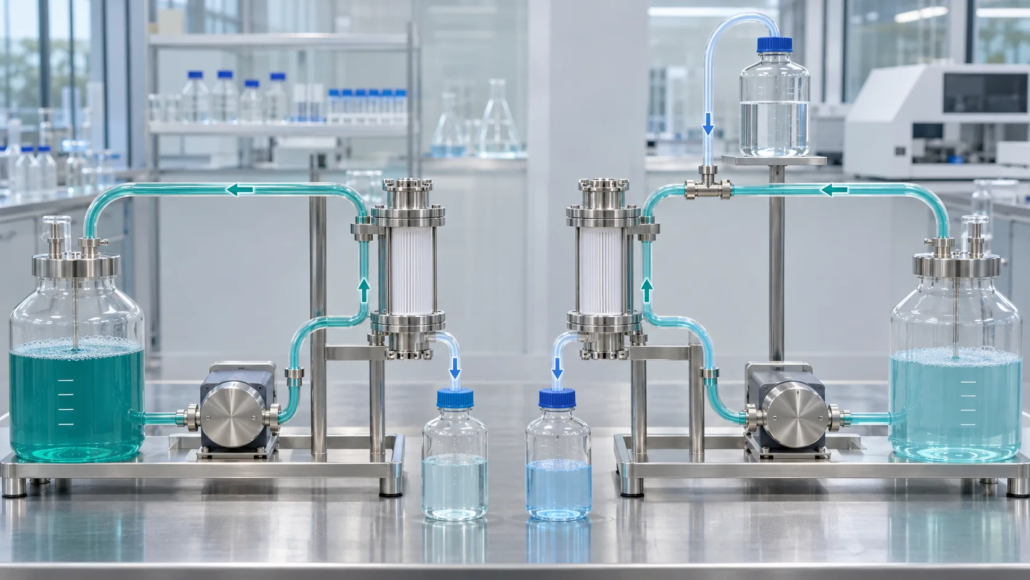
Ultrafiltration uses a membrane to divide a liquid feed into a retained stream and a permeate stream. Components that pass through the membrane move into the permeate, while components retained by the membrane remain in the concentrate. In a peptide process, the retained material may include larger peptides, proteins, aggregates, colloids, or other components with limited passage under the selected operating conditions.
The practical purpose can be concentration, clarification, fractionation, or a combination of these. A supplier may use the step to reduce water volume before drying, to separate a selected fraction, or to improve the consistency of a downstream powder. The process name alone does not show which purpose applies. Buyers should ask what the feed was, what the target stream was, and which release tests demonstrate that the intended change occurred.
Membrane retention is not determined only by nominal molecular-weight cut-off. Peptides are not rigid spheres with identical behavior. Shape, charge, aggregation, adsorption, and the surrounding salts can change apparent passage. A membrane selected for a simple calibration mixture may behave differently with a complex biological hydrolysate. A useful technical discussion therefore links membrane selection to the actual feed and to measured results.
What Diafiltration Adds
Diafiltration is a washing or exchange operation carried out while the desired retained material remains in the process loop. A new liquid, such as water or an approved buffer, is added while permeate is removed. This can reduce permeable salts, small solutes, residual reagents, or other low-molecular-weight components from the retained stream. The goal is usually compositional adjustment rather than simple volume reduction.
There are different ways to run diafiltration. Constant-volume diafiltration adds liquid at approximately the rate of permeate removal, keeping the vessel volume relatively stable. Discontinuous approaches may dilute the retained stream and then reconcentrate it. The actual sequence should be recorded because it affects water use, processing time, solute reduction, and the final mass balance.
Diafiltration does not guarantee complete removal of every small compound. The outcome depends on the compound’s passage, the membrane, the number of exchange volumes, mixing, concentration polarization, and equilibrium behavior. A supplier should show the relevant before-and-after data rather than using “washed” as a stand-alone quality claim.
Ultrafiltration and Diafiltration Compared
| Question | Ultrafiltration | Diafiltration |
|---|---|---|
| Main purpose | Concentrate, clarify, or separate based on membrane passage behavior | Reduce permeable solutes or exchange the liquid environment around the retained fraction |
| Typical operating change | Feed volume decreases as permeate leaves | Wash liquid is added while permeate is removed, often at controlled volume |
| Useful evidence | Volume reduction, solids, peptide profile, recovery, and permeate data | Before-and-after solute results, exchange volume, recovery, and final conductivity or related test |
| Primary risk | Fouling, adsorption, unintended loss, or unstable retention | Incomplete washing, dilution errors, extended exposure, or loss during repeated handling |
The two operations are often complementary. A process may first use ultrafiltration to concentrate a retained fraction, then use diafiltration to reduce salts or change the liquid environment, and finally reconcentrate before drying. That sequence should be treated as a process hypothesis until the supplier provides evidence for the specific material.
Why Mass Balance Matters
A membrane operation should be understandable as a mass balance, even when the supplier does not disclose every production parameter. At minimum, the review should identify feed volume, retained volume, permeate volume, solids or dry-matter measurements, and the destination of each stream. If the product is a peptide mixture, buyers may also request peptide-profile data or another agreed marker before and after processing.
Recovery should be described carefully. A high recovery of total dry solids does not automatically mean that the desired peptide fraction was retained. Conversely, a lower total-solids recovery may be expected if salts or other permeable components were intentionally removed. The correct question is whether the change matches the intended specification and whether the important components remain within the agreed range.
When a supplier reports concentration by volume, ask whether the calculation uses measured solids, density, moisture, or another basis. The same liquid volume can contain different amounts of material under different conditions. Clear units reduce confusion when a laboratory result is compared with a product specification, a pilot batch, or a finished powder.
Membrane Selection and Peptide Retention
Membrane selection should be connected to the desired separation. A nominal rating may be a useful starting point, but it is not a guarantee that every peptide below or above that number will behave in the expected way. The supplier should understand the feed composition, intended product fraction, fouling behavior, and cleaning requirements before making a process claim.
Peptide adsorption can reduce apparent recovery. Some material may bind to the membrane or system surfaces, especially when concentration, pH, ionic strength, and hydrophobic interactions change. A process review should ask whether the supplier monitors losses in the retentate, permeate, hold-up volume, and cleaning stream. If only the final powder is tested, an unexplained yield change can be difficult to diagnose.
Temperature and pressure also matter. Higher pressure may increase flux for a time, but it can intensify concentration polarization or compaction. Temperature can affect viscosity and flux, while prolonged exposure can affect the stability of the material. Buyers do not need a generic “optimal” pressure from a supplier; they need evidence that the chosen operating window is controlled and suitable for the material.
Fouling, Cleaning, and Process Consistency
Fouling occurs when retained material, aggregates, salts, or other components accumulate on or near the membrane surface. Flux can fall, pressure can rise, and retention behavior can change. A supplier should define the indicators used to monitor the operation, such as permeate flow, transmembrane pressure, temperature, conductivity, or a product-specific marker.
Cleaning records are relevant to both performance and cross-contact control. The review should ask which cleaning steps are validated or verified, how residues are assessed, and how the system is released before the next batch. The exact cleaning chemistry is a supplier-controlled detail, but the buyer can still request evidence that cleaning does not introduce an avoidable contamination or carryover risk.
Repeated cycling can create a different exposure history from a single concentration step. A production record should identify the number of cycles or exchange volumes, hold times, and major in-process checks. This information helps explain why two lots with the same product name may show different conductivity, moisture, peptide distribution, or drying behavior.
How Buyers Should Review Diafiltration Results
Start with the intended removal target. If the supplier says diafiltration reduces salts, request the relevant conductivity, ash, ion, or other agreed measurement before and after the operation. If the target is residual processing material, request a method and reporting limit that can actually support the conclusion. “Washed” should not replace a result.
Then check the exchange basis. A process described as “five volumes” should explain whether that means five vessel volumes, five retentate volumes, or another basis. Addition rate, permeate rate, mixing, and final concentration can affect the result. A clear process note avoids comparing unlike calculations.
Finally connect the result to the lot. The test should identify the sample, production lot, sampling point, and date. If a supplier provides a development report for a pilot run, do not treat it as proof that every commercial lot has the same result. Use it as process evidence and ask which routine release tests are used for production material.
Drying After Membrane Processing
Membrane concentration and washing do not determine how the final powder behaves by themselves. Drying can influence moisture, solubility, flow, color, bulk density, and the apparent peptide profile. Buyers should ask where the membrane operation ends and which quality attributes are controlled during the transition to drying.
A concentrated solution may need a defined hold-time limit before drying. Long holds, temperature changes, and repeated transfers can alter viscosity and microbial-control requirements. The process record should connect the final membrane concentration to the drying feed and to the finished powder tests. This is particularly important when a supplier compares samples made by different drying routes.
Do not infer that ultrafiltration or diafiltration guarantees a particular powder performance. Ask for the finished product specification, representative COA fields, and sample data relevant to the intended application. The membrane operation is one part of the product history.
What to Request from an Earthworm Peptide Supplier
| Document or data point | Review purpose | Follow-up question |
|---|---|---|
| Process flow summary | Shows where concentration, washing, and drying occur | Which stream becomes the commercial powder? |
| Membrane description | Explains the intended passage and retention behavior | What evidence supports suitability for this feed? |
| Mass balance | Connects feed, retentate, permeate, and product recovery | Are the units and calculation basis clear? |
| Before-and-after tests | Shows whether the intended solute or composition change occurred | Which results are routine release tests? |
| Lot-specific COA | Connects quality data to the commercial material | Does the COA match the quoted product and lot? |
These requests do not require a supplier to disclose proprietary recipes. They create a practical boundary between a useful technical explanation and an unsupported process label. A buyer can evaluate the material, documents, and controls without asking for confidential operating details.
For a sample review, keep the questions in the same order as the process: identify the feed, define the retained and permeate streams, record the washing basis, then compare the analytical results with the finished specification. This sequence makes it easier to separate a genuine concentration effect from dilution, handling loss, or a change introduced during drying.
FAQ
Is ultrafiltration the same as diafiltration?
No. Ultrafiltration commonly concentrates or separates a stream based on membrane passage behavior. Diafiltration adds a controlled liquid-exchange or washing step to reduce permeable solutes or change the retained stream’s liquid environment. They may be used together, but they are not interchangeable terms.
Does a membrane cut-off predict the final peptide profile?
Not by itself. Apparent retention also depends on peptide shape, charge, aggregation, adsorption, concentration, pressure, temperature, and the matrix. The final profile should be supported by testing of the relevant material and lot.
What does a buyer need to know about diafiltration volume?
Ask how the exchange volume is defined, how liquid addition and permeate removal are controlled, and which before-and-after test shows the intended reduction. A number without a stated basis is difficult to compare across suppliers.
Can diafiltration remove every small molecule?
No. Removal depends on passage, mixing, membrane performance, exchange volume, and the behavior of the compound in the matrix. The supplier should identify the target and provide a suitable analytical result rather than making a universal removal claim.
Should ultrafiltration be listed on an earthworm peptide COA?
The COA usually focuses on release attributes, while a process summary can explain the role of membrane processing. If the operation affects a buyer’s specification, request enough process and lot evidence to connect the operation with the reported quality result.
Send Your Ingredient Inquiry
Send your ingredient inquiry with the intended application, target peptide or solute attributes, required documentation, destination market, and expected volume. The technical team can clarify which earthworm peptide specifications and process evidence are available for the quoted material.