
Why Some People Choose Lumbrokinase When Nattokinase Causes Histamine or MCAS Reactions
Outline
- Understanding why enzyme supplements affect people differently
- What nattokinase and lumbrokinase actually are
- Why some people report reactions to nattokinase
- Is histamine the real problem?
- Why some people switch to lumbrokinase
- Benefits and limitations of lumbrokinase
- Who should avoid fibrinolytic enzymes?
- Tips for choosing a supplement if you have MCAS or histamine intolerance
- Final thoughts
- FAQs
Why Some People Choose Lumbrokinase When Nattokinase Causes Histamine or MCAS Reactions
If you’ve spent any time in online communities focused on chronic inflammation, histamine intolerance, or Mast Cell Activation Syndrome (MCAS), you’ve probably noticed a pattern. Someone starts taking nattokinase, feels worse almost immediately, and begins searching for alternatives. Before long, another member suggests lumbrokinase.
That recommendation comes up surprisingly often. But is there a scientific reason behind it?
The short answer is that we don’t know for certain. There are no large clinical trials comparing how people with MCAS respond to nattokinase versus lumbrokinase. Still, many patients and integrative practitioners have noticed that some individuals who don’t tolerate nattokinase seem to do better with lumbrokinase.
That doesn’t mean Lumbrokinase Powder is guaranteed to be easier on everyone. It simply means there are a few plausible reasons why the switch works for some people.
Let’s look at what we know—and where the evidence still has gaps.
What Is Nattokinase?
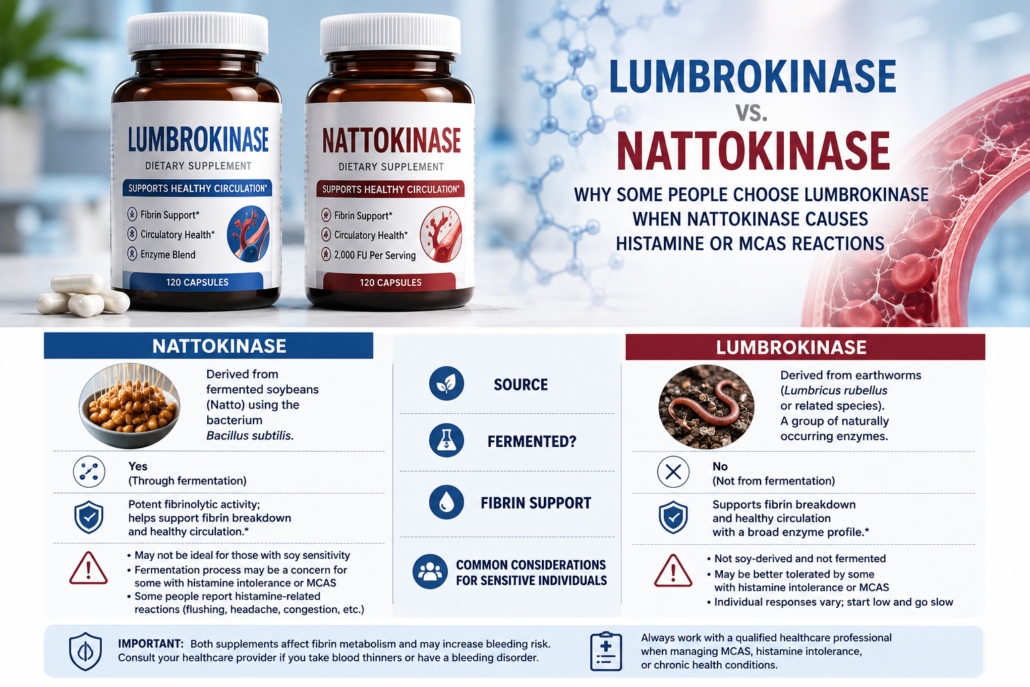
Nattokinase is a fibrinolytic enzyme originally isolated from natto, a traditional Japanese food made by fermenting soybeans with Bacillus subtilis.
Its main claim to fame is its ability to help break down fibrin, a protein involved in blood clot formation. Because of this activity, nattokinase is commonly used by people interested in supporting healthy circulation and normal blood flow.
Researchers have also explored its possible effects on blood pressure, cardiovascular health, and inflammation. While some early findings are encouraging, more high-quality research is still needed.
What Is Lumbrokinase?
Lumbrokinase is also a fibrinolytic enzyme, but it comes from earthworms rather than fermented soy.
Instead of being one single enzyme, lumbrokinase is a group of naturally occurring enzymes that work together to break down fibrin. It has been studied for decades, particularly in parts of Asia, for its potential role in supporting healthy circulation.
Although both supplements aim to support fibrin balance, they come from completely different biological sources.
That difference may matter for some sensitive individuals.
Why Do Some People React to Nattokinase?
Here’s where things become a little more complicated.
Most people who react to nattokinase don’t necessarily have a true allergy. Instead, they may experience symptoms such as:
- flushing
- itching
- headaches
- nasal congestion
- increased heart rate
- anxiety
- digestive upset
- worsening of existing MCAS symptoms
These reactions could happen for several different reasons.
The Fermentation Connection
Nattokinase is produced through bacterial fermentation.
Although high-quality manufacturing removes most fermentation materials, some sensitive individuals wonder whether trace fermentation-related compounds or residual proteins contribute to their symptoms.
There isn’t strong evidence proving this happens, but it’s one possible explanation discussed among clinicians who regularly treat histamine-sensitive patients.
Soy Sensitivity
Even highly purified nattokinase products may not be appropriate for everyone with severe soy allergies.
While most supplements contain little to no soy protein, individuals with significant allergies should discuss safety with their healthcare provider before trying them.
Increased Fibrin Breakdown
Another theory has nothing to do with histamine itself.
As fibrin is broken down, other inflammatory processes may temporarily become more noticeable. Some practitioners describe this as a temporary “die-off” or inflammatory response, although the exact biological mechanism hasn’t been clearly established.
For someone whose mast cells are already highly reactive, even small changes in inflammatory signaling could potentially trigger symptoms.
Again, this remains a hypothesis rather than a proven fact.
Why Some People Switch to Lumbrokinase
One reason is simply that lumbrokinase avoids several factors that concern sensitive patients.
It isn’t produced from fermented soy, so people worried about fermentation or soy exposure sometimes feel more comfortable trying it.
Some clinicians also believe lumbrokinase acts more selectively on fibrin than nattokinase. Laboratory studies suggest differences in how these enzymes work, but we still don’t have enough human research to say whether that translates into fewer reactions in people with MCAS.
Even so, anecdotal reports consistently describe individuals who tolerate one enzyme but not the other.
That doesn’t establish cause and effect, but it does explain why many practitioners consider lumbrokinase a reasonable alternative when nattokinase isn’t well tolerated.
Could the Reaction Be Histamine—or Something Else?
This is one of the biggest questions.
Many symptoms blamed on histamine overlap with symptoms caused by other inflammatory pathways.
For example:
- mast cell mediator release
- cytokine signaling
- changes in blood vessel tone
- temporary immune activation
A person may assume they are having a histamine reaction when another inflammatory process is actually responsible.
Without careful evaluation, it’s difficult to know exactly what’s happening.
That’s one reason healthcare providers who treat MCAS often recommend introducing new supplements slowly, sometimes every few days instead of all at once.
Potential Benefits of Lumbrokinase
People who tolerate lumbrokinase often report improvements in areas such as:
- circulation support
- fibrin balance
- recovery after illness
- general inflammatory symptoms
Researchers continue to investigate these potential benefits, but current evidence remains limited.
It’s worth remembering that dietary supplements are not approved to diagnose, treat, cure, or prevent diseases, and responses vary widely from person to person.
Who Should Avoid Either Supplement?
Both nattokinase and lumbrokinase affect fibrin metabolism.
That means they may not be appropriate for everyone.
You should speak with your healthcare provider before taking either enzyme if you:
- use prescription blood thinners
- have a bleeding disorder
- are preparing for surgery
- are pregnant or breastfeeding
- have experienced unexplained bleeding
- have significant medication interactions
Even natural supplements can have important effects on blood clotting.
Tips for People with MCAS or Histamine Intolerance
If you’re considering either enzyme, a cautious approach usually makes sense.
Many clinicians recommend:
- introducing only one new supplement at a time
- starting with the lowest available dose
- waiting several days before increasing the dose
- keeping a symptom diary
- avoiding multiple supplement changes simultaneously
This approach won’t prevent every reaction, but it can make it much easier to identify what’s helping and what’s causing problems.
Final Thoughts
It’s easy to find stories online claiming that lumbrokinase is the “safe” version of nattokinase for people with histamine intolerance or MCAS.
Reality is a little more nuanced.
There is currently no strong clinical evidence proving that lumbrokinase consistently causes fewer histamine-related reactions than nattokinase. However, differences in their source, production process, and enzyme profile provide plausible reasons why some individuals may tolerate one better than the other.
For people living with MCAS, the safest strategy is usually a personalized one. Introducing supplements slowly, working with a knowledgeable healthcare professional, and paying close attention to your own response often provides more useful information than relying on general recommendations.
What works well for one person may not work the same way for another—and that’s especially true when mast cells are involved.
Frequently Asked Questions
1. Can nattokinase trigger histamine release?
There is no strong evidence that nattokinase directly releases histamine. However, some people with MCAS or histamine intolerance report symptoms after taking it, and the exact reason remains unclear.
2. Is lumbrokinase better for people with MCAS?
Some patients and clinicians report better tolerance with lumbrokinase, but clinical studies comparing the two enzymes specifically in people with MCAS have not been conducted.
3. Is lumbrokinase made from soy?
No. Lumbrokinase is derived from earthworms, while nattokinase is produced through fermentation involving soybeans.
4. Can you take lumbrokinase with blood thinners?
Because lumbrokinase may affect fibrin breakdown, combining it with anticoagulant or antiplatelet medications may increase bleeding risk. Always consult your healthcare provider before combining these therapies.
5. How should someone with histamine intolerance start lumbrokinase?
People with histamine intolerance or MCAS often begin with the lowest available dose, introduce only one supplement at a time, and monitor symptoms carefully under the guidance of a qualified healthcare professional.


Leave a Reply
Want to join the discussion?Feel free to contribute!