Emulsifying Properties of Earthworm Protein: A Formulation Test Plan
Emulsifying Properties of Earthworm Protein: A Formulation Test Plan
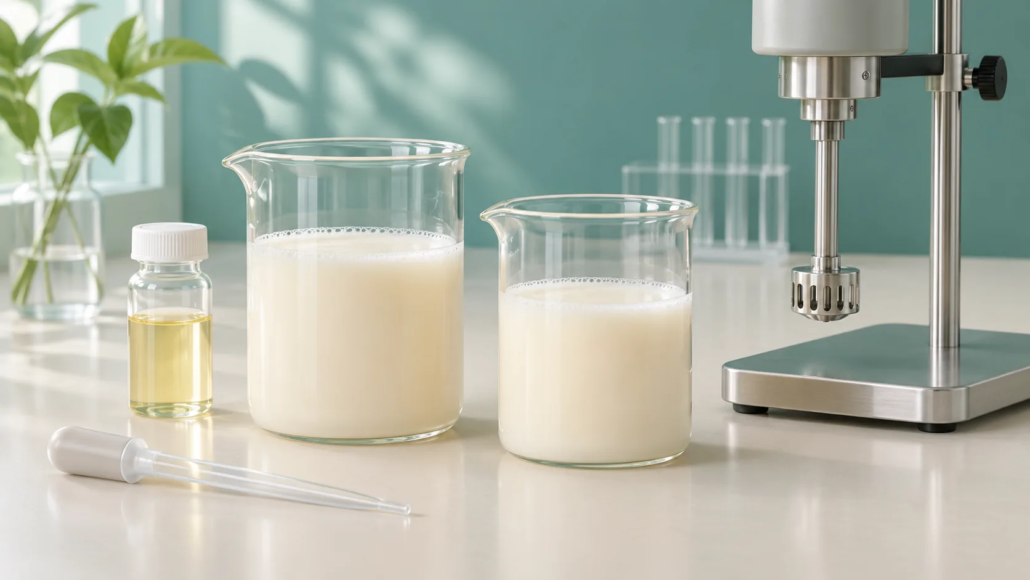
Evaluating the emulsifying properties of earthworm protein requires two separate questions: can a specified preparation help form an emulsion, and how does that emulsion change during a defined observation period? A convincing answer identifies the material, formulation, mixing process, measurement, and comparison. A photograph of a cloudy liquid cannot answer both questions.
For a team considering earthworm protein powder, the practical starting point is a controlled formulation study rather than a promise of performance. Whole powder, an extracted protein fraction, and a hydrolysate should not be treated as interchangeable test materials. Published findings on one preparation do not establish how an offered commercial grade will behave.
The plan below is a proposed framework for laboratory evaluation and purchasing discussions. It provides no commercial product test results, recommended ingredient dose, food-use authorization, or health claim. The intended application still needs its own safety and regulatory assessment.
Identify the emulsion and the decision it must support
An emulsion contains liquid droplets dispersed in another liquid. IUPAC’s emulsion terminology distinguishes oil-in-water systems from water-in-oil systems according to the continuous phase. State which system the project concerns before choosing an assay or interpreting an ingredient’s apparent usefulness.
Write a short decision statement for the study. For example, a development team might ask whether adding the candidate changes initial droplet formation or separation during a specified hold, compared with the same formulation without that candidate. This is a proposed experimental question, not evidence that the material produces a desirable change.
Also record the reason for investigating the ingredient. Is it being considered as the main interfacial ingredient, a partial replacement, or one component in an existing mixture? Those roles call for different comparisons. A successful result in a mixture cannot automatically be assigned to the candidate alone.
Read earthworm protein research at the preparation level
Published earthworm research supports asking formulation questions, but it does not remove the need to test the purchased material. A 2023 study of Eisenia andrei powder and a recovered protein extract investigated emulsifying capacity and stability alongside other properties. Its experimental preparation and measurement procedures belong with its findings.
In that paper, the emulsification methods include homogenization, an operational capacity calculation, and an optical assessment of diluted emulsion over time. When using the paper to plan further work, examine the printed equations and the meaning of each reported index rather than copying a percentage into a commercial specification. Confirm whether an index represents retained response, change from an initial response, or another calculation.
A useful literature note should therefore identify the tested fraction, its preparation, the endpoint, and the observation conditions. Keep published experimental values separate from supplier specifications. Neither the name earthworm protein nor a similar appearance establishes equivalence between the research extract and a new sample.
Keep formation, persistence, and composition as separate endpoints
The first study table should separate what is measured immediately after preparation from what is measured later. This helps prevent a strong initial signal from being described as long-term stability. It also keeps a composition measurement from being presented as direct proof of emulsification.
| Study question | Proposed observation | Interpretation boundary |
|---|---|---|
| What was added? | Material identity, batch, powder mass, and documented protein basis | Composition does not by itself demonstrate emulsion performance |
| What formed after mixing? | Initial appearance, appropriate droplet assessment, and the chosen capacity endpoint | An immediate observation does not describe later persistence |
| What changed during a hold? | Separation, size distribution, or another specified response at recorded times | A short hold supports only the evaluated interval and conditions |
| What happened under stress? | Response after the selected heat, centrifugal, or other challenge | A challenge result is not automatically a shelf-life estimate |
| Is the comparison repeatable? | Results from independently prepared batches of the test formulation | Repeated readings of one vessel do not represent independent preparations |
Choose a primary decision endpoint before looking at the results. Additional observations can help explain it, but they should not replace it simply because they look more favorable. If an endpoint cannot be measured reliably in the selected mixture, revise the method before evaluating the candidate.
Document the sample before choosing a protein basis
Record the supplier’s material description, grade identifier, batch, receiving date, and available preparation information. Keep the original sample identification attached to every test vessel and data file. If the material is extracted, defatted, hydrolyzed, or otherwise processed, document what is actually known rather than filling gaps from a research paper.
Decide whether the comparison concerns equal powder addition or equal measured protein addition. These answer different development questions. Equal powder mass addresses replacement by the supplied ingredient; a protein-normalized comparison addresses a different basis and requires adequate analytical information. Report both the calculation basis and the source of the protein result.
Where protein information is missing or unsuitable, do not manufacture a normalized comparison. Run the explicitly stated powder-basis study or obtain the missing evidence first. If a soluble fraction is removed for a separate experiment, retain that distinction in the report instead of assigning its behavior to the original unsplit powder.
Build controls that make the candidate’s contribution interpretable
A practical starting design includes the intended formulation without the candidate, the candidate-containing formulation, and an appropriate reference formulation if the project needs one. Keep all other additions and preparation steps matched as closely as the question allows. Document any deliberate difference.
A reference should answer a specific question. An established ingredient may show whether the chosen process can produce the expected type of dispersion, while a formulation without the candidate shows what the remaining ingredients do alone. Neither comparison should be described as proof of equal performance before the measurements exist.
If the project includes another emulsifier or thickener, decide whether to evaluate interaction separately. One possible sequence is to study the candidate within a simple matched system, then examine the intended mixture. This staged plan is a way to organize work, not a universal recipe or a claim about how the ingredient will respond.
Control preparation and sampling before collecting attractive images
Use a written preparation sheet covering oil identity, water or buffer, ingredient addition order, hydration history, final batch size, vessel geometry, and mixing equipment. Record the actual preparation and measurement temperatures. A comparison is difficult to interpret if these details change silently between formulations.
For mixing, describe the equipment and operating procedure sufficiently for the laboratory to repeat its own work. Avoid treating a nominal setting as a complete description of the process. Record interruptions, vessel changes, visible entrained air, and any departure from the planned sequence.
Specify where and when aliquots are collected. Sampling only from the top of a separated vessel may answer a different question from sampling a gently redispersed whole vessel. Choose the approach that fits the endpoint and use it consistently. Keep an untouched observation vessel when repeated sampling would disturb the separation being evaluated.
Use size measurements with evidence of what is being measured
Droplet assessment can add information that a bulk photograph misses. Malvern Panalytical’s original note on dairy and food emulsions demonstrates how laser diffraction can track changes during processing and storage. Its dairy examples also show why different particulate contributions and fat-phase changes require interpretation.
For a new earthworm-derived preparation, ask the analytical laboratory how it will distinguish oil droplets from undissolved material, aggregates, and bubbles. A size distribution should not be called an oil-droplet distribution merely because the instrument produced a curve. Microscopy or another suitable supporting observation may help assess what the population represents.
Record sample dilution, dispersant, handling, and any mixing performed before measurement. Consider whether the preparation step changes the feature being investigated. If the method cannot resolve the relevant populations, report that limitation and retain the measurement as a method-specific observation rather than a definitive explanation of the emulsion.
Describe separation without guessing its mechanism
Creaming and coalescence describe different changes. IUPAC describes creaming as macroscopic concentration of an emulsion under gravity or a centrifugal field. Coalescence involves the disappearance of the boundary between contacting droplets. A visible concentrated layer alone does not demonstrate that droplets have merged.
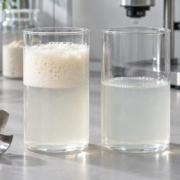
In the observation record, start with what is visible: an upper concentrated region, a clearer lower region, sediment, free oil, or another identifiable feature. Add photographs using the same vessel geometry, lighting, viewpoint, and elapsed time. Describe evidence for a mechanism separately from the visual description.
If redispersion is relevant to the application, specify a consistent way to assess it and record the outcome. Do not equate easy redispersion with proof of every other stability attribute. The report can legitimately state that a layer formed and was redispersed without claiming to have established the complete physical mechanism.
Keep storage observations separate from stress screening
Design the observation schedule around the decision being made. A short screening study may identify which formulations deserve further work, while a later program can investigate the intended storage and handling conditions. Name the stage in the study record so a screening result does not become an unsupported shelf-life statement.
For any stress test, record the exposure, sample geometry, handling, and endpoint. A centrifugal challenge, heat treatment, or temperature excursion is an experimental condition. Report the response to that condition directly. A calendar-life claim would need evidence connecting the evaluated challenge to behavior over the proposed storage period.
Preserve the unstressed comparison where useful. Otherwise, a change during the challenge may be difficult to separate from a change that would have occurred during ordinary holding. If the stress damages the measuring system or makes the endpoint uninterpretable, document the invalid observation rather than assigning a performance ranking.
Agree on acceptance before choosing the preferred formulation
Set project-specific acceptance criteria with the formulation team before the main comparison. Criteria should connect to an observable development requirement, such as an acceptable separation pattern or a defined change in a chosen measurement. This article supplies no universal numerical threshold for earthworm protein.
Report individual preparations as well as the chosen summary. Keep independently prepared formulations separate from repeated instrument readings of the same aliquot. Decide how to handle a preparation error before seeing whether it helps or hurts the preferred candidate, and retain the reason for any exclusion.
| Observed pattern | Question for review | Reasonable next action |
|---|---|---|
| Different initial appearance, uncertain particle identity | Does the signal represent droplets, solids, or air? | Review sampling and add a suitable supporting observation |
| Similar initial response, different later separation | Were preparation and holding conditions matched? | Review the time course and repeat independent preparations |
| A favorable stress result but little storage evidence | What period and conditions have actually been studied? | Limit the conclusion to the challenge and plan relevant holding work |
| Large differences between repeat preparations | Which material or process variable was uncontrolled? | Investigate repeatability before ranking formulations |
| Performance depends on another ingredient | Which mixture and addition sequence produced the result? | Retain the mixture-specific conclusion and investigate interaction if needed |
Translate the study into a useful supplier discussion
A supplier inquiry becomes more useful when it states the tested material, proposed role, formulation context, and unresolved evidence gaps. Ask whether the evaluation sample represents the grade being discussed and which current documents can support that identification. Keep sample approval tied to the evaluated material rather than only to a broad ingredient name.
Share the endpoint and the comparison basis with the supplier or contract laboratory. If a report says a material has emulsifying properties, request the method and conditions behind that statement. A general claim is insufficient for reproducing a result, and a research publication is not a substitute for the offered material’s own evidence.
Separate formulation suitability from market eligibility and safety. A physically promising laboratory dispersion does not establish that a finished application may be sold or consumed. The development record should state which technical question was answered and which application reviews remain outside that study.
FAQ
Does earthworm protein automatically act as an emulsifier?
No universal performance claim follows from the ingredient name. Evaluate the particular preparation in a specified formulation using matched controls and a suitable method. Findings on a recovered research extract do not establish performance for every commercial powder.
Are emulsifying capacity and emulsion stability the same?
They concern different aspects of the experiment. Capacity generally describes an operational formation-related measurement, while stability concerns change during specified conditions and time. Read the exact method and calculation before comparing percentages across reports.
Does a creamy appearance prove that the droplets are stable?
No. Record appearance as one observation and use appropriate measurements for the question. A photograph does not identify every particle population, establish a mechanism, or demonstrate behavior throughout an unevaluated storage period.
Should formulations be compared at equal powder mass or equal protein?
Choose the basis that matches the development decision. Equal powder addition and protein-normalized addition answer different questions. A protein-normalized comparison needs reliable composition information and a clearly reported calculation basis.
Can a centrifuge test establish the finished product’s shelf life?
A centrifuge test reports response to its specified challenge. Translating it into calendar shelf life requires additional supporting evidence. Keep stress-screening conclusions separate from observations under the intended storage and handling conditions.
Send Your Ingredient Inquiry
Contact Venacore Bio with your intended application, target market, candidate material, formulation role, comparison basis, and required documents. Include the laboratory endpoints and questions you need resolved so the ingredient discussion can stay connected to a defined evaluation.