Lumbrokinase Benefits: What Supplement Brands Can Explain Safely
Lumbrokinase Benefits: What Supplement Brands Can Explain Safely
Lumbrokinase benefits should be explained with care because supplement brands must avoid turning ingredient education into medical promises. When a buyer evaluates lumbrokinase powder, the safer content path is to discuss ingredient role, quality controls, documentation, formulation fit, and claim review rather than guaranteed health results.
This topic has search demand because people want plain answers. B2B teams want plain answers too, but they also need guardrails. A product page, blog article, distributor deck, and label claim may all face different rules. One careless sentence can travel farther than expected.
What Benefits Can Supplement Brands Explain Without Overclaiming?
Supplement brands can explain lumbrokinase benefits as ingredient-positioning benefits for product development, not as guaranteed effects for consumers. Safer language focuses on enzyme identity, specialty positioning, documentation, formulation use, and responsible claim review.
Lumbrokinase is commonly discussed as an enzyme ingredient associated with earthworm-derived material. In a supplement brand context, the “benefit” may be that the ingredient gives a formula a clear specialty-enzyme story. It may also help a brand build a more technical product concept for capsule, tablet, or private label development.
Those are commercial and formulation benefits. They are not disease claims. A brand can say that the ingredient is selected for an enzyme-focused supplement concept, that buyers should review activity units, and that supplier documents support quality evaluation. A brand should be careful with language that says a finished supplement treats, prevents, or cures a medical condition.
The distinction is not just wordplay. Marketing teams often inherit search terms from keyword tools, customer questions, or competitor pages. Search language may be blunt. Compliance language needs to be more disciplined. When the target buyer is a supplement company, the article should teach that buyer how to talk about the ingredient responsibly.
A good rule of thumb is simple: describe what the ingredient is, how it is reviewed, and where it may fit in product development. Do not promise what a person’s body will do after taking it. That may sound cautious, but serious B2B buyers usually prefer a supplier that knows where the line is.
| Buyer question | Safer explanation | Risky wording to avoid |
|---|---|---|
| What are lumbrokinase benefits? | Specialty enzyme ingredient positioning and documented quality review | Guaranteed medical result |
| Why use it in a supplement concept? | Supports an enzyme-focused formula after technical review | Treats a diagnosed condition |
| How should brands compare suppliers? | Review activity, COA, contaminants, and batch consistency | Works better than all alternatives |
| What can the label say? | Depends on target market, substantiation, and qualified review | Universal approved health claim |
How Do Lumbrokinase Benefits Connect to Ingredient Identity?
Lumbrokinase benefits start with ingredient identity because buyers need to know what material they are sourcing. A clear identity file helps the brand explain the ingredient accurately and compare suppliers without relying on vague claims.
Ingredient identity includes source, grade, activity range, carrier materials, processing description, and test method. For lumbrokinase, buyers may ask how the raw material is selected, how the enzyme preparation is controlled, and what documents can be shared during supplier qualification. Those questions are not glamorous, but they are the foundation of a reliable commercial page.
Identity also shapes consumer perception. Some brands may be comfortable explaining an earthworm-derived specialty ingredient. Other brands may need to consider vegetarian positioning, capsule shell choice, country-specific import rules, or retailer preferences. The ingredient story should match the product’s real market path.
For AI search and Google snippets, this is where clean wording matters. A concise answer might say that lumbrokinase is an enzyme ingredient used by some supplement brands in specialty formulas, and that B2B buyers should review source, activity, and quality documents before product launch. That sentence gives readers substance without making a treatment claim.
The strongest ingredient pages do not hide complexity. They make it manageable. They give the buyer enough detail to ask better questions, request the right files, and decide whether the ingredient fits the brand’s audience.
Which Quality Benefits Matter More Than Marketing Claims?
For B2B buyers, quality benefits matter more than broad marketing claims because they can be documented and verified. Activity testing, batch consistency, contaminant control, and clear specifications are stronger selling points than vague wellness language.
Activity testing is central because lumbrokinase is an enzyme ingredient. Buyers should ask what method is used, how activity is reported, and how the supplier manages normal variation. A number on a sales sheet is not enough if the method, batch link, and acceptance range are unclear.
Batch consistency helps brands plan repeat production. A first sample may look promising, but repeat orders are where suppliers prove themselves. The buyer should compare recent COAs, ask about retention samples, and confirm whether the supplier can keep product name, batch number, manufacturing date, expiry date, and package details consistent across documents.
Contaminant control is also a real benefit, even if it does not sound flashy. Microbial limits, heavy metal results, moisture, and storage guidance support raw material release. They also help the buyer respond to contract manufacturer questions, distributor checks, and retailer onboarding.
This is where a supplier can stand out without exaggeration. Instead of saying “our ingredient delivers amazing results,” the supplier can show a clean technical file, responsive documentation support, and practical guidance for sampling, packaging, and shipment. That is the kind of benefit procurement teams remember.
| Quality factor | What it shows | How buyers can verify it |
|---|---|---|
| Activity range | Functional specification for the enzyme ingredient | Review method and batch COA |
| Microbial limits | Basic raw material hygiene control | Check batch-specific test results |
| Heavy metals | Contaminant control for supplement use | Compare results with target-market requirements |
| Document consistency | Supplier discipline across shipments | Match COA, label, invoice, and packing list |
How Can Brands Discuss Search Terms Like “Lumbrokinase Benefits” Safely?
Brands can discuss search terms like “lumbrokinase benefits” by answering the intent while keeping the wording inside ingredient education. The article should explain what buyers can review, what documents matter, and why final claims depend on qualified market review.
Search intent is messy. Some readers want consumer health guidance. Some buyers want supplier qualification details. Some marketers want words they can place on a product page. A strong B2B article should separate those needs and avoid pretending that one sentence can solve all of them.
A safe content frame uses three layers. First, it explains the ingredient in plain language. Second, it explains the supplier and quality documents that support commercial review. Third, it reminds the reader that finished product claims, label directions, and warnings must be checked for the target market. That structure gives AI systems and human readers a clear answer without overreach.
The FDA’s dietary supplement claim rules in the United States are a useful reminder: disease treatment, prevention, cure, or diagnosis language can create major risk. Other markets may use different systems, but the principle travels well. If the claim sounds like a medical result, do not drop it into public copy casually.
Writers should also avoid hiding behind soft words. “Supports” can still be risky if the rest of the sentence points to a disease. “Promotes” can still overreach if no substantiation exists. The safer article teaches the buyer how to evaluate language, not just how to decorate a keyword.
What Formulation Benefits Can Buyers Evaluate?
Buyers can evaluate formulation benefits such as dosage-form fit, activity target, excipient compatibility, storage needs, and packaging route. These benefits are practical because they affect whether the ingredient can move from sample approval to finished product manufacturing.
Capsules are often the first format considered for specialty enzyme ingredients. They can keep the formula relatively direct, but they still require flow, density, fill weight, blend uniformity, and capsule-shell review. If the powder does not flow well, the manufacturer may need flow aids or a revised formula.
Tablets need extra caution because compression can affect sensitive ingredients. A buyer should ask whether activity remains acceptable after processing and storage. Pilot testing matters more than guesswork. A formula that looks easy in a spreadsheet may behave differently on the line.
Powder sachets or drink formats are more demanding. Taste, solubility, serving size, moisture exposure, and consumer directions can all become difficult. If a brand wants a beverage or stick-pack concept, it should discuss the target format before ordering commercial volume. A supplier can provide raw material guidance, but the finished-product owner must validate the final formula.
Packaging also belongs in the conversation. Enzyme ingredients may need protection from heat, humidity, and rough handling. Desiccants, sealed containers, foil bags, carton strength, shipping lane, and warehouse conditions can influence the final product plan. It is not glamorous work. It is how successful supplement launches stay boring in the best possible way.
What Checklist Helps Marketing and Regulatory Teams Work Together?
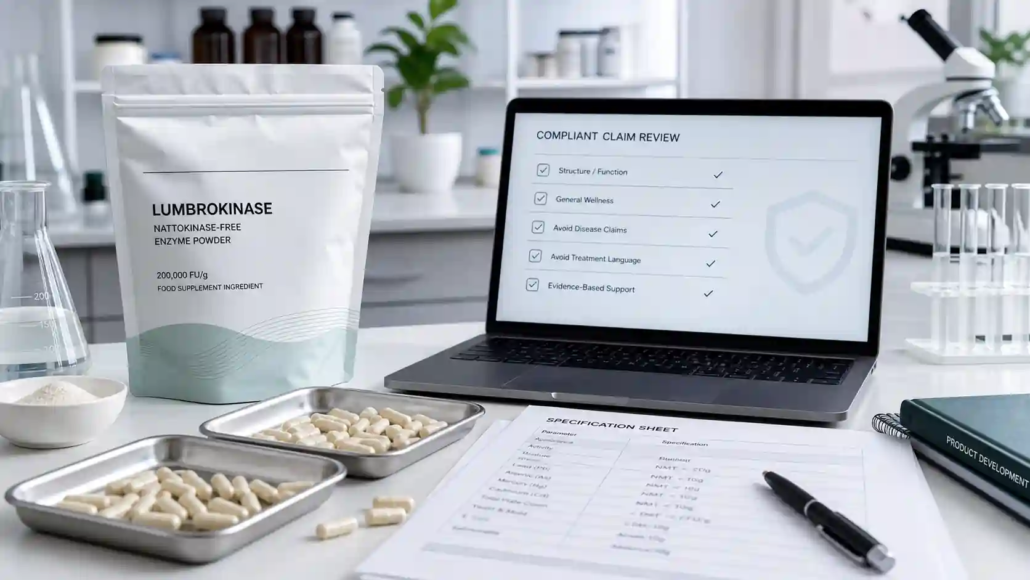
A shared checklist helps marketing and regulatory teams explain lumbrokinase benefits without drifting into unsupported claims. It keeps the article, product page, label draft, and sales deck connected to the same evidence file.
- Define the ingredient source, grade, and activity range before writing claims.
- Use the first natural product keyword as a link to the correct product detail page.
- Collect current specification sheets, COAs, activity method details, and contaminant results.
- Separate ingredient education from consumer medical guidance.
- Check every benefit phrase against the target market’s supplement claim rules.
- Ask the contract manufacturer about capsule, tablet, sachet, or packaging constraints.
- Create a short approved phrase list for sales, distributors, and agencies.
- Remove disease treatment, prevention, cure, or diagnosis language unless qualified review allows it.
This checklist works because it is small enough to use. Nobody wants a claims review process that only one specialist understands. A good checklist gives each team a job: supplier provides documents, quality reviews the batch, regulatory checks the market, marketing writes within the approved frame, and sales repeats the same language.
There is a human side here too. When teams rush, they often borrow language from search results because it feels fast. The better move is slower by a few minutes and faster over the full project: start with approved claims, then write from there. Fewer rewrites, fewer arguments, fewer awkward calls with distributors.
How Should Suppliers Support Benefit Discussions?
Suppliers should support benefit discussions with ingredient facts, document clarity, sample planning, and claim boundaries. A supplier should not replace the buyer’s legal, regulatory, or medical review, but it can make that review much easier.
A helpful supplier asks about the product concept before quoting. Is the buyer planning capsules, tablets, or a private label project? What destination market is involved? Which documents does the importer need? What activity range is expected? Is the buyer comparing multiple enzyme ingredients? These questions help the supplier share the right files and avoid vague promises.
Suppliers can also help by explaining normal batch variation. Enzyme materials may not behave like commodity powders. If activity range, moisture, or particle size can vary within agreed limits, the buyer should know that before production. Surprises during receiving inspection are rarely fun.
For benefit language, suppliers should give buyers a clean distinction between raw material facts and finished product claims. Raw material facts include source, specification, activity, test method, storage, and packaging. Finished product claims depend on formula, serving size, market rules, substantiation, and brand decisions. Keeping those two lanes separate is one of the quiet skills of good export supply.
What Should a Finished Product Brand Say in Public Copy?
A finished product brand should say only what it can support for its exact product and target market. Public copy can explain ingredient role, quality review, and formulation context, while avoiding personal treatment promises or disease language.
For example, a brand might say that its formula includes a specialty enzyme ingredient and that the raw material is reviewed through supplier specifications and batch testing. It might explain that the brand works with qualified manufacturing and reviews label language for the sales region. That kind of language is useful to consumers and fair to the evidence.
A brand should be careful with words that imply an outcome for a diagnosed condition. Even a blog article can create problems if it is connected to a product sales funnel. Ads, marketplace listings, influencer scripts, email campaigns, and distributor pages can amplify the same risky claim. One sentence can become many screenshots.
The better path is clear, sober, and still readable. Explain that lumbrokinase is an enzyme ingredient. Explain why source, activity, COA, contaminant testing, dosage form, and label review matter. Explain what buyers should ask suppliers before they build a product page. That is not bland writing. It is writing that respects the buyer’s real job.
For Venacorebio’s B2B audience, the promise is not magic. It is supply clarity: ingredient documents, sample support, bulk packaging, and communication that helps the buyer move from interest to a reviewed sourcing decision.
FAQ
What are lumbrokinase benefits for supplement brands?
For brands, the main benefits are specialty enzyme positioning, formulation potential, and a technical story supported by supplier documents. Consumer claims still need market-specific review.
Can a supplement brand claim lumbrokinase treats disease?
A supplement brand should avoid disease treatment, prevention, cure, or diagnosis claims unless qualified review confirms the exact language is allowed.
Which documents support safe lumbrokinase benefit language?
Useful documents include a specification sheet, recent COA, activity method details, microbial and heavy metal results, allergen statement, storage guidance, and packaging information.
Is lumbrokinase powder suitable for capsule formulas?
It is often evaluated for capsules, but buyers should review activity target, fill weight, flow, excipient compatibility, storage, and finished-product label language.
How can B2B buyers compare lumbrokinase suppliers?
Compare suppliers by activity reporting, COA quality, contaminant testing, batch consistency, sample support, documentation speed, packaging, MOQ, and claim-boundary guidance.
Send Your Lumbrokinase Ingredient Inquiry to Venacorebio
Tell us your target formula, activity range, order quantity, dosage form, documentation needs, and destination market. Venacorebio can help you review bulk lumbrokinase powder specifications, samples, packaging routes, and B2B supply details for your next supplement project.