Lumbrokinase Production Facilities: What B2B Buyers Should Review Before Ordering
Lumbrokinase Production Facilities: What B2B Buyers Should Review Before Ordering
A lumbrokinase production facility is more than a room with stainless steel equipment. For a supplement brand, contract manufacturer, or ingredient distributor, it is the place where raw-material control, enzyme processing, documentation, packaging, and shipment discipline either come together or quietly fall apart.
That is why a facility review should start with the ingredient itself: lumbrokinase powder is an enzyme ingredient, so buyers need to ask about activity consistency, batch traceability, hygiene controls, and claim-safe documentation before discussing price. A clean brochure is nice. A facility that can answer hard procurement questions is better.
This guide explains how B2B buyers can evaluate lumbrokinase production facilities without turning every supplier conversation into a full audit. The aim is practical: know what to request, what to compare, and what should make you pause before sending a purchase order.
What should buyers expect from a lumbrokinase production facility?
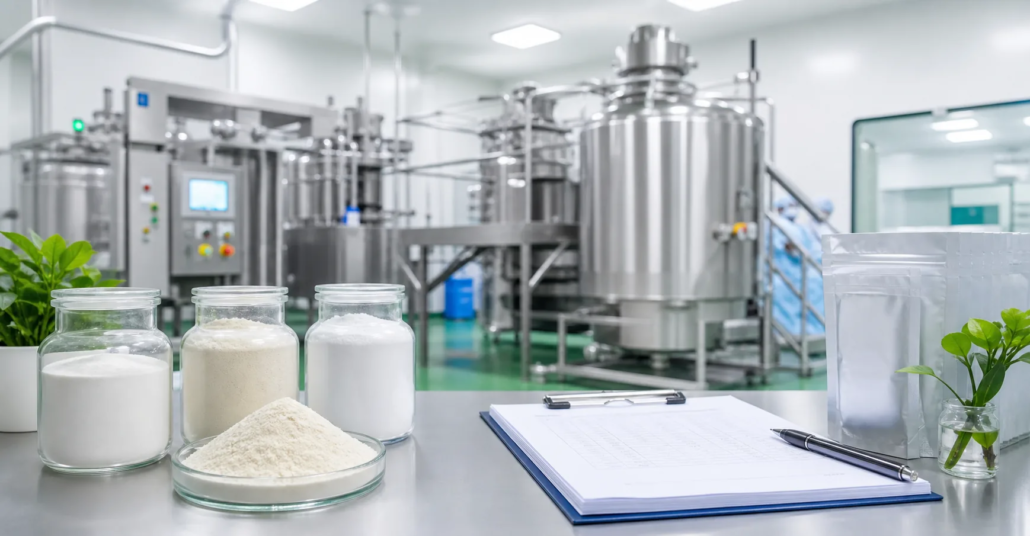
A serious lumbrokinase production facility should control raw material sourcing, extraction or processing steps, drying, milling, sieving, blending, packing, and finished-product testing under documented procedures. Buyers should expect traceable batch records, controlled production areas, qualified equipment, and clear quality release rules rather than vague promises about purity or potency.
In B2B sourcing, the word “facility” can mean very different things. Some suppliers only trade finished powder from another plant. Some handle packaging but not upstream processing. Others manage the ingredient from raw material intake through finished bulk export. None of these models is automatically wrong, but the buyer needs to know which model is being offered.
For lumbrokinase, facility capability matters because enzymes can be sensitive to heat, moisture, and processing variation. A facility that treats enzyme powder like a generic botanical powder may miss the point. Activity testing, moisture control, clean handling, and storage discipline all shape whether the shipped batch matches the approved sample.
A good supplier can usually explain the production route in plain English. They may not disclose every proprietary detail, and fair enough. Still, they should be able to describe which steps are controlled, which tests are performed, and how deviations are handled. If every answer sounds like “yes, we can do everything,” the conversation is not getting more reliable; it is getting cloudy.
For buyers, the practical starting point is to request a facility profile, a current business license or manufacturing qualification document where relevant, a sample certificate of analysis, and a basic process flow. These documents do not prove perfection, but they give your technical, regulatory, and purchasing teams something concrete to review.
| Facility area | What buyers should ask | Why it matters |
|---|---|---|
| Raw material intake | How are incoming lots identified, inspected, and released? | Weak intake control can create inconsistent finished batches. |
| Processing area | Are processing parameters recorded by batch? | Enzyme activity may vary when process controls drift. |
| Drying and milling | How are heat, moisture, and particle-size targets managed? | Powder quality depends on physical and activity-related control. |
| Packaging | What packaging options protect the ingredient during export? | Moisture and poor sealing can damage bulk material during storage. |
| Quality release | Who reviews the COA before shipment? | Final release discipline reduces documentation surprises. |
How does production control affect lumbrokinase batch consistency?
Production control affects batch consistency because lumbrokinase is evaluated not only by appearance, but also by activity, moisture, microbiology, heavy metals, and other specification items agreed with the buyer. If a facility cannot repeat its own process, a sample approval may not protect the next order.
Think of batch consistency like baking with a sensitive starter culture. The ingredients, temperature, timing, and handling all matter. Small changes may not look dramatic from the outside, yet the final result can behave differently. Lumbrokinase is not bread, of course, but enzyme ingredients share that annoying truth: process details matter.
Buyers often focus on the certificate of analysis because it is easy to compare in a spreadsheet. That is useful, but a COA is the last page of a longer story. The facility needs batch production records, equipment cleaning logs, in-process checks, and a system for investigating out-of-specification results. When those records are weak, the COA becomes a thin promise.
One practical review method is to compare three documents from the same batch: the approved specification, the COA, and the label or packing list. The item name, batch number, net weight, test items, and release date should match cleanly. If the supplier struggles to align these basics, bigger questions deserve attention.
For repeat supply, ask how the facility handles sample-to-bulk matching. Some buyers approve a 100-gram sample and later order 25 kilograms or more. The supplier should explain whether the bulk batch comes from the same production lot, a reserved lot, or a later manufacturing run made to the same specification. That small question can prevent a large misunderstanding.
Which quality systems are worth checking without overcomplicating the audit?
Buyers should check documented quality procedures, batch traceability, cleaning records, test methods, complaint handling, and supplier qualification before getting lost in paperwork. Certifications can help, but the strongest signal is whether the facility can connect procedures to real batch evidence.
Many B2B buyers ask for GMP, ISO, HACCP, or similar documents. Those requests are reasonable, especially for dietary supplement, nutraceutical, or functional food supply chains. Yet certification names alone do not tell the whole story. An expired certificate, a certificate for a different company, or a certificate that covers only packaging may not support your purchasing decision.
The facility review should therefore ask two questions at the same time. First, what quality system does the site claim to follow? Second, what records can it provide for the specific ingredient and batch you are buying? The second question is usually where real capability shows up.
For a lumbrokinase ingredient, buyers should also ask about analytical methods. Enzyme activity can be reported in different ways, and the method should be stated clearly enough for technical review. If your brand has its own specification format, share it early. Waiting until the shipment is ready before discussing test methods is a classic way to create stress.
Here is a simple checklist for a procurement team that does not have time for a full on-site audit:
- Request a facility profile and confirm the legal manufacturer name.
- Ask for a recent COA using the same specification range you plan to buy.
- Confirm activity unit, test method, moisture, microbiology, heavy metals, and residual solvent items where relevant.
- Ask whether third-party testing can be arranged for pre-shipment review.
- Check that labels, batch numbers, invoice details, and packing lists use consistent product naming.
- Confirm storage conditions and shelf-life support documents.
- Review whether the supplier can support your market’s claim and labeling boundaries without making medical promises.
This is not glamorous work. It is also where a lot of sourcing risk quietly disappears.
What production documents should a buyer request before placing a bulk order?
Before placing a bulk order, buyers should request a specification sheet, COA template or recent COA, process-flow summary, allergen or GMO statement if needed, microbiological and heavy-metal testing scope, packing specification, and storage guidance. For regulated supplement markets, additional documents may be needed depending on the destination country and finished-product claim strategy.
The exact document set depends on how the ingredient will be used. A distributor selling to several supplement brands may need broader documentation than a buyer conducting early formula screening. A contract manufacturer may ask for different files again, especially if it must qualify the ingredient inside its own quality system.
There is a practical way to keep the request tidy: separate commercial documents from technical documents. Commercial documents include quotation, lead time, MOQ, payment terms, and export packing. Technical documents include COA, specification, test methods, flow chart, safety data sheet, and shelf-life or storage information. Mixing them in one email thread can make follow-up messy.
For lumbrokinase production facilities, buyers should pay close attention to whether documents are batch-specific or general. A general specification is useful for early evaluation. A batch-specific COA is needed before shipment. A flow chart explains the production path. A packing specification explains how the powder will be protected during transit. Each document answers a different question.
One buyer-side habit helps a lot: create a document gap list before negotiating final price. If a supplier’s price looks attractive but the facility cannot provide enough documentation for your market, the low price may not be usable. Nobody wants to discover that after payment.
| Document | When to request it | Buyer-side use |
|---|---|---|
| Product specification | Before sample approval | Confirms target activity, physical traits, and safety tests. |
| Certificate of analysis | Before shipment | Checks actual batch results against agreed specification. |
| Process-flow summary | During supplier qualification | Helps quality teams understand controlled production steps. |
| Packing specification | Before PO confirmation | Confirms bag, drum, label, and pallet requirements. |
| Storage guidance | Before receiving inventory | Supports warehouse handling and shelf-life review. |
How should buyers evaluate capacity, lead time, and OEM support?
Buyers should evaluate capacity by asking about realistic monthly output, reserved inventory, sample-to-bulk timing, packaging line availability, and seasonal production limits. OEM support should be reviewed separately from bulk ingredient supply because formulation, capsule filling, private-label packaging, and finished-product documentation involve different capabilities.
Production capacity is a tempting number. A supplier might say it can produce a large monthly volume, and maybe it can. The better question is how much of that capacity can be allocated to your specification, your packaging, and your shipment window. A facility with strong general output may still need extra time for a custom particle size, special test panel, or private-label packing request.
For lumbrokinase, lead time should include more than manufacturing days. It should include raw material availability, production scheduling, in-process control, finished-product testing, COA approval, packaging, export document preparation, and booking. If third-party testing is needed, add time. If your destination market requires special labels or statements, add time again. It sounds obvious, but rush orders often fail because the timeline was built around production only.
OEM and ODM discussions need even more clarity. Some facilities are excellent at bulk powder, while finished dosage forms are handled by a partner factory. That can still work if roles are transparent. Buyers should ask who makes the finished product, who owns the batch record, who issues the COA, and who handles packaging proof approval.
For private-label brands, packaging artwork can become a bigger bottleneck than the ingredient itself. Confirm label size, bottle or pouch material, carton layout, barcode placement, and market-specific language early. A production facility that has a disciplined artwork approval process will save everyone a few headaches.
What warning signs suggest a production facility needs deeper review?
A facility needs deeper review when it cannot identify the legal manufacturer, refuses basic batch documents, changes activity units without explanation, offers medical-style claims, or gives unusually short lead times for custom orders. These signs do not always prove a bad supplier, but they do mean the buyer should slow down.
The biggest red flag is claim language. Lumbrokinase is often discussed in health-related contexts, but ingredient suppliers should not promise that a bulk powder will treat, cure, or prevent disease. B2B product knowledge should focus on specification, quality, formulation role, documentation, and lawful claim review for the buyer’s market.
Another warning sign is document mismatch. If the COA uses one product name, the invoice uses another, and the label uses a third, the buyer’s receiving team may struggle to qualify the shipment. Small naming differences are common in international trade, but they should be explained and controlled.
Be cautious with suppliers that resist third-party testing before shipment. Not every order needs outside testing, and buyers should be reasonable about cost and timing. Still, a capable facility should not treat third-party review as an insult. It is a normal part of serious ingredient sourcing.
Price can also distort judgment. A low quote may reflect efficiency, inventory position, or a supplier trying to build a new relationship. It may also reflect weak testing, old stock, or unclear manufacturing responsibility. The only way to know is to connect price with specification, documents, and facility control.
How can a buyer compare several lumbrokinase facilities fairly?
Buyers can compare facilities fairly by using the same request list, same target specification, same sample quantity, same packaging requirement, and same response deadline for each supplier. A structured comparison prevents the loudest sales pitch from looking like the strongest manufacturing option.
A simple supplier scorecard works well. Give each facility points for document completeness, activity clarity, sample response, lead-time realism, packaging support, export experience, and communication quality. The score does not replace judgment, but it turns scattered email replies into something the team can discuss without guessing.
Communication deserves its own score. A facility that answers slowly but accurately may be better than one that replies in minutes with thin answers. On the other hand, bulk ingredient sourcing requires steady coordination. If every request needs five reminders, your future shipment may feel the same way.
Buyers should also separate “must have” items from “nice to have” items. A must-have could be a clear COA, matching activity method, and export packing suitable for the destination market. A nice-to-have could be custom sample labeling or extra visual documentation. This keeps the evaluation fair and avoids rejecting a workable facility for a small issue.
The final choice should usually balance quality evidence, documentation fit, supply reliability, and commercial terms. That sounds less dramatic than choosing the lowest price, but B2B ingredient sourcing is not a one-click purchase. It is a supply relationship, and facility discipline is one of the few things that still matters after the invoice is paid.
FAQ
What is a lumbrokinase production facility?
A lumbrokinase production facility is a manufacturing site or controlled production partner that processes, tests, packs, and releases lumbrokinase ingredient batches. Buyers should confirm exactly which steps the facility controls before placing a bulk order.
Why does facility review matter for bulk lumbrokinase powder?
Facility review matters because enzyme activity, moisture, microbiology, traceability, and packing can affect whether a bulk batch matches the approved sample. A strong review helps buyers reduce sourcing surprises.
Should buyers request third-party testing for lumbrokinase?
Third-party testing can be useful when the buyer needs extra confirmation for activity, heavy metals, microbiology, or market-specific requirements. The need depends on order size, internal quality policy, and destination-market expectations.
Can a lumbrokinase supplier support OEM or private-label projects?
Some suppliers can support OEM or private-label projects directly, while others work with partner facilities. Buyers should confirm who handles formulation, finished-product production, packaging, batch records, and final COA release.
What is the safest way to compare lumbrokinase facilities?
The safest way is to send the same specification request, document checklist, sample request, and packaging requirement to each supplier. This keeps the comparison fair and helps the buyer see real differences in facility capability.
Send Your Ingredient Inquiry to Venacorebio
Tell us your target activity, specification, order quantity, packaging plan, dosage-form idea, and destination market. Venacorebio can help you review sample options, documentation needs, custom requirements, and bulk supply details for bulk lumbrokinase powder.