Earthworm Protein Shelf Life Guide: What B2B Buyers Should Check
Earthworm Protein Shelf Life Guide: What B2B Buyers Should Check
Earthworm protein shelf life is not just a date printed on a label. For B2B buyers, it is a quality-management topic that connects product identity, moisture control, packaging, warehouse conditions, COA review, and customer handling. A realistic shelf-life review helps procurement teams reduce avoidable risk before they approve a supplier or place a repeat order.
When buyers evaluate earthworm protein powder, they should ask how the supplier defines shelf life, what storage conditions apply, which quality items are monitored, and how the material should be handled after opening. The answer should come from supplier documents and sample testing, not from generic industry language.
This guide explains shelf-life review for supplement brands, functional food teams, distributors, and contract manufacturers. It focuses on sourcing and handling decisions. It does not provide medical advice and does not claim that any ingredient can diagnose, treat, prevent, or cure disease.
What does shelf life mean for earthworm protein powder?
Shelf life means the period during which a supplier expects the ingredient to remain within defined quality limits when it is stored under stated conditions. It is meaningful only when the product, packaging, storage conditions, and quality criteria are clearly described.
A shelf-life statement should not be read as a universal guarantee under every warehouse or transport condition. Heat, moisture, light, damaged packaging, repeated opening, and poor inventory rotation can all affect powder quality. A buyer should check the supplier’s label, specification, COA, storage guidance, and packing information together.
For protein powders, common review areas include appearance, odor, moisture, microbiology, heavy metals, protein-related indexes where provided, and general powder flow. The exact limits should come from the current supplier specification. If a value is not listed, do not fill the gap with a number from another ingredient or another supplier.
Good shelf-life management starts before purchase approval. The buyer should know the planned destination market, warehouse environment, lead time, expected turnover, and customer document needs. A product that looks acceptable for one supply chain may need extra review for another.
Which factors can shorten usable shelf life?
The main factors that can shorten usable shelf life are moisture exposure, high temperature, damaged packaging, poor sealing after opening, long transport delays, and storage with strong odors or incompatible materials. These risks can reduce quality perception even when the original production was controlled.
Moisture is often the first practical concern for powder ingredients. If the inner bag is not sealed well, or if the material is opened in a humid room, clumping and flow changes may occur. That can create production problems and customer complaints. Buyers should ask whether the supplier provides moisture-related guidance and whether desiccant, sealed inner packaging, or rapid resealing is recommended.
Temperature also matters. A warehouse does not need to be complicated, but it should avoid unnecessary heat exposure. High temperatures during transport or storage can affect odor, color, and overall material condition. Buyers should compare supplier storage guidance with the actual conditions in their own supply chain.
Packaging damage is a simple but serious issue. Torn inner bags, crushed cartons, wet pallets, or poor pallet wrapping can turn a compliant shipment into a quality incident. Receiving teams should inspect packaging before the material enters normal inventory.
| Risk factor | What buyers may observe | Practical control |
|---|---|---|
| Moisture exposure | Clumping, flow change, appearance change | Keep inner bags sealed and store in dry conditions |
| Excess heat | Odor or color concerns, quality complaints | Follow supplier temperature guidance |
| Damaged packaging | Broken seal, wet carton, contamination concern | Inspect on receipt and isolate questionable units |
| Poor rotation | Older lots remain in stock too long | Use FIFO or FEFO inventory rules |
| Odor exposure | Unwanted smell transfer | Store away from strong-smelling materials |
What documents should buyers request?
Buyers should request a current specification, COA, packing information, storage guidance, label or sample label details, and any shelf-life statement the supplier can support. These files help confirm whether the quoted material fits the buyer’s quality system.
The specification should list the product name, appearance, routine test items, units, and acceptance limits. The COA should show tested results for a batch or representative sample. Packing information should describe inner and outer packaging, net weight, carton or drum format, and any handling details. Storage guidance should state the conditions required to protect the powder.
When reviewing shelf-life documents, check whether the date format is clear. Some markets use day-month-year, others use month-day-year, and confusion can create receiving problems. The buyer should also confirm whether the stated period begins from production date, packing date, or another date.
If the customer requires extra testing near expiry, stability records, or specific storage language, raise that requirement before placing the order. It is easier to confirm document availability at quotation stage than after goods have shipped.
How should buyers inspect goods on arrival?
Buyers should inspect packaging condition, label consistency, lot number, production or expiry date, quantity, and basic sensory condition when goods arrive. Any irregularity should be recorded before the material is released for production.
Receiving inspection does not need to replace laboratory testing. It acts as an early screen. Check whether cartons or drums are dry, sealed, and undamaged. Confirm that the product name and lot number match the order and documents. If the shipment includes several lots, make sure each lot has a matching COA or agreed document set.
For sample or first-order material, the quality team may also inspect appearance, odor, and powder flow. If the powder appears clumped, unusually dark, wet, or different from the approved sample, isolate it and ask the supplier for review. Do not blend questionable material into production before the issue is understood.
Good receiving records protect both buyer and supplier. Photos, lot numbers, carton counts, pallet condition, and inspection notes make it easier to resolve a problem fairly. A vague complaint weeks later is harder to investigate than a clear record made on arrival.
How should unopened material be stored?
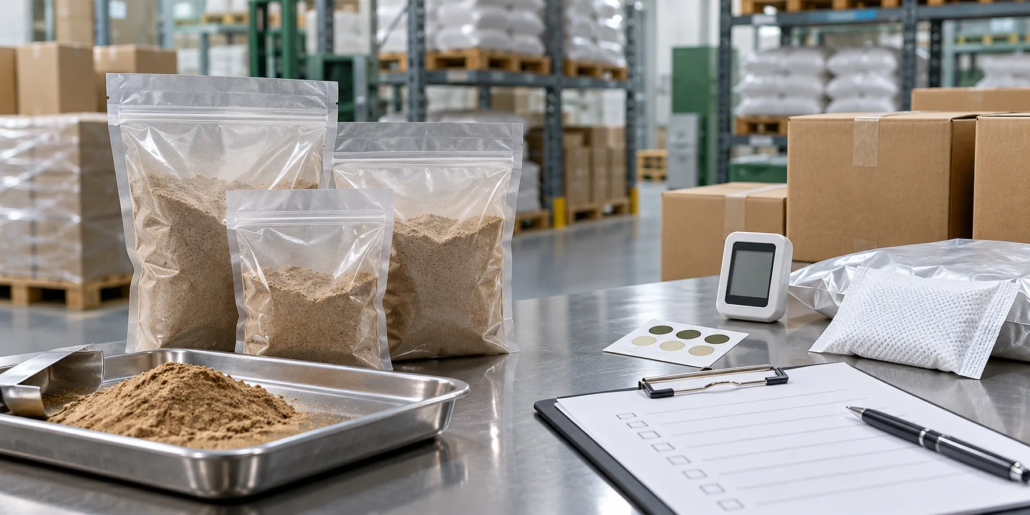
Unopened earthworm protein powder should be stored according to supplier guidance, typically in clean, dry, well-sealed conditions away from direct heat, moisture, sunlight, and strong odors. The exact conditions should come from the supplier’s product documents.
Warehouse teams should avoid placing ingredient cartons directly against damp floors or walls. Pallets should be kept organized, labeled, and protected from damage. If the warehouse has areas with different temperature or humidity profiles, store protein powder in the area that best matches the supplier’s conditions.
Inventory rotation matters. FIFO means first in, first out. FEFO means first expired, first out. For ingredients with expiry dates, FEFO is often more useful because it prioritizes the material that should be used sooner. The selected method should be clear to warehouse and production teams.
Storage control should also include segregation. Keep raw materials away from cleaning chemicals, strong-smelling goods, allergens where relevant, and materials with contamination risk. Even if the powder remains chemically acceptable, odor transfer or cross-contact concern can still create a commercial problem.
What changes after a package is opened?
After a package is opened, the buyer has more responsibility for protecting the powder. Air, moisture, handling tools, and room conditions can affect material condition, so opened material should be resealed quickly and used within the buyer’s internal handling rules.
Many shelf-life statements refer to unopened packaging stored under stated conditions. Once an inner bag is opened, the original shelf-life statement may no longer describe the real handling situation. Buyers should ask the supplier whether it has recommended use-after-opening guidance, especially for humid environments or long production schedules.
Opened material should be identified clearly. Record the opening date, remaining quantity, operator, and lot number. Use clean tools and avoid returning spilled material to the bag. If partial bags are common, consider smaller packaging or planned production batches that reduce repeated opening.
Production teams should also watch for sensory or handling changes. If an opened bag starts clumping or developing an unusual odor, isolate it and consult quality staff. The cost of holding one questionable bag is usually lower than the cost of a finished-product complaint.
How does shelf life affect purchasing and production planning?
Shelf life affects purchasing by setting a practical window for import, warehousing, production, and customer delivery. Buyers should match order quantity to turnover speed rather than buying more than the supply chain can use well.
A larger order can reduce unit cost, but it can also create inventory age risk. If the material sits too long, the buyer may face pressure to use older stock quickly or sell it with a shorter remaining shelf life. That can reduce flexibility for customers who require a minimum remaining shelf life at delivery.
Production planning should include lead time, transit time, customs clearance, incoming inspection, production schedule, finished-product shelf life, and customer delivery requirements. A raw material that arrives with limited remaining shelf life can disrupt the whole plan.
Buyers should ask suppliers what remaining shelf life is normally available at shipment and whether fresh production can be arranged for large or sensitive orders. That question should be part of commercial discussion, not an afterthought.
| Planning question | Why it matters | Buyer action |
|---|---|---|
| How much stock will be used each month? | Prevents slow-moving inventory | Match order size to realistic demand |
| What remaining shelf life does the customer require? | Affects shipment acceptance | Confirm before purchase order approval |
| How long is international transit? | Uses part of the shelf-life window | Include transit and clearance time in planning |
| Will goods be opened repeatedly? | Raises moisture and handling risk | Plan batch sizes and resealing controls |
| Is extra testing needed before use? | Can delay release to production | Schedule incoming QA review early |
How can buyers discuss shelf life with suppliers?
Buyers can discuss shelf life with suppliers by asking direct, document-based questions. The goal is to understand what the supplier can support, what the buyer must control, and what should be confirmed before shipment.
Useful questions include: What is the stated shelf life under recommended storage conditions? What date does the shelf-life period start from? What packaging format is used? What storage conditions are written on the label or specification? What remaining shelf life is typical at shipment? Can the supplier provide a COA for each lot? Can special packing be discussed for humid destinations?
Suppliers should answer these questions with clear documents or practical explanations. If an answer is vague, ask for confirmation in writing. If the buyer has strict customer requirements, share them early so the supplier can confirm whether the order can meet them.
A strong supplier relationship is built on clarity. The buyer controls its warehouse, production room, and inventory rotation. The supplier controls manufacturing, packing, and pre-shipment documents. Shelf-life success depends on both sides doing their part.
FAQ
Is shelf life the same as expiry date?
They are related but not identical in every document system. Shelf life describes the supported storage period under stated conditions. Expiry date is the specific date shown on a label or document. Buyers should confirm how the supplier calculates and displays the date.
Can earthworm protein powder be used after opening?
Opened material may be usable when it is handled, resealed, and stored correctly, but the buyer should follow supplier guidance and internal quality rules. Record the opening date and inspect material condition before use.
What is the biggest storage risk for powder ingredients?
Moisture exposure is often a major practical risk because it can affect clumping, flow, and quality perception. Heat, damaged packaging, odor exposure, and poor stock rotation can also create problems.
Should buyers request fresh production?
Fresh production may be useful for large orders, long supply chains, or customers that require high remaining shelf life. Buyers should discuss this at quotation stage because production schedule, MOQ, and lead time may be affected.
What should a buyer do if a shipment arrives with damaged packaging?
Isolate the affected units, take photos, record lot numbers and carton details, and contact the supplier before releasing the material. Do not use questionable material until the quality team has reviewed it.
Send your ingredient inquiry
For earthworm protein powder sourcing, send your target application, destination market, required remaining shelf life, packing preference, and document list. Venacorebio can help prepare a practical B2B review file for quotation and sample planning.