Lumbrokinase Extraction Process: Separation Stages and Evidence Buyers Should Review
Lumbrokinase Extraction Process: Separation Stages and Evidence Buyers Should Review
The lumbrokinase extraction process is not one universally fixed recipe. Published studies describe different ways to recover and separate earthworm-derived enzyme preparations. For commercial buyers, the important question is how an offered material is identified, controlled, tested, and connected to a reproducible manufacturing record.
When evaluating lumbrokinase powder, ask for a product-specific process overview and the evidence supporting its specification. A paper about an isolated enzyme fraction does not establish the composition, activity, purity, or manufacturing route of a supplier’s powder.
This article explains the separation concepts behind published extraction work and provides a technical purchasing review framework. It is not a laboratory protocol, a description of Venacore Bio’s verified production settings, or evidence that a commercial ingredient treats disease. No operating temperature, extraction ratio, activity specification, or shelf life is prescribed here.
Identify the Intended Material Before Reviewing the Process
Start by clarifying what the supplier means by lumbrokinase. The offered material may be described using a product name, an enzyme activity grade, a composition statement, and a particular assay method. Those descriptions should be understood together rather than reduced to the word extract.
A buyer can ask whether the product is an enzyme-containing preparation, a separated fraction, or another specified material. Also ask whether carriers or other ingredients are present and how they appear in the specification. Keep unanswered questions open; do not infer a single isolated enzyme from a general product name.
Write down the purpose of the review. A distributor comparing ingredient offers needs different detail from a research laboratory purchasing a characterized fraction. If the intended application requires a level of characterization or documentation that the supplier cannot support, identify that mismatch before investing in samples.
The review should end with an agreed material description, not merely a list of attractive equipment names. That description becomes the reference for the process discussion, sample evaluation, quotation, and later lot acceptance.
What Published Extraction Studies Actually Show
Published methods demonstrate possible separation routes, not a mandatory commercial sequence. A 2010 study using Eisenia andrei described water homogenization, clarification, salt fractionation, membrane processing, and chromatographic separation. Its preparation was made for the researchers’ experiments; it should not be treated as a specification for every lumbrokinase product.
A 2008 separation study investigated an aqueous two-phase system followed by anion-exchange chromatography. A 2024 extraction optimization paper examined salt precipitation and chromatographic purification. These examples show why the actual route must be confirmed rather than inferred from a product label.
Do not transfer reported purity or activity figures into a commercial quotation. Ask whether the tested fraction, analytical method, and reporting basis match the offered material. Laboratory separation work also does not establish human efficacy, destination-market authorization, or the suitability of a finished formulation.
Use the literature to prepare better questions. It can help a technical team recognize the purpose of a step, but only product-specific evidence can connect that step to the material being purchased.
Read a Process Map by the Question Each Stage Answers
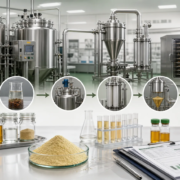
A useful process map explains the purpose of each stage and the controls associated with it. It should distinguish preparing an extract from concentrating it, separating fractions, and releasing the final powder. The following table is a discussion aid, not a required sequence or a claim that every listed operation is used.
| Stage under review | Technical question | Evidence to request |
|---|---|---|
| Source material control | What material entered the process? | Identity description, source traceability, and acceptance record scope |
| Extraction | What target material was recovered into the extract? | Process purpose and relevant control categories |
| Clarification | How was the extract separated from unwanted solids? | Operation description and monitoring approach |
| Fractionation or concentration | What was retained, removed, or enriched? | Fraction identity and activity accounting where available |
| Drying and blending | How did the final powder composition arise? | Finished-material description and added-ingredient disclosure |
| Release | Why was this lot accepted? | Specification, methods, results, and authorized review |
If a supplier omits a stage from the public overview, ask for an explanation at an appropriate confidentiality level. The absence of public detail is not itself proof of poor manufacturing, but essential quality questions still need an answer before approval.
Review Source Material and Extraction Controls
Source material review should establish identity and traceability before the extraction route is discussed. Ask how the source is described, which records identify incoming lots, and how the manufacturer determines whether material is acceptable for processing. Avoid treating a photograph or species name alone as a complete source qualification file.
For the extraction stage, request an explanation of the target fraction and the categories of process conditions that are controlled. Relevant questions may concern the extraction medium, handling time, temperature management, pH control, and contact materials. These are questions for the actual process owner, not settings that a buyer should copy from an unrelated paper.
Ask how the process owner handles a departure from its own approved conditions. A clear answer should describe review responsibility and the type of evidence used to decide whether a batch can proceed. A broad statement that the extraction is gentle does not explain how a deviation is detected or assessed.
Where details are confidential, a controlled summary may still identify the purpose of a stage, the records maintained, and the person responsible for answering quality questions. Decide whether that level of information is sufficient for the intended purchase.
Separate Clarification From Purification
Ask what the supplier means when it uses words such as filtered, concentrated, or purified. Those terms should be tied to a specific operation and an observed result. Do not treat a cleaner-looking liquid as proof of enzyme identity or a higher purity grade.
The 2010 study separated its clarified extract through several further operations before collecting enzyme fractions. The purchasing lesson is that different points in a process can represent different materials. A result measured on a selected fraction should not be assigned to the starting extract or final blended powder without supporting data.
For each separation step, ask which stream or fraction continues, how it is identified, and what is measured before it moves forward. If fractions are combined, ask how the combined material is described and tested. A process diagram that shows only boxes and arrows may conceal these practical distinctions.
Membrane or filtration terminology also needs context. Ask what the operation is intended to remove or retain and how that purpose is verified. Do not infer sterility, contaminant removal, or a particular composition from the presence of a filter in a diagram.
Evaluate Enrichment Without Confusing Yield and Activity
A process review should distinguish the amount of recovered material from the analytical properties assigned to it. Ask the manufacturer how it reports mass, measured activity, and any purification comparison. Keep the original units and bases visible throughout the review.
The 2008 study reported activity recovery and purification outcomes for its own experimental system. Such results are meaningful within that study’s materials and methods. They are not a conversion rule or a purchase guarantee for an unrelated commercial preparation.
For an offered lot, request the assay method, sample preparation, reporting unit, and basis of calculation. Ask whether an activity value refers to the powder as supplied, a dry basis, or a protein-normalized result. If two quotations use different methods or bases, ask a qualified technical reviewer whether a valid comparison can be made.
Do not rank suppliers using the largest number on a data sheet before those differences are resolved. Also avoid converting one activity unit into another without an established method relationship. A transparent explanation of what was measured is more useful than a dramatic figure with an unclear denominator.
Ask What Changes Between the Liquid Fraction and Final Powder
Drying, blending, and packing should be included in the review because the purchased material is the finished powder, not an intermediate test fraction. Ask how the supplier connects intermediate information to the final lot specification and release report.
Request disclosure of carriers, processing aids, or other relevant ingredients at the level needed for the project. Clarify whether a composition statement describes the material as supplied. A buyer should not infer that the entire powder consists of isolated active enzyme simply because it is sold under an enzyme-related product name.
Ask for the actual handling instructions, packaging description, and supporting stability information available for the offered material. This article does not assign a drying method, storage temperature, moisture limit, or shelf life to any supplier’s product. Those details need product-specific confirmation.
If a laboratory sample differs from the intended bulk packaging or finished formulation, record that difference. Decide whether further testing is needed before relying on the result for a commercial order. A powder trial and a packaged finished-product stability program answer different questions.
Connect Process Claims to Reviewable Records
Translate each important supplier statement into an evidence request. The aim is not to demand disclosure of every trade secret. It is to establish enough information for the buyer’s quality team to understand the material, review its risks, and define acceptance requirements.
| Statement being considered | Useful follow-up question | What not to infer |
|---|---|---|
| Controlled extraction | Which records show that the batch followed the approved process? | A universal operating recipe |
| Purified material | What is measured, by which method, on which fraction? | A single-enzyme composition without characterization |
| High activity | What assay, unit, reference, and reporting basis support the figure? | Clinical performance or equivalence to another method |
| Consistent supply | How are multiple lots reviewed against the agreed specification? | Every future lot is already accepted |
| Stable powder | What evidence supports the stated storage and shelf-life conditions? | An unlimited life under any transport conditions |
Where evidence is incomplete, record the gap and its effect on the purchase decision. A gap may require clarification, further testing, or a different project scope. It should not be closed with marketing language or an unrelated certificate.
Plan Sample and Lot Comparisons Before Ordering
A sample evaluation should reference the same material description and methods used in the proposed purchase. Ask which lot the sample represents and whether future orders will use the same specification version. Any planned difference should be visible to the reviewer before testing begins.
Define the laboratory work and application trials separately. Laboratory results address the tested attributes under the stated methods. A formulation trial addresses behavior in the buyer’s own process. Neither should be presented as proof of an untested attribute or medical effect.
When reviewing several lots, keep method changes and reporting changes visible. An apparent difference may require investigation before it is attributed to extraction performance. Ask the supplier and testing laboratory to explain any inconsistency rather than averaging incompatible results into a reassuring number.
Document the next decision: request more evidence, proceed to a controlled trial order, or stop. If proceeding, reference the agreed specification, document package, review responsibilities, and change-notification expectations in the purchasing record. Process understanding is useful only when it leads to a clear, limited approval decision.
Keep Technical Review Separate From Market Authorization
A technically well-described extraction route does not by itself authorize an ingredient for a particular destination or application. Have qualified advisers review the proposed product category, composition, intended use, and claims before commercialization. Supplement, food, research, and pharmaceutical projects should not be treated as interchangeable.
The FDA dietary supplement overview explains that FDA does not approve supplements for safety and effectiveness before sale. A process document, activity result, or supplier certificate should not be described as an FDA product approval.
For a pharmaceutical or API-level request, establish the required document list before sampling. Do not infer pharmaceutical manufacturing suitability from a supplement-oriented ingredient offer. Ask which documents actually exist, what scope they cover, and whether they meet the project’s review needs.
Keep public product claims within the evidence and applicable rules. This process discussion makes no recommendation for self-treatment, no dose proposal, and no promise of therapeutic performance. Buyers should not reuse laboratory extraction observations as disease claims for an ingredient or finished product.
FAQ
Is there one standard lumbrokinase extraction method?
No single route should be presumed from the name alone. The studies cited here investigated different separation approaches. Confirm the actual material description and process overview for the offered product.
Does more chromatography always mean a better commercial powder?
Do not rank an offer by its number of separation steps. Review whether the finished material meets the intended specification, how the results were measured, and whether the documentation supports the proposed application.
Can I compare activity figures from different suppliers directly?
First compare methods, units, sample preparation, and reporting bases. If these differ, seek a qualified assessment or an agreed testing approach. Do not invent a conversion between incompatible activity measurements.
Does a published extraction paper prove a supplier uses that process?
No. A publication describes the authors’ materials and work. Supplier-specific records are needed to connect a manufacturing claim to the material offered for purchase.
What should I request before a technical sample?
Request the material description, specification, relevant assay information, available lot records, and a process summary appropriate to the project. Explain the destination and intended use so document gaps can be identified before dispatch.
Send Your Ingredient Inquiry
Contact Venacore Bio with your lumbrokinase application, destination market, required activity reporting method, proposed evaluation plan, and document checklist. Ask the team to confirm the offered material and the process, sample, and quality information available for review before discussing a bulk order.