Lumbrokinase Manufacturing Process: What B2B Buyers Should Review
Lumbrokinase Manufacturing Process: What B2B Buyers Should Review
The lumbrokinase manufacturing process matters because buyers are not only purchasing an enzyme ingredient name. They are qualifying a raw material supply chain, a process control system, a batch documentation file, and a repeatable route for commercial orders. For supplement brands, importers, distributors, and contract manufacturers evaluating lumbrokinase powder, the most useful review focuses on raw material control, extraction and separation logic, activity testing, contamination limits, batch traceability, packing, storage, and compliant communication.
Lumbrokinase is commonly discussed as an earthworm-derived enzyme ingredient in nutraceutical sourcing. That does not make every powder equivalent. Two quotes can use the same product name while differing in activity basis, process maturity, document scope, lead time, sample handling, and export support. A buyer who only compares unit price may miss the process details that decide whether the material can pass QA review and move into a formulation project.
This article explains the manufacturing process from a B2B qualification angle. It does not provide medical advice or finished-product claim language. The goal is to help buyers ask sharper questions before they approve a supplier, request a sample, or place a bulk order.
What does a practical lumbrokinase manufacturing process include?
A practical lumbrokinase manufacturing process includes controlled raw material acceptance, preparation, extraction, separation, concentration, drying, milling or sieving, blending where applicable, release testing, packing, and batch record review. Buyers do not need the supplier’s confidential formula, but they do need enough process visibility to judge consistency and documentation.
The process should begin before production starts. A serious supplier should define accepted raw material type, receiving criteria, storage conditions, and internal lot coding. If the raw material is not identified and controlled, later testing cannot fully repair the risk. Buyers should ask whether incoming material is inspected, whether records are kept by lot, and how rejected material is handled.
After preparation, the enzyme-focused steps usually involve extraction and separation under controlled conditions. The supplier may not disclose every parameter, but it should be able to describe the general route, the key control points, and the way batches move from wet processing to powder form. Vague answers such as “advanced technology” are not very useful for QA teams. A better answer names the stages in order and connects each stage to a control purpose.
Drying and post-processing also deserve attention. Enzyme ingredients can be sensitive to heat, moisture, and handling. Buyers should ask how the supplier controls drying conditions, particle consistency, moisture targets, foreign matter risk, and final packing environment. These questions are ordinary supplier qualification questions, not demands for trade secrets.
Why should buyers review raw material control first?
Buyers should review raw material control first because the finished powder can only be as reliable as the source material and intake system behind it. Raw material identity, lot traceability, storage, and acceptance checks set the foundation for enzyme activity and safety-related testing.
Raw material control is often hidden behind the final COA. A COA is important, but it is not the whole story. It shows selected results for a sample or batch. It does not automatically explain how the source material was selected, stored, prepared, and protected from mix-ups. For repeat supply, buyers need both the final document and the system that produces it.
Useful supplier questions include: What is the raw material acceptance procedure? How are lots coded? Are incoming materials segregated before release? What records connect the raw material lot to the finished batch? How are nonconforming materials managed? The supplier’s answers should be specific enough to support a procurement file.
For new buyers, this review also reduces communication risk. If the supplier can explain intake and lot control clearly, later conversations about sample matching, batch documents, and shipment timing usually become easier. If the supplier cannot explain basic control steps, the buyer should slow down before discussing commercial scale.
How are extraction and separation reviewed in supplier qualification?
Extraction and separation are reviewed by asking how the supplier moves from prepared raw material to enzyme-focused intermediate material, what controls are monitored, and how the process prevents contamination, mix-ups, and uncontrolled variation. Buyers should focus on control logic rather than trying to obtain proprietary operating details.
A supplier can protect its process knowledge while still giving a useful overview. For example, it can explain whether the process includes controlled extraction, separation or filtration, concentration, drying, and final powder handling. It can identify which stages are monitored for time, temperature, pH, material ratio, cleanliness, or other internal criteria. The exact numbers may be confidential, but the existence of control points should not be mysterious.
Buyers should also ask whether the process used for samples is the same as the process used for bulk supply. A polished sample is not enough if the commercial process is different. If a supplier sends a small hand-prepared sample and later produces bulk under a different route, the buyer may see changes in color, odor, activity, flow, moisture, or solubility behavior.
Process records are especially useful when a buyer works with a contract manufacturer or distributor customer. A simple flow chart can help internal teams understand how the ingredient is produced, where release testing fits, and which records are available if a customer asks. The flow chart should not include unsupported health claims; it should explain manufacturing sequence and quality control.
Which quality tests are most relevant to lumbrokinase powder?
The most relevant tests for lumbrokinase powder include activity basis, appearance, moisture, microbiological limits, heavy metals, and other specification items required by the buyer’s market and application. The exact test panel should be confirmed against the supplier’s latest specification and batch COA.
Activity is usually the first item buyers notice because lumbrokinase is an enzyme-focused ingredient. Venacorebio’s product page presents lumbrokinase powder as available across activity ranges and notes fibrin plate assay as the assay method. Buyers should still request the latest COA before placing an order, because website information screens the product while batch documents support a specific shipment.
Activity numbers should be compared carefully. A higher number is not useful if the assay method, unit expression, sample identity, or batch date is unclear. Buyers comparing suppliers should normalize the grade, method, COA scope, sample source, and intended application before treating quotes as equivalent.
Non-activity tests are just as important for commercial approval. Moisture can affect handling and storage. Microbiology and heavy metals affect quality review and destination-market risk. Appearance, odor, and particle behavior affect formulation. The supplier should be able to explain which tests are routine release items and which require special arrangement or third-party testing.
| Review area | What buyers should ask | Why it matters |
|---|---|---|
| Activity basis | What grade is quoted, and what assay method supports it? | Prevents comparison of unlike enzyme materials |
| Batch COA | Does the COA match the sample or shipment lot? | Connects test results to the material being purchased |
| Microbiology | Which limits are routine release items? | Supports QA review for supplement or ingredient use |
| Heavy metals | Are results included in the batch document or available by request? | Helps importers and brands manage contaminant review |
| Moisture and storage | What storage conditions and shelf-life statement are provided? | Reduces handling and stability problems after receipt |
How should buyers read a lumbrokinase process flow chart?
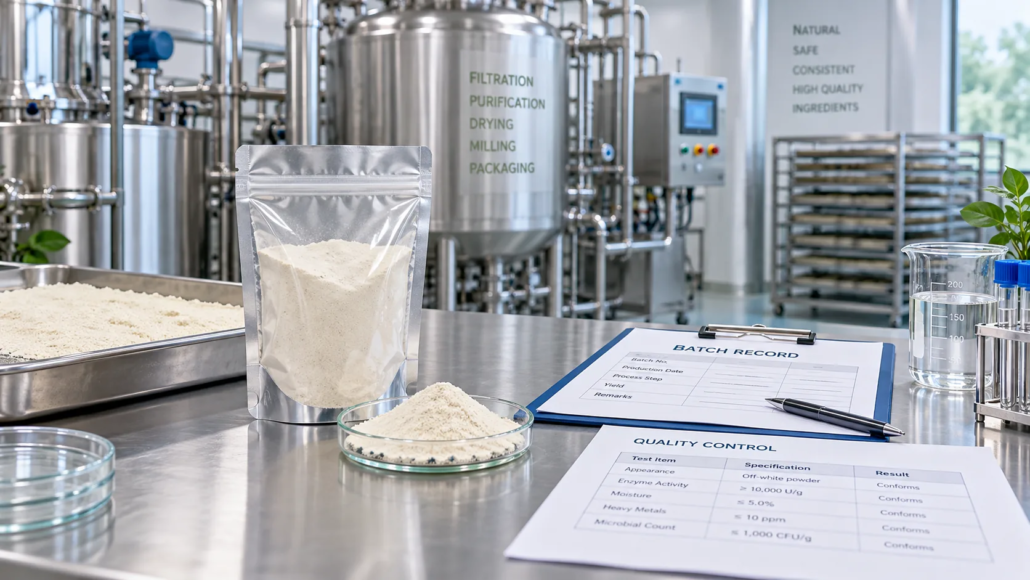
Buyers should read a lumbrokinase process flow chart as a quality and traceability map. The chart should show the main production stages, inspection points, batch identification steps, and final release sequence without turning the document into a marketing promise.
A useful flow chart is usually simple. It may begin with raw material receiving, then move through preparation, extraction, separation, concentration, drying, sieving or milling, testing, packing, and storage. Each stage should make sense. If the chart jumps from raw material directly to finished powder without quality checkpoints, the buyer should ask for clarification.
The flow chart should align with other documents. Product name, batch coding, process description, and release testing should not contradict the specification or COA. If one document says lumbrokinase powder, another says earthworm enzyme powder, and a third uses a different name, the buyer should ask the supplier to standardize wording before internal approval.
Buyers should avoid over-reading the flow chart. It does not prove every value by itself. It is one piece of a supplier qualification file, alongside the specification, COA, MSDS or safety document where available, packing information, sample label, shipment documents, and supplier communication record.
What process details affect formulation performance?
Process details can affect formulation performance through particle size, moisture, odor, color, flow, dispersibility, activity retention, and batch-to-batch consistency. These properties influence capsules, tablets, sachets, blends, and other supplement raw material projects.
A capsule project may care about bulk density and flow because those affect fill weight and production speed. A tablet project may care about compressibility and compatibility with excipients. A powder blend may care about odor, color, and uniform mixing. These performance questions cannot be answered by product name alone.
Buyers should test samples under the intended product conditions. Use the same excipients, target inclusion rate, mixing time, packaging idea, and storage observation method planned for the project. Record practical observations: Does the powder clump? Does odor change after blending? Is the color acceptable? Does the material flow through equipment? Does the sample match the COA and label?
Manufacturing communication helps here. If a supplier understands how drying, sieving, and packing influence powder behavior, it can discuss sample evaluation more practically. If the supplier only repeats broad phrases, the buyer may need more sample testing before making a commitment.
What documents should accompany a manufacturing-process review?
A manufacturing-process review should be supported by a product specification, batch or representative COA, process flow chart, MSDS or safety document where available, storage statement, packing details, sample label, and export document guidance. The document set should match the buyer’s project stage and destination market.
At the screening stage, a representative COA and specification may be enough to decide whether to request a sample. At the sample stage, the buyer should ask for the sample batch identity, activity basis, storage guidance, and packing label. At the purchase stage, the buyer should request the current batch COA and final shipment documents.
Buyers should not assume pharmaceutical-level files are available unless the supplier confirms them. Lumbrokinase is often discussed in health-related contexts, but a B2B ingredient inquiry must stay aligned with the actual product category, document scope, and local compliance review. If the buyer needs special registrations, facility certificates, allergen statements, animal-origin statements, or market-specific documents, the exact checklist should be sent before quotation.
Document timing is part of supplier reliability. If documents arrive only after repeated reminders, the order may face delays. If documents arrive quickly but contain inconsistent product names or old batch information, the buyer should request corrections before payment or shipment.
| Document | Best use | Buyer caution |
|---|---|---|
| Specification sheet | Defines routine product limits and identity | Confirm it matches the quoted grade |
| COA | Shows test results for a representative or actual batch | Check lot number, date, and activity method |
| Process flow chart | Explains production sequence for QA review | Do not treat it as proof of claims by itself |
| MSDS or safety file | Supports handling and logistics review | Confirm latest version and product name |
| Packing information | Helps warehouse, shipping, and sampling teams | Check bag/carton format against order quantity |
How does packing protect the finished enzyme powder?
Packing protects finished lumbrokinase powder by reducing moisture exposure, contamination risk, labeling errors, and shipment damage. Buyers should review inner bag, outer carton, label information, net weight, storage conditions, and whether the packing format fits the planned order quantity.
Venacorebio’s product page lists 1.5 kg per bag and 9 kg per carton as a packing reference for lumbrokinase powder. That can help buyers plan trial orders and carton-level purchases, but the buyer should still confirm current packing before payment. Packing may vary by order size, route, and customer requirement.
Labels should connect the physical goods to the documents. Product name, batch number, net weight, storage condition, and production or expiry information where applicable should align with the COA and invoice. If the sample label uses one name and the COA uses another, the buyer should ask for correction before internal testing.
Good packing also supports re-testing and complaint handling. If a buyer receives damaged cartons, unclear labels, or missing batch codes, it becomes harder to investigate. A simple packing photo before shipment can prevent avoidable receiving problems.
What should buyers confirm before scaling from sample to bulk?
Before scaling from sample to bulk, buyers should confirm that the approved sample, quoted grade, manufacturing route, batch COA, packing format, lead time, and shipment documents all refer to the same product plan. Sample approval should not be separated from process and document approval.
Ask whether the bulk order will come from the same batch as the sample or from a later production batch. If it will come from a later batch, ask how the supplier controls consistency. Request a current COA before shipment and compare it with the sample file. If important values shift, ask whether the difference affects formulation or internal specifications.
Commercial timing should also be realistic. Venacorebio’s lumbrokinase page indicates in-stock shipment within 3 working days or made-to-order production within 7 to 15 days after payment, depending on availability. Buyers should confirm the latest stock status, holiday schedule, route, and document timing for each order.
Scaling is smoother when the buyer sends a clear purchase brief: activity grade, quantity, destination, packing preference, document checklist, sample reference, payment term, and required delivery schedule. That gives the supplier a practical basis for confirming feasibility.
How can buyers avoid unsupported health claims during manufacturing discussions?
Buyers can avoid unsupported health claims by keeping manufacturing discussions focused on ingredient identity, process control, testing, documents, packing, storage, and formulation handling. Disease treatment, prevention, cure, or guaranteed health outcome language should not be used as a raw material qualification shortcut.
This is especially important for lumbrokinase because online searches often contain health-related questions. A supplier may be asked about finished-product benefits, dosage, or disease-related wording. For B2B raw material sourcing, the safer approach is to discuss specification, COA, activity method, sample testing, and compliance review boundaries.
Buyers can still discuss application categories carefully. It is reasonable to say the ingredient is being evaluated for supplement or nutraceutical formulation, subject to the buyer’s local rules. It is not appropriate to turn that conversation into a promise that the raw material will diagnose, treat, prevent, or cure a condition.
A disciplined supplier will usually welcome this boundary. It protects both sides and keeps the transaction centered on verifiable manufacturing and quality information.
Buyer checklist for a lumbrokinase manufacturing audit file
A practical audit file does not need to be complicated, but it should be organized. Buyers can use the following checklist when comparing suppliers or preparing an internal approval packet:
- Confirm product name, grade, and activity basis.
- Request the latest specification and representative or batch COA.
- Ask for a general process flow chart with key production stages.
- Check raw material control and batch traceability language.
- Confirm assay method and whether the quoted grade matches the sample.
- Review microbiology, heavy metals, moisture, appearance, and storage items.
- Verify packing format, label information, net weight, and carton plan.
- Confirm lead time for stock versus made-to-order production.
- Keep finished-product claims separate from raw material documents.
- Store all supplier files under the same product and batch naming convention.
This checklist helps buyers turn a manufacturing conversation into a repeatable supplier review. It also makes internal handoff easier between procurement, QA, regulatory, formulation, and logistics teams.
FAQ
Does a supplier need to disclose every lumbrokinase production parameter?
No. A supplier does not need to disclose confidential operating parameters, but it should explain the general manufacturing route, key control stages, release testing, and batch traceability system clearly enough for buyer qualification.
Is activity grade enough to compare lumbrokinase suppliers?
No. Activity grade should be reviewed together with assay method, COA scope, sample identity, microbiology, heavy metals, moisture, packing, lead time, and supplier communication. A single number does not define the whole supply risk.
Should buyers request third-party testing for every order?
Not always. Third-party testing may be useful for first orders, high-risk markets, strict customer programs, or large purchases. The need depends on the buyer’s QA policy, destination requirements, and confidence in the supplier’s batch documents.
What is the difference between a process flow chart and a COA?
A process flow chart describes the production sequence, while a COA reports selected test results for a representative or actual batch. Buyers should use both documents together rather than treating either one as complete proof by itself.
Can manufacturing-process review include health benefit claims?
It should not. Manufacturing review should stay focused on ingredient identity, process control, test methods, documents, packing, and storage. Health claims require separate finished-product compliance review in the buyer’s target market.
Send your ingredient inquiry with target activity grade, order quantity, destination country, document checklist, and sample needs. Venacorebio can help review whether the current lumbrokinase powder supply option fits your B2B project requirements.