Enzymatic Hydrolysis of Earthworm Peptides: What Ingredient Buyers Should Know
Enzymatic Hydrolysis of Earthworm Peptides: What Ingredient Buyers Should Know
Enzymatic hydrolysis is one of the key process ideas behind earthworm peptide powder. In simple terms, enzymes help break larger protein materials into smaller peptide-focused fractions under controlled conditions. For B2B buyers, the value of this process depends on repeatability, specification control, sensory behavior, document support, and whether the finished powder fits the intended product format.
The topic can sound technical, but the buying question is straightforward. Can the supplier explain the process clearly enough for QA, formulation, purchasing, and compliance teams to evaluate the ingredient? If the answer is vague, a buyer may receive a sample that looks interesting but is difficult to approve for a real project.
This article explains enzymatic hydrolysis from a sourcing perspective. It does not make disease, treatment, or guaranteed health outcome claims. It focuses on how buyers can review process controls, documents, samples, and communication before moving from interest to quotation or bulk order.
What does enzymatic hydrolysis mean for earthworm peptide ingredients?
Enzymatic hydrolysis means using enzymes under controlled conditions to split larger protein structures into smaller peptide fractions. For earthworm peptide ingredients, the process is usually discussed because it helps define the powder’s identity, specification, and application behavior.
Hydrolysis is not a magic word. It is a manufacturing step that must be controlled. Time, temperature, enzyme selection, pH, raw material condition, separation, and drying can all influence the finished powder. Buyers do not need every confidential process setting, but they do need enough information to understand whether the supplier controls the process consistently.
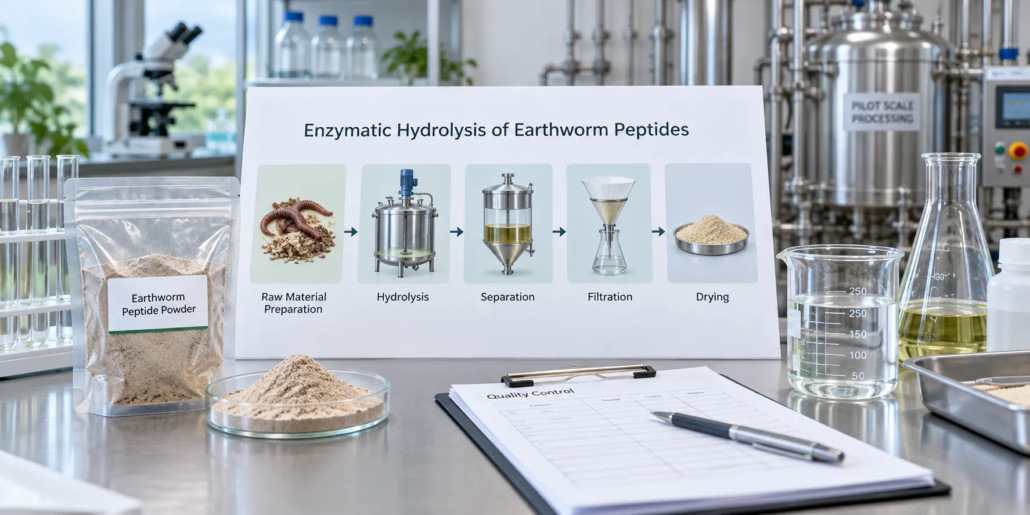
A serious supplier should be able to describe the broad route: raw material acceptance, preparation, enzyme-assisted processing, separation, filtration or purification as applicable, concentration, drying, sieving, testing, and packing. If a supplier uses the word “hydrolyzed” but cannot connect it to a product specification or COA, the buyer should ask more questions.
The term also affects communication. A peptide-focused ingredient may need different explanation than a broader protein powder. The supplier’s documents should make that difference clear without pushing the buyer toward unsupported health claims.
Why does hydrolysis matter in B2B sourcing?
Hydrolysis matters because it can affect how the ingredient is specified, tested, formulated, and explained. Buyers are not only purchasing a powder; they are purchasing a controlled process result that must be reviewed batch after batch.
From a sourcing angle, hydrolysis can influence peptide-related indexes, solubility, odor, color, dispersibility, and the way the powder behaves in capsules, tablets, sachets, powder blends, or functional food concepts. None of these traits should be guessed from the name. They should be checked through documents and samples.
The process also gives buyers a sharper way to compare suppliers. If two suppliers both offer earthworm peptide powder, ask how each defines the grade, which checks are routine, what the COA includes, how the sample connects to production, and whether the quoted bulk grade matches the sample grade. These questions often reveal more than a price sheet.
Hydrolysis matters for repeat orders as well. A buyer may accept a first sample after a small trial, but commercial buying requires stable production rhythm. The same material name should point to the same process route, document set, and finished powder expectations across future batches.
Which process controls should buyers ask about?
Buyers should ask about raw material acceptance, enzyme-assisted processing conditions, separation, filtration, concentration, drying, sieving, packing, and batch testing. The supplier does not need to disclose trade secrets, but the process should be visible enough for buyer-side review.
Raw material control comes first. The supplier should explain how incoming earthworm-derived material is checked, stored, and traced before processing. A clean hydrolysis process cannot fully rescue poorly controlled starting material. Identity, hygiene, moisture, odor, and storage conditions all matter.
Hydrolysis conditions come next. Buyers can ask which factors are controlled without asking for proprietary formulas. Time, temperature range, pH control, enzyme type category, and process endpoint review are reasonable discussion points. The goal is to confirm process discipline, not to copy the supplier’s production method.
Separation and drying deserve equal attention. Poor separation may leave unwanted residue or worsen sensory properties. Drying can influence moisture, clumping, flow, and storage behavior. For an ingredient that may enter capsules, tablets, sachets, or blends, these physical details are not minor.
| Process area | Buyer question | Why it matters |
|---|---|---|
| Raw material acceptance | How is source identity and condition checked? | Controls the foundation of the batch |
| Hydrolysis conditions | Which process factors are monitored? | Supports repeatable peptide-focused processing |
| Separation and filtration | How are unwanted solids or residues managed? | Affects clarity, color, odor, and powder quality |
| Drying | How are moisture and powder handling controlled? | Influences clumping, flow, and storage behavior |
| Final testing | Which tests are batch release items? | Connects process control to the COA |
How does hydrolysis affect the finished powder?
Hydrolysis can affect the finished powder by changing peptide profile, solubility behavior, sensory traits, particle handling, and document requirements. The exact result depends on the supplier’s process and product grade, so buyers should test samples instead of assuming performance.
Solubility is often discussed with peptide ingredients, but it must be checked under real formula conditions. A powder may disperse differently in plain water, flavored bases, acidic drinks, capsule blends, or tablet premixes. Temperature, mixing method, pH, and other ingredients can all change the result.
Sensory profile is just as practical. Earthworm-derived materials may have odor or color characteristics that need early review. A capsule project may have more tolerance than a beverage or sachet product. If the finished product depends on a clean taste profile, the buyer should test the sample at the planned use level before discussing label design or launch timing.
Hydrolysis may also affect how the specification is written. Buyers may see peptide-related fields, molecular size information where available, protein-related values, moisture, ash, microbiology, heavy metals, appearance, and storage. Every field should be tied to what the supplier actually tests and controls.
What documents should support a hydrolyzed peptide ingredient?
A hydrolyzed peptide ingredient should be supported by a product specification, batch COA, process flow chart, sample label, packing information, storage statement, and optional third-party tests when required. These documents make the process reviewable for the buyer’s internal team.
The product specification defines routine expectations. It should use the same product name as the quote and sample label. It should also list the tests the supplier uses to describe the powder. If the supplier claims a peptide-focused grade, ask which fields support that description.
The batch COA shows actual results for one lot or sample. It should include batch number, test items, limits, actual values, date, and issuer. A COA that does not connect to the sample under review is weaker than it looks. Buyers should ask for corrected files when batch identity is missing.
The process flow chart does not need confidential detail. It should show the main manufacturing stages in plain language. For many buyers, this document helps QA and customer-facing teams understand how the ingredient is produced without relying on supplier sales language alone.
| Document | What it should clarify | Buyer use |
|---|---|---|
| Product specification | Name, source, routine tests, storage, packing | Confirms whether the product fits the brief |
| Batch COA | Actual results for the sample or lot | Supports QA approval and supplier comparison |
| Process flow chart | Main stages from raw material to powder | Explains hydrolysis and downstream handling |
| Sample label | Product name, batch code, net weight, storage | Links the physical sample to documents |
| Third-party report | Independent tests for selected items | Useful for strict customers or first orders |
How should formulators test hydrolyzed earthworm peptides?
Formulators should test hydrolyzed earthworm peptides in the intended product format, not only as a dry sample on a desk. Sensory profile, flow, dispersibility, moisture behavior, compatibility, and storage observation should be checked before a commercial commitment.
Start with a controlled sample review. Record appearance, odor, color, texture, and any clumping after opening. Keep a retained sample with the original label. Then test the powder in the planned formula at the intended use level. A capsule, tablet, powder blend, and beverage concept will each expose different issues.
For capsule projects, ask the contract manufacturer to review flow, bulk density, fill weight, and compatibility with excipients. For tablets, compression behavior and binding may matter. For sachets or drink powders, dispersibility, taste masking, color impact, and moisture protection may become more important than the peptide discussion itself.
Documentation should move with the sample. When the formulator tests the ingredient, the QA team should have the specification and COA. When purchasing requests a quote, the same grade and sample lot should be referenced. This prevents the common mistake of approving one sample and buying a slightly different material.
How should buyers discuss claims and compliance?
Buyers should discuss hydrolyzed earthworm peptide ingredients through source, process, specification, quality controls, sample testing, and intended product format. They should avoid disease, treatment, prevention, or guaranteed effect language unless their own local compliance review has approved specific finished-product wording.
This matters because peptide-related terms can invite overstatement. A supplier may be tempted to explain the ingredient by listing broad health outcomes. That can create problems for brands selling into regulated markets. A safer B2B discussion stays close to ingredient facts: what it is, how it is produced, how it is tested, and how it can be evaluated.
Finished-product claims are not created by a raw material COA. A COA supports quality review for one batch. It does not decide label claims, advertising claims, dosage claims, or market access. Those decisions belong to the buyer’s regulatory team, local consultant, or finished-product owner.
A supplier that uses careful language is easier to work with. It helps the buyer prepare internal files, customer responses, and product briefs without needing to remove risky wording at every step.
What should buyers include in a hydrolyzed peptide inquiry?
Buyers should include target product format, expected order quantity, sample needs, specification questions, document requirements, destination market, packing preference, and compliance limits in a hydrolyzed peptide inquiry. A clear request helps the supplier respond with a useful offer instead of a generic price.
Use this checklist before sending an RFQ:
- State that the inquiry is for hydrolyzed earthworm peptide powder and ask the supplier to confirm the exact product name.
- Describe the intended product format, such as capsules, tablets, sachets, powder blends, or functional food concepts.
- Request the specification, sample COA, process flow chart, packing details, and storage statement.
- Ask which peptide-related indexes are available and which are routine release tests.
- Ask whether the sample grade matches the bulk grade that will be quoted.
- Share target order quantity, sample quantity, destination market, and preferred packing size.
- List any microbiology, heavy metal, allergen, or third-party test needs from your QA team.
- Ask for realistic lead time, sample dispatch timing, and repeat-order planning.
- Keep medical and treatment wording out of the inquiry unless your compliance team has already approved it.
- Save supplier answers, documents, sample photos, and formulation notes in one review file.
A clear inquiry also protects the buyer. If a supplier cannot answer basic process and document questions at the sample stage, the same gaps may appear again during shipment, customer review, or repeat ordering.
When is an enzymatic hydrolysis process ready for purchase approval?
An enzymatic hydrolysis process is ready for purchase approval when the sample, specification, COA, process explanation, formulation test notes, packing plan, and compliance boundaries all match the buyer’s project. Readiness should be based on reviewable files, not only supplier confidence.
The approval path should connect technical and commercial facts. The sample should match the quoted grade. The COA should match the sample or lot. The product name should be consistent across files. The formulator should have tested the powder in the intended format. The QA team should accept the test scope. Purchasing should understand MOQ, lead time, packing, and shipment documents.
If one part remains unclear, ask before ordering. That does not mean rejecting the supplier. It means treating hydrolyzed peptide sourcing as a controlled ingredient project. Good suppliers expect these questions and answer them with documents, not pressure.
For many buyers, the strongest sign is calm consistency. The supplier explains the process in plain language, provides matching documents, avoids unsupported claims, and helps the buyer test the powder under real conditions. That is what turns hydrolysis from a technical word into a reviewable B2B supply decision.
FAQ
What is enzymatic hydrolysis in earthworm peptide production?
It is a controlled process where enzymes help break larger protein material into smaller peptide-focused fractions. Buyers should review how the supplier controls and documents the process.
Does hydrolysis guarantee better performance in every formula?
No. Hydrolysis may affect solubility and sensory behavior, but every formula is different. Buyers should test samples in the intended dosage form before choosing a grade.
Which documents should support hydrolyzed earthworm peptide powder?
Useful documents include the product specification, batch COA, process flow chart, sample label, packing details, storage statement, and third-party reports when required.
Can suppliers share every hydrolysis process detail?
Not always. Some process settings may be proprietary. Buyers can still ask for the general process flow, routine controls, batch testing scope, and document consistency.
Can hydrolyzed peptide ingredients be marketed with medical claims?
Raw ingredient documents do not approve medical claims. Finished-product wording must be reviewed under the rules of the destination market and product category.
Send Your Ingredient Inquiry to Venacorebio
Tell us your target product format, hydrolysis-related specification questions, sample needs, order quantity, destination market, and document checklist. Venacorebio can help you review bulk earthworm peptide powder options, COA questions, sample planning, packing details, and compliance-aware sourcing language before your team moves toward a purchase order.