Protein Isoelectric Point: Investigating Earthworm Protein Precipitation
Protein Isoelectric Point: Investigating Earthworm Protein Precipitation
A protein’s isoelectric point is the pH at which its net electrical charge is zero under the stated conditions. This concept helps explain some pH-related precipitation, but it does not assign one universal precipitation pH to an earthworm protein ingredient. A commercial powder can contain multiple protein components and other materials, so an observed solubility minimum needs a sample-specific explanation.
When evaluating earthworm protein powder, start with the actual sample and the behavior your project needs to understand. Is the concern a sediment after acid addition, incomplete dispersion from the outset, or a change after heating? Those observations call for different comparisons, even when they occur at a similar final pH.
This guide offers a way to plan and interpret an investigation with a qualified laboratory. It does not supply a commercial product’s measured isoelectric point, guarantee solubility, prescribe a production process, or establish suitability for consumption. Ingredient safety, permitted use, and any human-use work require their own review.
Understand What an Isoelectric Point Describes
The IUPAC terminology entry for isoelectric point describes zero net electrical charge at a particular pH. Net charge concerns the balance of charges; it does not mean that all charged groups disappear. The conditions attached to the measurement matter when the term is used in a technical report.
For a project involving a mixture, ask which entity the reported value describes. A value for one isolated protein is not automatically a value for an entire dried ingredient. Likewise, the pH of a powder dispersion is a measured property of that preparation; it is not, by itself, the isoelectric point of every protein present.
Keep the report’s vocabulary tied to its evidence. If the laboratory measured a pH-dependent soluble-protein curve, call it that. If it directly characterized a particular protein’s charge behavior, identify the material and technique. Avoid turning a convenient shorthand into a stronger molecular claim than the study supports.
Use Earthworm Research Without Transferring Its Numbers
Published studies show why the material description matters. A 2023 study of an Eisenia andrei protein extract reported a low-solubility region in its pH-dependent testing and discussed an isoelectric pH near five. The preparation was a recovered experimental extract, not an interchangeable description of all earthworm powders.
A separate 2022 study preparing earthworm protein isolates used acid precipitation at pH four as part of its preparation. That selected processing condition does not establish a universal molecular isoelectric point. The two papers should not be combined into a specification range or treated as contradictory supplier test reports.
Use such publications to frame questions: what source material was studied, what fraction was recovered, how was it processed, and what endpoint was measured? The answer may suggest a useful comparison, but the offered commercial sample still needs its own evidence.
A buyer should therefore ask for a sample-specific study rather than asking the supplier to certify whichever pH appears first in a search result. Research examples can inform an investigation without becoming purchasing guarantees.
Describe the Precipitation Problem Before Choosing Tests
Write a short observation record before asking why the sample precipitated. Include the material identity, preparation sequence, visible change, time of observation, and any available temperature and pH records. If the problem appeared only in a formulation, record the other ingredients rather than describing the system as protein in water.
Separate observation from explanation in that record. “A layer formed after acid addition” is an observation. “The powder reached its isoelectric point” is an interpretation requiring evidence. Keeping both in separate fields prevents the initial theory from determining every later test.
| Observed behavior | Question to investigate | Useful comparison to propose |
|---|---|---|
| Particles remain immediately after mixing | Was the sample dispersed adequately before pH adjustment? | Documented preparation without the adjustment step |
| Cloudiness develops after acid addition | Is the change reproducibly associated with final pH? | Controlled pH series with other factors recorded |
| Change appears after heating | What role does thermal history play? | Matched preparation without that heating stage |
| Only a complete formulation shows a layer | Which matrix contribution needs further study? | Ingredient-only and appropriate matrix controls |
| Samples differ between days | Were preparation and observation conditions comparable? | Repeated documented preparations from identified material |
These comparisons are questions for study design, not diagnoses. Ask the laboratory which ones are feasible and which additional records it needs. If the original preparation is poorly documented, acknowledge that limitation before treating a repeat trial as a precise reproduction.
Build a Controlled pH Comparison With the Laboratory
A useful comparison changes pH deliberately while recording the other factors that could influence the outcome. Ask the laboratory to propose an appropriate range, spacing, preparation method, and repetition plan for the actual material. Do not copy a research extraction recipe into a food or supplement formulation trial.
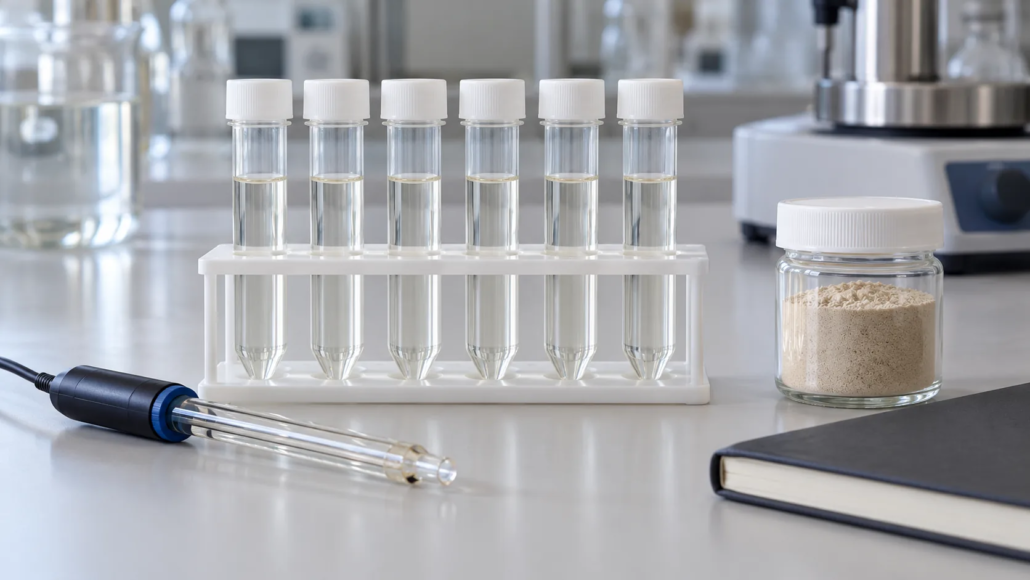
Record the final measured pH rather than relying only on a nominal buffer label or an amount of acid added. Ask how the measurement will be performed, when it will be recorded, and how the equipment’s suitability will be checked. A tube label is an instruction; a recorded measurement is evidence of what was obtained.
Ask how the study will handle dilution during adjustment. If liquid is added to one preparation, the comparison should account for the resulting volume and concentration. Otherwise, a difference attributed to pH may also involve a different amount of powder per unit volume.
Keep the same sample reference visible across all test portions. If more than one lot is studied, present each lot separately before discussing any common trend. Pooling unrelated samples can hide the very variability a purchasing team needs to understand.
Control Salt, Temperature, and Preparation History
pH is one variable among several. Original technical guidance from Cytiva on protein purification discusses solubility and stability in relation to pH, ionic strength, and additives. It also distinguishes low solubility from loss of activity or structural changes. These are general protein principles, not measured properties of a particular earthworm ingredient.
For the investigation, request a complete record of the buffer or water system, salts introduced during adjustment, concentration basis, mixing sequence, holding time, and thermal history. Ask which variables the laboratory can hold constant and which must be reported as limitations.
A useful follow-up might compare two preparation sequences that reach the same final pH. Frame the question narrowly: does the sequence change the observed endpoint under these conditions? Do not presume that returning to an earlier pH will necessarily restore the original state; ask whether reversibility needs separate assessment.
Likewise, a successful short observation does not answer a storage question. If the project concerns later settling, agree on a separate time-based evaluation and its conditions. Do not turn the duration of a bench observation into a commercial shelf-life claim.
Measure Soluble Protein Rather Than Appearance Alone
Appearance is useful for documenting a problem, but the study should specify what it measures. Ask whether the endpoint concerns visible particles, turbidity, sediment volume, or protein recovered in a separated liquid phase. Those outputs should have separate names in the report.
If the laboratory reports soluble protein, ask how it separates the liquid from particles and how it quantifies protein in that fraction. Request the separation conditions, analytical method, blank treatment, calibration information, and original calculation basis. A percentage without a numerator and denominator cannot support a careful comparison.
For example, distinguish protein remaining in the separated liquid from total dry material recovered there. Dissolved non-protein components should not be silently counted as measured protein. Ask the analyst how the method addresses the actual sample matrix rather than choosing an assay solely because it produces a convenient color response.
Consider retaining identified fractions for additional characterization if the study warrants it. Ask the laboratory what evidence would clarify the material in the sediment. A visible pellet alone does not establish that the recovered fraction is pure protein or that its formation had a single cause.
Report a Solubility Minimum Without Overstating a pI
When results show a minimum, describe the observed region and the tested conditions before proposing a mechanism. Ask whether the design had enough resolution and repeatability to support a single value, a broader interval, or only a preliminary observation. The report should not imply more precision than the experiment provides.
| Result available | Appropriate reporting approach | Conclusion requiring more evidence |
|---|---|---|
| Photographs show different cloudiness | Describe appearance, sample, pH, and observation time | Exact protein solubility or molecular pI |
| Separated-liquid protein values form a minimum | Report the operational curve and measurement method | One universal pI for all ingredient components |
| A pellet forms during a process trial | Identify the recovered fraction and process conditions | Purity, composition, or retained functionality without testing |
| Behavior differs after formulation changes | Report the specific comparison and remaining variables | A general verdict on every product application |
| A selected sample performs acceptably | State the sample and tested acceptance criteria | All-lot consistency or unrestricted shelf life |
Keep interpretations connected to their evidence even when the commercial team needs a short conclusion. A concise sentence that includes material, method, conditions, and limitation is more useful than a universal number copied onto every future specification.
Translate the Investigation Into a Formulation Decision
Ask the project team what result would change the next step. A developer investigating acid-associated sediment might need to decide whether to continue that formulation, change the mixing approach, request another material description, or commission further characterization. Define those options before reviewing the results.
Use a decision log with the actual evidence and the reviewer responsible for accepting it. Record unresolved questions as conditions for the next trial, rather than rewriting them as favorable product attributes. If the material remains unsuitable under the tested conditions, preserve that result; it may prevent an expensive repeat of the same experiment.
For comparisons between offers, ask whether all samples were evaluated under equivalent conditions and whether their descriptions are comparable. A whole-material powder, recovered protein fraction, and hydrolyzed preparation should not be ranked as interchangeable simply because they share an earthworm-related name.
Physical compatibility is also a separate question from safety, nutritional quality, permission for a destination market, or human benefit. A clear-looking preparation does not close those reviews, and a sediment does not by itself explain their outcomes.
Prepare a Sample and Documentation Request
A focused request should identify the formulation question, the proposed sample, the destination, and the information needed by the laboratory. Ask for the available material description, specification, lot documentation, and relevant processing or added-ingredient information. Do not presume that an isoelectric-point test is included in a routine supplier package.
Ask the technical reviewer to list any information that is still missing and explain how its absence affects the study. Where confidentiality limits disclosure, discuss a suitable review arrangement. The final record should make clear what was actually reviewed and what remains unresolved.
After the trial, connect the sample identity and report to the purchase discussion. If future material differs, ask whether the earlier work remains relevant. This keeps the investigation useful as evidence for a specific sourcing decision rather than letting a sample observation become an unrestricted marketing claim.
FAQ
Does earthworm protein powder have one known isoelectric point?
Do not assume a single value for a commercial mixture. Identify which protein, fraction, or operational test a reported value describes. A sample-specific pH-solubility study can support a limited conclusion without assigning every component the same molecular behavior.
Does precipitation prove that the sample reached its pI?
It is evidence of a physical change under the tested conditions. Ask whether preparation, salts, temperature, concentration, or the formulation matrix contributed. A controlled investigation is needed before assigning the change solely to a protein’s isoelectric point.
Can I use a research precipitation pH as a product specification?
A research condition belongs to the studied preparation and procedure. It should not become a guarantee for another material without supporting work. Request evidence for the actual offered ingredient and agree on the intended measurement and acceptance basis.
Is the clearest tube always the best formulation?
Visual clarity answers only a limited observation question. Define the required physical behavior, analytical endpoint, and time conditions. Assess safety, legal suitability, nutritional questions, and other product requirements separately before deciding whether a candidate formulation can proceed.
What should a useful laboratory report contain?
Request sample identity, preparation history, final pH measurements, controlled variables, endpoints, analytical methods, calculation bases, repeated observations, and interpretation limits. The report should state whether it describes appearance, an operational solubility minimum, or a more specific molecular measurement.
Send Your Ingredient Inquiry to Venacorebio
Discuss your earthworm protein project with Venacore Bio. Send the intended application, destination, observed preparation problem, proposed laboratory comparison, and document checklist. Ask the team to confirm the offered material and available information before arranging samples or discussing bulk supply.