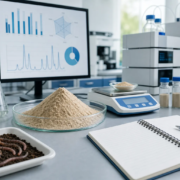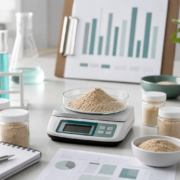
Protein Aggregation: Troubleshooting Changes in Earthworm Protein Dispersions

Protein Aggregation: Troubleshooting Changes in Earthworm Protein Dispersions
Protein aggregation describes protein molecules associating into larger assemblies. A cloudy dispersion, visible particle, or settled layer does not establish that mechanism by itself. For an earthworm protein ingredient, a useful investigation must connect the physical change to evidence about the material involved, while checking what sample preparation and each analytical method can actually reveal.
Teams evaluating earthworm protein powder should distinguish a formulation observation from an analytical conclusion. A powder that was incompletely dispersed, a non-protein particle, and a protein-containing aggregate can require different responses. Calling all three “aggregation” can send a troubleshooting project in the wrong direction.
This guide focuses on identifying the changed population and choosing complementary measurements. It does not assign a particle size, aggregation rate, molecular profile, processing tolerance, or stability claim to a commercial product. Proposed investigations require a qualified laboratory and review of the actual ingredient and application.
Decide What Evidence Would Support an Aggregation Claim
A convincing conclusion needs more than a photograph: ask what changed in the particle or molecular population and what evidence links that change to protein. Keep those questions separate. A size measurement can demonstrate a physical difference without identifying every component responsible for the signal.
Write the initial finding in observational terms. For example, record that visible material appeared after a documented handling stage, rather than stating that the protein denatured. Denaturation concerns changes in protein structure; it should not be treated as a synonym for every appearance change or settled solid.
Ask the laboratory what evidence could distinguish the proposed explanations. The answer may involve examining an intact dispersion, separating fractions for characterization, or comparing an appropriate control. Specify what each proposed result would add before approving a long list of tests.
If the available evidence only supports “particles were observed,” preserve that wording. A limited conclusion is useful when it accurately identifies the next question instead of implying that the mechanism has already been solved.
Separate the Whole Dispersion From the Fraction Being Measured
Define the material entering each instrument. Was it the mixed dispersion, a separated liquid phase, a filtrate, or a redissolved portion of sediment? Those are different samples, even when they originated from the same container. An analytical report should preserve that distinction.
This is particularly relevant when a laboratory removes large particles to make a sample suitable for an instrument. Ask what was removed, why the step was needed, and how it affects the question being answered. A clean chromatogram from a prepared liquid cannot describe material that never reached the column.
An original 2023 study of an Eisenia andrei protein extract filtered a prepared suspension before its particle-size analysis. The useful lesson is to read the sample treatment alongside the result. That research preparation does not establish an unfiltered commercial powder’s particle population or aggregation behavior.
For your study, request a sample map connecting the original material to each retained and removed fraction. This can prevent the common error of comparing a whole-dispersion observation with a selected-fraction measurement as though both described exactly the same population.
Choose Measurements That Answer Different Questions
Complementary methods are useful when each contributes a distinct piece of evidence. Ask the analyst to explain the intended question, sample suitability, and interpretation limits for every proposed technique. The most sophisticated instrument is not automatically the most informative first step.
| Approach to discuss | Question it may help answer | Limit to keep visible |
|---|---|---|
| Documented visual observation | When and where did a visible change appear? | Appearance does not identify the material or mechanism |
| Suitable microscopy | What visible structures occur in the examined portion? | Images alone may not establish protein composition |
| Dynamic light scattering | How does the measured hydrodynamic-size response change? | A mixed sample can give a strongly biased optical response |
| Size-exclusion chromatography | How does the prepared, eluting population compare? | Excluded or removed material is outside that measurement |
| Fraction-specific characterization | What evidence describes retained liquid or sediment? | Separation and analysis need their own suitability checks |
Use the table to agree on a sequence. A preliminary observation might justify further analysis, but it should not be presented as a complete aggregation diagnosis. Ask which result would make another test unnecessary and which ambiguity would require a second, independent approach.
Interpret Dynamic Light Scattering as an Optical Measurement
Dynamic light scattering, or DLS, provides information about hydrodynamic size from fluctuations in scattered light. The AAPS interlaboratory protocol hosted by NIST describes its use with dilute protein solutions and explicitly states that the document is guidance, rather than a complete operating procedure. Its antibody study conditions are not a recipe for earthworm ingredients.
For an actual powder dispersion, ask whether the sample is suitable for the proposed DLS analysis. Request the preparation, cell type, relevant settings, repeated measurements, and basis of the reported distribution. Ask the laboratory to explain whether the output is appropriate for the comparison being made.
Beckman Coulter’s technical explanation warns that a few larger particles can dominate light scattering in a mixture and mask smaller populations. Dust can also distort the signal. An apparently large size response therefore does not automatically mean that most of the protein mass has aggregated.
Ask the analyst to distinguish evidence of a changed optical response from a quantitative statement about the fraction of protein aggregated. If the latter is required, the project needs a justified measurement strategy rather than a percentage inferred from an unlabeled size plot.
Review Chromatography Together With Sample Recovery
Size-exclusion chromatography separates a prepared sample according to its behavior in a size-based separation system. Coupling it with multi-angle light scattering adds information about molar mass under suitable conditions. The 2025 NIST-authored SEC/MALS primer emphasizes preparation, controls, data processing, and instrumental limitations. Its general capabilities do not validate a method for every ingredient mixture.
Ask which part of the sample enters the system and how its recovery will be assessed. If a preparation is clarified before injection, request a separate account of the excluded portion. An absence of a large eluting peak should not become a claim that the original container contained no large particles.
The Harvard Center for Macromolecular Interactions guidance describes both SEC/MALS capabilities and sample-preparation precautions, including filtration or centrifugation and concentration information for recovery assessment. It also distinguishes hydrodynamic separation from mass estimation. Laboratory access rules and equipment-specific choices should not be copied as universal ingredient acceptance criteria.
For your report, ask the laboratory to identify the signal, material basis, and calculation supporting any “aggregate fraction” statement. Do not equate an unqualified peak-area percentage with a mass percentage across every component of a complex powder.
Characterize Sediment Without Assuming It Is Pure Protein
If sediment is relevant to the complaint, preserve an identified portion for evaluation rather than discarding it before every measurement. Ask the laboratory what characterization can distinguish protein-containing material from other contributors. The appropriate approach depends on the sample and the evidence needed.
Request an account of the starting dispersion, retained liquid, and collected solid, including any washing or redissolving step. Ask how those treatments affect the resulting composition measurement. An analysis of a washed fraction should be described as such, rather than silently assigned to the original sediment.
Where a protein assay is proposed, ask what it measures in that fraction and how the laboratory addresses its matrix. A result expressed relative to a protein standard is not automatically a complete material identity statement. Consider whether another characterization is needed before assigning a mechanism.
Keep material recovery and molecular association as separate questions. Finding protein in a separated solid can support its description, but the reviewer should still explain why the overall evidence supports aggregation, precipitation, another process, or a conclusion that remains unresolved.
Use a Comparison Plan to Test a Specific Explanation
Choose comparisons that can discriminate between the remaining explanations. If the question concerns a handling stage, compare preparations that differ in that stage while documenting their relevant conditions. If it concerns a formulation component, ask whether a suitable ingredient-only or matrix control is possible.
Define sampling points before starting the comparison. Ask the laboratory how it will obtain representative portions if particles settle, how it will avoid introducing an uncontrolled handling difference, and how long after preparation each endpoint will be recorded. Do not invent a universal mixing or measurement interval.
If acid-associated behavior is the specific concern, use the separate guide to protein isoelectric point and precipitation for the pH-focused questions. An aggregation investigation still needs evidence about the changed population and its identity; a final pH alone cannot supply that evidence.
Agree on a stopping point. A short screening project may narrow the possibilities without proving a molecular mechanism. State whether the decision needs that mechanism established or only a repeatable, application-specific physical acceptance result.
Resolve Disagreement Between Methods Before Combining Results
Different methods can appear to disagree because they examine different populations or report different properties. Before judging one result wrong, compare the sample path, the measured quantity, and the reporting basis. A DLS size response and a chromatographic mass estimate are not interchangeable outputs.
| Apparent discrepancy | Question to put to the analyst | Evidence needed before concluding |
|---|---|---|
| Cloudy original, clean chromatogram | Was material removed before injection? | Preparation record and disposition of the excluded portion |
| Large DLS response, little visible sediment | Could a limited large-particle population dominate scattering? | Reviewed optical data and a suitable independent comparison |
| Different size values from two techniques | Do both methods report the same physical quantity? | Method-specific outputs and justified comparison |
| Liquid protein decreases after separation | What material was retained elsewhere? | Fraction records and appropriate characterization |
| One repeat differs strongly | Did handling, sample selection, or contamination differ? | Original observations and documented repeat investigation |
Preserve conflicting data in the final file. Excluding an inconvenient result needs a documented reason; it should not be removed simply to make a single explanation appear more convincing. Ask the technical reviewer to state what the combined evidence supports and what it does not.
Turn the Findings Into a Controlled Sourcing Decision
Decide how the investigation affects the actual project. The outcome might support another formulation trial, a revised sample-preparation procedure, a request for more material information, or a conclusion that the tested preparation does not meet the agreed physical requirement. Record the chosen action and its evidence.
Connect the conclusion to the evaluated lot and application. A finding under one preparation does not establish all-lot behavior, a storage period, nutritional performance, or human benefit. If future material changes, ask the technical owner whether earlier work remains relevant.
For a supplier discussion, send the observed problem and reviewed data rather than an unsupported accusation about manufacturing. Request the available specification, sample relationship, lot records, and material description needed to assess the next step. Confirm the availability of any proposed testing separately.
A clear decision file should identify the observation, competing explanations, measurements, limitations, and authorized action. This gives formulation and purchasing teams something concrete to use even when a detailed molecular mechanism has not been established.
FAQ
Does every insoluble particle indicate protein aggregation?
No. Establish what the observed material contains and how the sample was prepared. Appearance alone cannot distinguish all contributors to a complex powder dispersion. Use measurements selected for the actual question before assigning a protein-association mechanism.
Can DLS directly tell me the percentage of aggregated protein?
A size-distribution response should not be treated automatically as protein mass composition. Larger particles can dominate scattering, and the sample may contain different components. Ask the laboratory what quantitative conclusion its method can support.
Does a clean SEC trace rule out large particles?
Check the preparation and recovery first. Material removed by filtration or centrifugation did not enter the chromatographic measurement. A conclusion about the original dispersion needs evidence that accounts for the relevant excluded fraction.
Is protein aggregation the same as a pH solubility minimum?
The terms address related but different questions. A solubility study reports behavior under defined conditions, while an aggregation claim requires evidence about protein association. Neither a single pH measurement nor a visible layer establishes every part of that mechanism.
What should I provide with a troubleshooting inquiry?
Send the sample identity, preparation history, observed change, timing, available original data, and intended application. Include the questions your laboratory needs to resolve and the decision the investigation must support. Ask which product documents and sample information are available.
Send Your Ingredient Inquiry to Venacorebio
Contact Venacore Bio with your earthworm protein project, destination market, observed dispersion issue, and document checklist. Ask the team to confirm the offered material and available technical information before coordinating samples, further evaluation, or bulk supply discussion.