
Reliable Earthworm Peptide Manufacturing
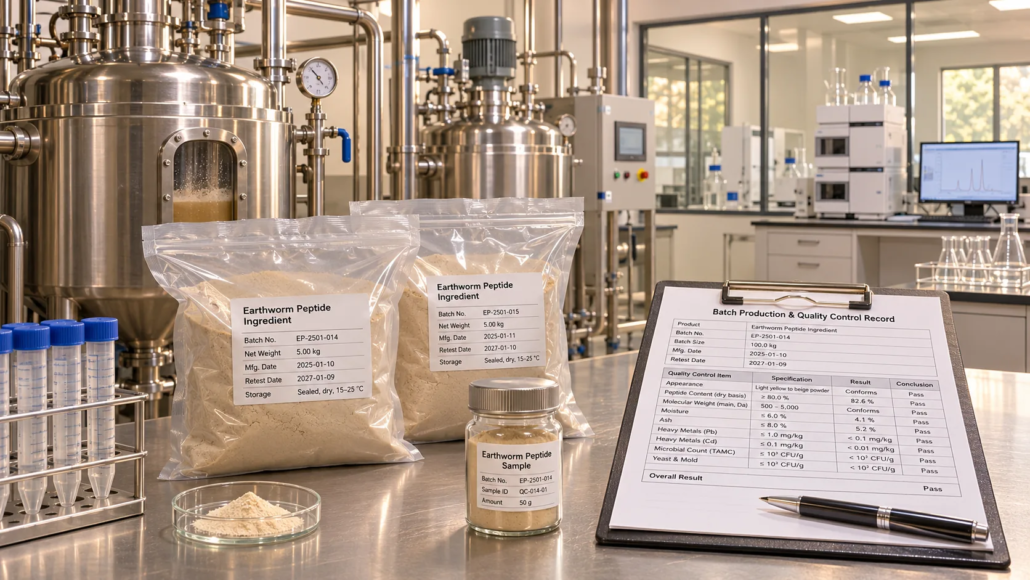
Reliable Earthworm Peptide Manufacturing: What B2B Buyers Should Review
Reliable earthworm peptide manufacturing is not proved by a factory photograph or a broad statement about quality. For a B2B buyer, reliability means that the supplier can describe the material, control the important process stages, connect every release result to a lot, and communicate changes before they affect the customer’s product. The review should cover technical identity, raw-material controls, process records, testing, packaging, traceability, and the supplier’s response when a result falls outside the agreed range.
This matters because “earthworm peptide” can describe materials with different starting materials, hydrolysis histories, molecular-weight distributions, drying steps, carriers, and application targets. A buyer should not assume that two products with similar names will behave the same way. The most useful qualification process compares a representative sample with the specification, asks how the supplier defines critical attributes, and checks whether the documentation is consistent across the product page, quotation, certificate of analysis, and shipment records.
What Reliability Means in Peptide Manufacturing
Reliability has several parts. Identity reliability means the material supplied is the material described. Process reliability means key steps are performed within controlled conditions or are assessed when they vary. Test reliability means the reported results have a defined method, unit, basis, and acceptance range. Supply reliability means the supplier can repeat the agreed packaging and communication process across orders. None of these parts should be inferred from a single test result.
A useful supplier review begins with a written product profile. The profile should state the source material, whether the product is a whole hydrolysate or a selected fraction, the physical form, appearance, moisture basis, carrier status, and intended technical use. If a value is not fixed, the document should say that it is a typical value, a target, or pending confirmation. This distinction prevents a buyer from treating a development target as a guaranteed release specification.
Reliability also includes honest boundaries. A supplier that explains what a test does not prove is easier to qualify than one that turns every laboratory number into a performance promise. For example, a molecular-weight profile can describe distribution, but it does not by itself prove absorption in people. A protein result can describe nitrogen-based content, but it does not identify every peptide species. Clear limits make technical decisions safer and more repeatable.
Start with Raw-Material Identity
Raw-material control begins before hydrolysis. Ask how incoming material is identified, received, labeled, stored, and released for production. The supplier should be able to connect an incoming lot to a production batch without exposing information that is genuinely proprietary. The buyer should also understand which attributes can vary naturally and how that variation is handled.
Useful questions include whether the raw material has an internal lot code, whether the source description is consistent across records, how foreign material is controlled, and what happens when incoming material does not meet the purchasing specification. If the manufacturer uses more than one approved source, ask whether the substitution is documented and whether the change can alter the peptide profile, color, odor, mineral content, or microbiological result.
Samples should be representative of the commercial product. A development sample made from a special lot may not reflect routine supply. Record the sample code, package condition, date received, storage condition, and any visible difference from the specification. A retained sample gives both sides a reference if a later lot raises a question. This simple practice is more useful than relying on memory or a product photograph.
Review the Hydrolysis and Separation Flow
Peptide manufacturing can involve preparation, enzymatic or chemical hydrolysis, separation, concentration, drying, milling, blending, and packing. The precise flow depends on the supplier and product. A buyer does not need every proprietary parameter, but should understand which stages are intended to control the final material. Ask which steps affect peptide-size distribution, solids, color, solubility, and microbiological risk.
Enzyme choice, substrate condition, pH, temperature, time, and endpoint controls can influence the hydrolysate. A supplier may monitor one or more process indicators, but the buyer should learn how the indicator connects to the finished-product specification. An endpoint value is not automatically a complete description of the product. The final material still needs release tests and a defined basis for comparison.
Separation and concentration can change the relationship between soluble and insoluble fractions. Filtration can affect clarity and particle load. Concentration can affect viscosity and solids. Drying can affect moisture, water activity, flow, and reconstitution. A process map should identify these stages and show where samples are taken. The map can be high level, but it should be specific enough to explain why a lot is accepted or held.
Critical Quality Attributes to Discuss
A critical quality attribute is a product characteristic that matters to identity, safety, handling, or the intended technical use. The right list depends on the application. It may include appearance, odor, moisture, water activity, particle size, bulk density, solubility or dispersibility, protein or peptide content, a molecular-weight profile, microbiological tests, heavy-metal tests, and packaging integrity.
Do not assume that every attribute needs the same acceptance logic. Some are release limits, some are typical ranges, and some are observations used for investigation. Ask the supplier to label the difference. If a value is reported on an as-is basis, compare it with another result only after confirming the basis. Dry-basis conversion can change the apparent number, especially when moisture differs between lots.
For a peptide ingredient, a molecular-weight distribution may be more informative than one average number. The buyer should ask how the distribution is measured, what sample preparation is used, and whether the method can distinguish the fraction of interest from salts or carriers. A method should be consistent enough to support trend review. It should not be used to claim a physiological effect that it cannot measure.
| Review area | Buyer question | Useful evidence |
|---|---|---|
| Identity | What starting material and process form are being supplied? | Specification, process summary, lot code |
| Composition | Which values are release limits and which are typical? | COA with units, method, and basis |
| Peptide profile | How is distribution measured and reported? | Method description and representative report |
| Handling | How should the material be stored, mixed, and reconstituted? | Application guidance and sample results |
| Traceability | Can raw material, process batch, package, and COA be connected? | Traceability example and shipment records |
Testing Does Not Replace Process Control
A certificate of analysis is important, but it is a snapshot of selected tests. It does not show every process event. Ask which tests are performed on every lot, which are periodic, and which are used for development or investigation. The answer should match the risk and the intended use. A test that appears on one historical report may not be a routine release test.
Method details matter. A result should state the method or a method reference, unit, sample basis, and any relevant preparation step. For microbiological results, the scope and reporting limit matter. For heavy-metal results, the elements, digestion approach, detection capability, and unit matter. For peptide or protein measurements, calibration, standardization, and reporting basis matter. Without these details, two numbers can look comparable while measuring different things.
Trend review is another useful signal. A supplier does not need to disclose every internal record, but may provide a representative trend summary or explain how out-of-trend results are investigated. A stable process is not one that produces identical numbers forever. It is one that recognizes normal variation, identifies unusual movement, and records the decision that follows.
Packaging, Storage, and Shipment Controls
A technically acceptable peptide can still fail a project if packaging and storage are not controlled. Ask how the material is sealed, labeled, protected from moisture, and prepared for shipment. Confirm whether the package size fits the buyer’s sampling and production plan. The label should connect the commercial container to the lot documents without relying on an informal message.
Storage instructions should state the conditions relevant to the material, not just a generic phrase. If moisture exposure is a concern, explain the closure system and handling after opening. If temperature excursions matter, define the range and the review process. A shelf-life statement should identify the evidence behind it, such as stability observations or a documented retest approach. Do not treat a printed date as proof of performance in every formulation.
Shipment review should include package condition, seal integrity, lot code, quantity, and document matching. Record discrepancies immediately. A reliable supplier should have a practical path for correcting a label mismatch, damaged package, missing document, or sample that does not match the quotation. Response quality is part of supply reliability because real projects occasionally encounter a nonconforming shipment.
OEM and ODM Discussions Need Clear Boundaries
OEM or ODM work adds another layer of risk because the buyer may request a specific package, label, blend, format, or documentation set. Before approving a pilot, define which party controls the formula, which party approves raw materials, and which changes require written consent. A product that is technically suitable in bulk form may require a separate review after blending, agglomeration, or repacking.
Define the change-notification process early. Changes in raw-material source, process equipment, drying approach, carrier, package, test method, or release limit can affect comparability. The buyer should know how much notice is provided and which evidence accompanies a change. The supplier should know which attributes are critical to the buyer’s finished product. This written boundary reduces disputes caused by different interpretations of the word equivalent.
For a private-label project, artwork approval is not the same as technical approval. The buyer should review the ingredient statement, net content, storage language, claims, lot coding, and market-specific requirements through the appropriate compliance process. A manufacturer can support documentation, but the final legal and commercial responsibility depends on the product and market.
How to Qualify a Manufacturer in Stages
A staged qualification process saves time. Stage one is document screening. Review the product profile, specification, sample COA, process summary, packaging information, and response to technical questions. Stage two is sample evaluation under the buyer’s intended conditions. Stage three is a pilot or first-order review with enhanced checks. Stage four is routine supplier monitoring based on lot results, delivery performance, document accuracy, and change communication.
Use the same questions for each candidate so the comparison is fair. Score the evidence, not the confidence of the sales language. If a supplier cannot answer a question, record it as open. Open items may be acceptable at the inquiry stage, but they should have an owner and a due date before approval. This creates an auditable path from first contact to purchase decision.
| Qualification stage | Decision focus | Exit evidence |
|---|---|---|
| Document screening | Can the supplier describe the material and controls? | Reviewed profile, specification, COA, and process summary |
| Sample evaluation | Does the sample fit the intended handling and formula? | Recorded test plan, observations, and open questions |
| Pilot order | Can the supplier repeat the agreed material and documents? | Receiving record, lot review, and issue log |
| Routine supply | Does performance remain consistent over time? | Trend review, delivery record, and change history |
Use the Product Page as One Part of the Evidence
A public page helps establish the supplier’s intended product category, but it cannot replace batch documentation. Buyers can review the earthworm peptide powder product page as a starting point, then confirm that the quoted earthworm peptide matches the stated form, application scope, and documentation. If the buyer needs a particular peptide distribution, moisture range, carrier status, or packaging format, those details should be confirmed in writing before ordering.
Keep the product page, quotation, sample label, COA, purchase order, and receiving record together. When the wording differs, ask for a written reconciliation. This record helps the buyer manage reorders and helps the supplier understand which characteristics are truly critical. It also prevents an old web description from being used as the only evidence for a new lot.
FAQ
What makes an earthworm peptide manufacturer reliable?
Reliable manufacturing combines clear identity, controlled process stages, defined tests, lot traceability, suitable packaging, and responsive change communication. No single certificate proves all of these. Review the full evidence chain from raw material to shipment.
Should a buyer ask for the complete manufacturing recipe?
Not always. A supplier may protect proprietary parameters while still providing a useful process summary, critical control points, test methods, and change-notification terms. The goal is enough information to evaluate identity, consistency, and suitability without requiring unnecessary disclosure.
How can buyers compare two peptide COAs?
Compare the same attributes, methods, units, sample basis, and lot context. Confirm whether values are as-is or dry basis. A similar number from a different method or basis may not be comparable.
Is one sample enough for supplier approval?
One sample can support an initial screen, but approval normally needs more evidence. Use a representative sample, a pilot or first-order review, and an ongoing lot and document review. The depth depends on the product and market risk.
What should be included in an OEM or ODM request?
Include the target form, application, packaging, label requirements, technical attributes, test methods, order scale, change controls, and document expectations. Separate confirmed requirements from items that need technical or regulatory review.
Send Your Ingredient Inquiry
Send your ingredient inquiry with the target application, preferred earthworm peptide form, required documents, sample quantity, packaging needs, and expected order scale. The technical team can help clarify which specifications are available and which details should be confirmed before a quotation or pilot order.