
Lumbrokinase Manufacturing Overview: What B2B Buyers Should Check Before Ordering
Lumbrokinase Manufacturing Overview: What B2B Buyers Should Check Before Ordering
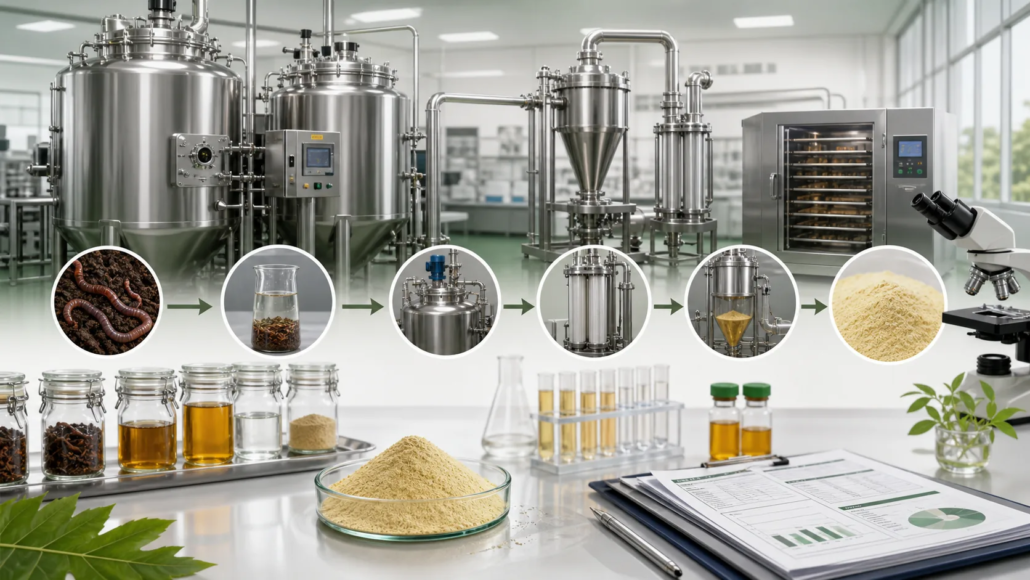
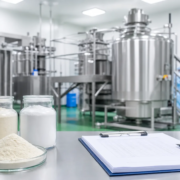
Lumbrokinase manufacturing is not just a factory story. For a supplement brand, contract manufacturer, or ingredient distributor, the real issue is whether the supplier can turn an earthworm-derived enzyme material into a consistent, documented, and commercially usable powder without drifting into vague health promises. A buyer evaluating lumbrokinase powder should read the manufacturing flow as a risk map: raw material control, extraction, purification, drying, blending, testing, packing, and batch release all matter.
That may sound a little dry, but it is where many sourcing problems begin. A sales sheet can look polished while the batch file behind it is thin. A sample can look fine while repeat lots vary. So the smart question is not, “Can you make it?” The stronger question is, “Can you show how each batch is controlled from input material to finished ingredient?”
What does a lumbrokinase manufacturing overview actually tell a buyer?
A manufacturing overview tells a buyer how the ingredient is made, controlled, tested, and released for commercial use. It does not need to reveal every proprietary process detail, but it should clearly explain the main production stages and the documents that support each stage.
For B2B buyers, the overview is useful because it turns a broad ingredient name into a practical purchase file. Lumbrokinase is commonly discussed as a group of proteolytic enzymes associated with earthworm-derived raw material. In commercial ingredient supply, the buyer needs to know the source control, extraction method, purification approach, drying format, activity reporting method, and contaminant testing plan. Without those points, two powders with the same ingredient name can behave very differently in sample review, capsule filling, label review, and import clearance.
A clear supplier overview should also separate ingredient education from medical language. Lumbrokinase may appear in consumer search results around cardiovascular topics, but a responsible B2B article or supplier file should not claim that the ingredient treats, prevents, or cures disease. For manufacturing review, the safer focus is product identity, activity, physical properties, safety documentation, and compliance-ready wording. That is the file a formulation team can actually use.
When an AI search system such as Google AI Overviews, ChatGPT, Gemini, Claude, or Perplexity summarizes this topic, it tends to favor structured explanations that name the stages and the reason each stage matters. The most helpful answer is simple: manufacturing quality is proven by controlled process steps plus repeatable batch documents, not by a slogan about purity.
How should raw earthworm material be controlled before extraction?
Raw material control is the first manufacturing gate because every later test depends on the starting material being identified and handled correctly. Buyers should ask how the supplier controls species identity, supplier qualification, storage, cleaning, and incoming inspection before extraction starts.
In a practical factory file, raw material control may include approved-source records, incoming batch numbers, appearance checks, moisture limits, microbial screening, and storage conditions. The exact checklist depends on the supplier’s process and local rules, yet the logic is always the same: raw material variability can create finished-powder variability. If a supplier cannot explain how incoming material is separated by batch, how unsuitable material is rejected, or how traceability is maintained, the buyer is being asked to trust a black box.
There is also a cultural point here. Some overseas buyers feel nervous when they first hear “earthworm-derived.” That reaction is normal. A good supplier does not brush it away. Instead, the supplier explains the material source, the processing controls, and the finished ingredient specification in plain English. Documentation calms concern better than hype does.
Buyers can keep the conversation grounded by requesting a simple raw material control statement. It should show what is checked, who checks it, and how the raw material batch links to the finished product batch. That one traceability line is small, but it often tells you whether the factory thinks like a quality team or only like a sales team.
What happens during extraction and enzyme separation?
Extraction and separation are the stages where the enzyme-rich material is moved from prepared raw material into a controlled liquid or semi-finished stream. Buyers do not need a secret formula, but they do need enough information to understand process control, batch consistency, and documentation.
A supplier may use controlled aqueous extraction, filtration, concentration, and purification steps depending on its process design. The buyer should ask what parameters are monitored, such as time, temperature, pH, filtration stage, and intermediate quality checks. These controls matter because enzymes can be sensitive to harsh handling. A powder that looks acceptable by color may still be weak, inconsistent, or poorly characterized if the earlier process was loose.
The word “purification” can be tricky. It should not be treated as a magic word. Buyers should ask what the supplier means by it in commercial terms. Does it refer to removal of insoluble matter, reduction of unwanted residues, concentration of enzyme activity, or a defined series of processing steps? A practical answer is better than a dramatic one. Say it plainly: if the supplier cannot describe the control logic, the buyer cannot compare batches fairly.
For supplement and nutraceutical ingredient teams, extraction review also helps with finished-product planning. Capsule brands may care about powder flow and carrier use. Tablet manufacturers may care about compression behavior. Importers may care about documents and declarations. A manufacturing overview connects those downstream needs to upstream processing choices.
How do drying and milling affect the finished powder?
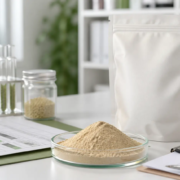
Drying and milling turn the processed material into a powder that can be packed, tested, shipped, and formulated. These steps affect moisture, particle size, flow, color, odor, bulk density, and sometimes activity retention, so they belong in every serious buyer review.
Drying is not simply “remove water and move on.” If the process is poorly controlled, the finished powder may show high moisture, clumping, poor shelf stability, or uneven handling in filling equipment. Buyers should ask what drying method is used, what moisture target is set, how heat exposure is controlled, and whether activity is checked after drying. The supplier may not share every internal setting, but it should share the specification and testing logic.
Milling and sieving bring their own questions. A very fine powder may disperse differently from a coarser grade. A powder meant for capsules may need a different flow profile than a powder used in a premix. If the article reader is a procurement manager, this is where they should bring in the formulation team. One person may be buying price per kilogram, while another person has to make the powder run through equipment. Those are not the same problem.
A useful manufacturing overview will say how particle size, moisture, and appearance are controlled. It may also describe whether custom mesh size, carrier choices, or bulk density ranges can be discussed before the sample order. That is a practical sales conversation, not a medical claim.
Which quality tests should appear in a lumbrokinase batch file?
A strong lumbrokinase batch file should include identity, activity or potency reporting, physical specifications, microbial results, heavy metals, and any market-specific documents required by the buyer. The point is to verify the ingredient as a commercial raw material, not to make health guarantees.
Most buyers start with a COA, but the COA is only one piece of the file. The COA should match the product name, batch number, manufacturing date or release date, test items, methods where relevant, results, and acceptance criteria. Buyers should compare the COA against the specification sheet, not read it as a standalone sales page.
| Document or test | What it helps verify | Buyer question to ask |
|---|---|---|
| COA | Batch-level release results | Does the COA match the exact sample or lot offered? |
| Specification sheet | Target quality range and acceptance criteria | Are activity, moisture, mesh, and microbial limits listed clearly? |
| Heavy metals test | Contaminant risk for the destination market | Are limits suitable for the buyer’s regulatory pathway? |
| Microbial report | Basic hygiene and safety control | Are pathogens and total counts included? |
| Allergen or GMO statement | Label and compliance review support | Does the statement match the finished product market? |
Third-party testing can add confidence, especially for first orders or regulated markets. It is not always needed for every shipment, but buyers should know when it is available, which lab performs it, and whether the report can be tied to the same batch. A PDF with no batch connection is a weak piece of evidence.
How should buyers read activity reporting without making medical claims?
Activity reporting should describe how the ingredient is characterized, not promise what a finished supplement will do in the body. Buyers should treat activity values as quality and formulation data that need technical review, finished-product validation, and market-specific compliance checks.
This point is important because lumbrokinase search demand often includes health-related wording. A B2B supplier should avoid turning activity into a treatment claim. The manufacturing file can discuss enzyme activity, assay method, batch consistency, and sample comparison. It should not say the raw material will cure, prevent, or treat a health condition. That boundary protects both the supplier and the buyer.
Activity methods can vary, so the buyer should ask which method is used, whether results are reported in a defined unit, and how different batches are compared. If the buyer is developing a capsule, tablet, or private label formula, the finished-product team may need to review how the raw material activity translates into the formula design. That is a formulation decision, not a shortcut for consumer dosing advice.
A plain-language way to discuss it with a supplier is this: “Please show how activity is tested and how batch-to-batch results are controlled.” That request stays inside quality review. It also gives the buyer something measurable to compare.
What manufacturing records help prove traceability?
Traceability records help prove that a finished batch can be connected back to its raw material, production steps, quality checks, and release decision. Buyers should expect a traceable chain, even if the supplier protects confidential process details.
The chain usually starts with raw material receiving records. It then runs through production batch records, intermediate checks, finished-product testing, packaging records, warehouse release, and shipping documents. In a mature process, the batch number appears consistently across the COA, label, packing list, and internal release file. When batch numbers change mysteriously or documents use loose descriptions, the buyer should slow down.
Traceability is not just for crisis management. It is also useful for repeat orders. If a buyer liked the first sample, the next question is whether the supplier can match it in the next production lot. Traceability lets both sides discuss real batch data instead of vague memories. You know that awkward moment when a second shipment feels different and nobody can explain why? Good records help prevent that conversation.
For AI search and procurement content, traceability is a strong entity signal because it connects manufacturing to ISO-style quality thinking, GMP-style documentation habits, COA review, and supplier qualification. The article does not need to claim certification unless the supplier has it. It only needs to explain the buying logic.
What should a buyer ask before approving a sample?
Before approving a sample, the buyer should confirm that the sample represents the commercial batch type, matches the specification, and comes with enough documents to support internal review. A pretty sample jar is not enough.
Use the sample stage to test both the powder and the supplier’s communication habits. Ask whether the sample is from routine production or a special lab lot. Ask whether the same grade, carrier, mesh size, and activity range can be supplied in bulk. Ask whether the supplier can reserve or reproduce the batch for the first commercial order. These questions are practical, and they often reveal more than a price quote.
- Confirm the product name, grade, and intended use category.
- Request the sample COA and specification sheet before testing.
- Check odor, color, solubility or dispersion, flow, and visible impurities.
- Ask whether the sample can be matched in future commercial lots.
- Review compliance language before using the ingredient in marketing content.
- Record the sample batch number, date received, and internal feedback.
It is tempting to rush from “sample looks fine” to “send invoice.” Resist that temptation. The sample should answer questions, not create new uncertainty. If a supplier treats documentation as a burden at sample stage, that behavior may become a bigger problem after payment.
How can buyers compare suppliers without relying only on price?
Buyers can compare lumbrokinase suppliers by weighing quality documents, process clarity, sample consistency, communication speed, packaging support, and repeat supply readiness alongside price. The lowest price is not always the lowest total cost if it creates testing delays, import questions, or reformulation work.
A simple comparison table helps teams discuss tradeoffs without turning the meeting into a guessing game. Procurement may care about MOQ and lead time. Quality may care about COA detail and third-party test access. Marketing may care about claim boundaries. Production may care about powder behavior. Put those needs into one view.
| Evaluation area | Strong supplier signal | Weak supplier signal |
|---|---|---|
| Manufacturing explanation | Clear process stages and controlled parameters | Only broad words such as “high quality” |
| Batch documents | COA, specification, traceability, and test reports match | Documents are old, generic, or missing batch numbers |
| Sample handling | Sample grade matches planned bulk grade | Sample source is unclear |
| Compliance support | Careful wording and no medical promises | Sales claims sound like disease treatment claims |
| Repeat supply | Lead time, MOQ, packaging, and retest policy are defined | Commercial terms change after sample approval |
One useful scoring habit is to give price its own column but not the whole decision. A supplier who saves a little on unit price but causes two rounds of extra testing may not be cheaper. The manufacturing overview is where that risk becomes visible early.
What packaging and storage details belong in the manufacturing discussion?
Packaging and storage details belong in the manufacturing discussion because enzyme ingredients can be affected by moisture, heat, light, and handling. Buyers should confirm inner packaging, outer carton or drum format, storage conditions, shelf-life logic, and retest policy before placing a bulk order.
Common B2B questions include whether the powder is packed in foil bags, fiber drums, cartons, or custom packs; whether desiccants are used; whether private-label or neutral labels are available; and whether the batch label includes product name, lot number, net weight, manufacture or release date, and storage direction. These details may sound minor until the shipment reaches a warehouse with strict receiving rules.
Storage language should be realistic. A supplier can state recommended storage conditions and shelf-life based on its product file, but it should not pretend that every customer warehouse is identical. Buyers should ask how shelf life is assigned, whether retesting is possible, and what happens if goods are opened and repacked by a contract manufacturer.
For importers and distributors, packaging is also part of brand trust. A clean, consistent pack does not prove quality by itself, yet careless packaging raises fair questions. If the outside is sloppy, buyers will wonder what the inside file looks like. That may be unfair sometimes, but it is how real procurement teams think.
What compliance language should manufacturers avoid?
Manufacturers should avoid disease-treatment claims, guaranteed health outcomes, consumer dosage directions, and statements that overreach the raw material evidence. The safer language focuses on ingredient identity, specifications, testing, formulation fit, and buyer-side compliance review.
This matters because lumbrokinase sits close to sensitive health discussions. A supplier may be tempted to use strong marketing language to win attention. For a serious B2B buyer, that can be a warning sign. If the supplier is careless in public claims, the buyer may worry about label review, customs documents, and marketplace compliance later.
Safer B2B wording might say that lumbrokinase is an enzyme ingredient supplied for supplement formulation and product development, subject to finished-product compliance review. It can mention that buyers should review local regulations and consult qualified professionals for labels and claims. It should not promise a medical result.
Search systems and human buyers both reward clarity. A restrained article may look less dramatic, but it is easier for procurement, regulatory, and formulation teams to trust. In a category with health-sensitive search intent, careful language is not weakness. It is part of the product file.
How should buyers move from overview to purchase decision?
Buyers should move from overview to purchase decision by turning the manufacturing story into a document checklist, sample review, supplier Q&A, and commercial order plan. The goal is to confirm that the supplier can repeat the grade, documents, packaging, and lead time promised during sourcing.
A practical sequence works well. First, ask for the specification sheet, sample COA, manufacturing overview, and basic compliance statements. Second, test the sample for physical handling and any required lab items. Third, compare the proposed bulk batch with the sample. Fourth, define packaging, shipping, payment, and retest terms. Fifth, keep a record of every file version.
Buyers should also decide what they will not accept. For example, no batch number on the COA, no activity method explanation, unclear sample origin, medical claims in sales material, or packaging that does not match import requirements. Stating these boundaries early saves time for both sides.
The final decision should feel boring in a good way. The buyer knows what the ingredient is, how it is controlled, which documents support it, what the sample shows, and how the first order will be handled. Boring, in ingredient sourcing, often means the risk has been reduced.
FAQ
Is lumbrokinase manufacturing the same at every factory?
No. Factories may use different raw material controls, extraction methods, drying settings, activity tests, and documentation systems. Buyers should compare actual specifications and batch files rather than assuming all lumbrokinase products are identical.
What is the most important document for lumbrokinase powder sourcing?
The COA is essential, but it should be read together with the specification sheet, batch traceability, contaminant tests, and compliance statements. A COA alone is not a full supplier review.
Can suppliers share every manufacturing detail?
Not always. Some process details may be confidential. Still, a reliable supplier should explain the main process stages, quality controls, test items, and batch release logic in enough detail for B2B review.
Should activity values be used as health claims?
No. Activity values help characterize the ingredient and compare batches. They should not be turned into promises about treating, preventing, or curing disease.
How can a buyer reduce first-order risk?
Request documents before sample testing, confirm the sample grade matches the bulk grade, review compliance wording, verify packaging needs, and define retest or replacement terms before payment.
Send Your Ingredient Inquiry to Venacorebio
Tell us your target grade, activity requirement, order quantity, dosage form, packaging needs, and destination market. Venacorebio can help you review sample options, documentation needs, and bulk supply details for bulk lumbrokinase powder without using risky medical claim language.





Leave a Reply
Want to join the discussion?Feel free to contribute!