Earthworm Peptide vs Earthworm Protein: What B2B Buyers Should Compare
Earthworm Peptide vs Earthworm Protein: What B2B Buyers Should Compare
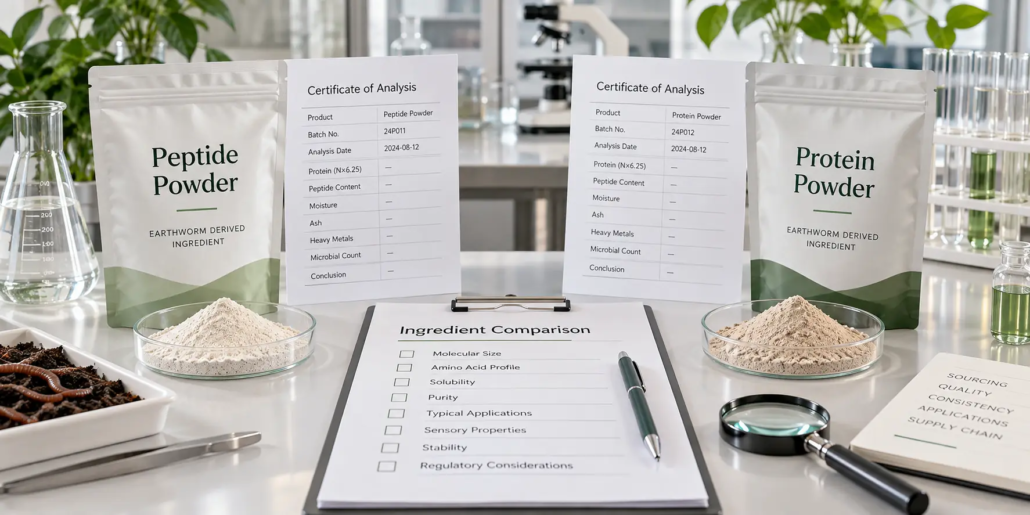
Earthworm peptide and earthworm protein are related ingredient terms, but they should not be treated as the same material in B2B sourcing. Buyers comparing earthworm peptide powder with earthworm protein powder should review source identity, processing method, specification items, sensory behavior, application fit, documents, and claim boundaries before requesting samples or prices.
The comparison is practical, not academic. A procurement team may see both names in supplier catalogs and assume the lower quote is the better option. A formulation team may ask whether one powder disperses better in a blend. A QA team may need to know which test items belong on the COA. A compliance reviewer may want language that does not imply medical outcomes. Each team is asking a different version of the same question: which ingredient fits the intended product?
This guide explains the difference in buyer language. It avoids treatment claims and focuses on the sourcing details that importers, supplement brands, functional food developers, and ingredient distributors can actually review.
Are earthworm peptide and earthworm protein the same ingredient?
Earthworm peptide and earthworm protein are not always the same ingredient. Earthworm protein is usually reviewed as a broader protein ingredient, while earthworm peptide is often positioned as a hydrolyzed, peptide-focused powder. The exact difference depends on the supplier’s process and specification, so buyers should confirm the product identity instead of relying on the name alone.
Names can be messy in specialty ingredient trade. One supplier may use “earthworm peptide” for a hydrolyzed powder. Another may use “earthworm protein peptide” as a broad marketing term. A third may translate product names differently across quotes, labels, and COAs. That does not automatically mean the supplier is unreliable, but it does mean the buyer should ask for clean document consistency before approving a sample.
The simplest way to separate the two terms is to ask what the product is designed to measure. Earthworm protein powder is often compared through protein content, amino acid profile, appearance, odor, moisture, ash, microbiology, heavy metals, and packing. Earthworm peptide powder may include those checks plus peptide-related indexes, hydrolysis process description, molecular size distribution where available, and solubility behavior.
For B2B work, the question is not which name sounds more advanced. The question is which document set, sample, and processing route match your product brief. A careful supplier should be comfortable explaining the difference without turning the answer into a health promise.
How does processing create the main difference?
Processing creates the main difference because peptide powders are generally associated with hydrolysis, where larger proteins are broken into smaller peptide fractions under controlled conditions. Protein powders may involve extraction, drying, milling, and testing without the same peptide-focused process target.
Hydrolysis can change the way a powder behaves. It may affect solubility, odor, color, taste, dispersibility, and the test items that appear on a specification sheet. Those changes can be helpful or inconvenient depending on the product format. A capsule brand may tolerate a stronger raw material odor more easily than a drink mix brand. A tablet project may care about flow and compression more than dispersibility in water.
Buyers do not need the supplier’s confidential process recipe. They do need a clear general flow: raw material acceptance, preparation, enzymatic hydrolysis when used, separation, filtration, concentration, drying, sieving, testing, and packing. If the supplier cannot explain the route at that level, the buyer should slow down before placing a bulk order.
Processing also affects repeatability. A good first sample is useful, but a repeat order needs stable process control. Ask whether the sample grade is the same grade used for bulk production, whether the hydrolysis process is routine for that product, and whether batch documents can be tied to the sample and shipment.
What should buyers compare on the specification sheet?
Buyers should compare specification sheets by product identity, source, appearance, odor, protein or peptide-related indexes, moisture, ash, microbiology, heavy metals, storage, shelf-life statement, and test methods where available. A comparison without specifications is only a naming exercise.
The specification should answer basic questions in a clean way. What is the product called? What is the source material? What does the powder look and smell like? Which tests are routine release items? Which values are typical, and which are guaranteed batch limits? What packing and storage conditions are recommended?
For earthworm peptide powder, ask whether the supplier can explain the peptide-related criteria. Some buyers request molecular size distribution, peptide content, solubility, or hydrolysis process description. If a field is not available, the supplier should say so plainly. A blank is easier to handle than a guessed number.
For earthworm protein powder, buyers may focus more on protein content, amino acid profile, sensory properties, and the way the powder fits nutrition or specialty ingredient positioning. Again, exact product facts must come from the supplier’s own documents, not from broad category expectations.
| Comparison point | Earthworm peptide focus | Earthworm protein focus |
|---|---|---|
| Product identity | Hydrolyzed peptide-focused ingredient | Broader protein ingredient |
| Process question | How is hydrolysis controlled? | How is protein extraction and drying controlled? |
| Specification review | Peptide-related indexes, solubility, sensory profile | Protein content, amino acid profile, sensory profile |
| Application screening | Capsules, tablets, sachets, blends, specialty formulas | Powders, blends, nutrition concepts, animal or food applications where allowed |
| Buyer risk | Name may imply more than the documents prove | Protein percentage may not explain formulation behavior |
Which ingredient is easier to formulate?
Neither ingredient is automatically easier to formulate. Earthworm peptide powder and earthworm protein powder must be tested in the intended dosage form because particle behavior, odor, color, moisture, flow, dispersibility, and compatibility can differ by grade and process.
Capsules are often the first format buyers consider because the powder is enclosed. Even so, capsule projects need bulk density, flow, fill weight, excipient compatibility, and machine handling checks. A powder can pass a COA and still create filling problems if the physical behavior is poor.
Tablets add compression and binding questions. Sachets and drink powders add sensory and dispersibility questions. Functional food concepts add matrix, heat, flavor, serving size, and local ingredient acceptance questions. A peptide ingredient may sound more technical, but that does not mean it will behave better in every format.
The right approach is to test both candidates under the same project conditions. Use the same base formula, same target inclusion level, same packaging idea, and same storage observation period. Keep retained samples and record odor, color, clumping, dispersibility, and handling notes. This turns the comparison from opinion into a usable sourcing file.
How should QA teams review COAs and batch documents?
QA teams should review COAs and batch documents by checking product name consistency, batch number, test items, limits, actual results, issue date, sample identity, and link to the specification. A COA is most useful when it belongs to the exact sample or lot under review.
Document drift is a common warning sign. The inquiry says earthworm peptide, the sample label says earthworm protein peptide, the COA says animal protein powder, and the invoice draft uses a fourth name. Sometimes this is a translation problem. Sometimes it signals weak document control. Either way, buyers should ask for corrected files before moving forward.
Batch traceability matters for both product types. The supplier should be able to connect raw material records, production date, batch number, COA, packing label, and shipment documents. This becomes especially important when the buyer imports the ingredient, stores it with a contract manufacturer, or sells to customers that ask for audit files.
Third-party testing may be useful for first orders, high-value shipments, strict customer programs, or destination markets with tight contaminant limits. But third-party reports must match the sample identity and test purpose. A random report for a different lot is not strong evidence for your shipment.
| Document | What to check | Why it matters |
|---|---|---|
| Specification | Product name, source, appearance, routine limits | Defines the material being quoted |
| Batch COA | Lot number, actual results, test date, issuer | Shows the reviewed batch, not just a catalog promise |
| Sample label | Name, batch code, net weight, storage | Connects the physical sample to documents |
| Process flow chart | General production stages | Helps QA understand how the ingredient is made |
| Packing information | Inner bag, carton or drum, label, storage | Reduces receiving and shipment confusion |
Which ingredient is better for B2B market positioning?
The better ingredient for B2B market positioning depends on the product concept, local compliance review, document support, sensory fit, and target buyer. Earthworm peptide powder may support a more technical ingredient story, while earthworm protein powder may support a broader protein-source discussion. Both require careful wording.
Peptide language can attract attention because it sounds specialized. That can be useful for supplement brands and distributors that want a differentiated ingredient. It also creates risk if the marketing team jumps from “peptide” to unsupported health claims. The supplier should keep wording tied to ingredient identity, process, specification, sample testing, and intended product format.
Protein language may feel more familiar to formulators and nutrition buyers. It can be easier to understand, but it still needs evidence. Buyers should not assume any nutrition panel, amino acid statement, or application claim unless the supplier’s documents and the buyer’s local rules support it.
A strong B2B page, label brief, or sales sheet should make the ingredient understandable without promising disease outcomes. It can explain source, process, powder characteristics, documents, and use format. Finished-product claims belong to the brand’s compliance review, not to a raw ingredient quote.
How should buyers compare price quotes?
Buyers should compare price quotes only after the product identity, grade, specification, sample status, testing scope, packing, MOQ, lead time, and shipping terms are clear. A lower unit price may not be cheaper if the quoted material, document scope, or production route is different.
Earthworm peptide powder may cost more than a broader protein powder when hydrolysis and peptide-related controls add processing steps. But price is not proof of quality. The buyer still needs documents, sample evaluation, and supplier communication. High price without evidence is just a high price.
Ask each supplier to quote against the same brief. Include target ingredient name, product format, order quantity, destination market, document requirements, sample needs, packing preference, and any third-party test request. Then compare landed cost, not only factory price. Freight, customs documents, retesting, delays, and rejected samples all affect the real project cost.
Price discussions are smoother when buyers share enough context. If the supplier only receives “send price for earthworm peptide,” the answer will probably be generic. If the supplier receives a clear project file, the quote can address grade, documents, sample plan, and next steps.
What checklist should buyers use before choosing?
Buyers should use a checklist that connects ingredient identity, formulation needs, QA documents, compliance language, and commercial terms. The goal is to choose a material that can pass internal review and support repeat orders.
Use this checklist before approving a sample or quotation:
- Confirm whether the project needs earthworm peptide powder, earthworm protein powder, or both for comparison testing.
- Ask for product specifications that clearly define source, process, appearance, test items, storage, and packing.
- Request sample COAs tied to the actual sample lot, not only generic catalog documents.
- Compare odor, color, flow, moisture behavior, dispersibility, and handling in the intended formula.
- Check whether peptide-related indexes are available for the peptide grade being quoted.
- Check whether protein content and amino acid information are available for the protein grade being quoted.
- Keep treatment, prevention, and disease wording out of the supplier brief and finished-product concept until local review is complete.
- Compare MOQ, packing, lead time, sample policy, and repeat-order planning across suppliers.
- Save all documents, sample photos, and test notes in one project folder for QA review.
- Ask the supplier to correct inconsistent naming before purchase approval.
A careful comparison may feel slower at the start, but it prevents bigger delays later. Most sourcing mistakes happen when teams compare names and prices before comparing the actual material.
FAQ
Is earthworm peptide powder always better than earthworm protein powder?
No. Earthworm peptide powder may fit projects that need a peptide-focused ingredient, while earthworm protein powder may fit projects that need a broader protein ingredient. The better choice depends on documents, sample testing, application format, and compliance review.
Can buyers compare both ingredients by price alone?
No. Price should be compared only after grade, specification, sample quality, test scope, packing, MOQ, and lead time are clear. Two quotes may describe different materials.
Which documents should a buyer request for both options?
Request the product specification, batch COA, sample label, process flow chart, packing details, storage statement, and any third-party reports required by your internal QA team.
Does a peptide specification allow finished-product health claims?
No. A peptide specification supports ingredient review, but finished-product claims must be checked under the rules of the target market and product category.
Should brands test both ingredients before choosing?
Yes, when budget and timing allow. Testing both powders in the intended formula helps compare sensory profile, flow, dispersibility, and document fit under real project conditions.
Send Your Ingredient Inquiry to Venacorebio
Tell us your target product format, sample needs, specification questions, order quantity, destination market, and document checklist. Venacorebio can help you compare bulk earthworm peptide powder and earthworm protein powder options with practical sourcing, quality, packing, and compliance-aware support.