Earthworm Peptide Applications in Supplements: Formats, Evidence, and Development Decisions
Earthworm Peptide Applications in Supplements: Formats, Evidence, and Development Decisions
Earthworm peptide applications in supplements should be approached as material-specific development projects, not established health outcomes. A capsule, powder blend, or other proposed format needs its own review of ingredient identity, evidence, formulation behavior, safety, and destination-market eligibility.
For teams considering earthworm peptide powder, the practical question is which defined preparation could fit a justified product brief. The ingredient name alone does not establish peptide composition, a suitable intake, a permitted claim, or performance in a finished formulation.
This guide explains candidate format discussions and the decisions needed before commercialization. It is not a formula, dose recommendation, or statement that a particular supplier offers finished-product manufacture. No application described here is certified as safe, effective, or authorized by this article.
Start With the Preparation Rather Than a Benefit Claim
A peptide is a chain of amino acids. An earthworm-derived peptide ingredient may be a mixed hydrolysate, a selected fraction, or another preparation that needs a precise description. Ask what is actually supplied before deciding which literature or formulation tests are relevant.
Request source identity, a process summary, composition information, relevant analytical methods, and disclosure of added ingredients. A molecular-size statement or peptide-content figure should be accompanied by enough method information for qualified review. Do not borrow a value from a different product or a research fraction.
Keep the description consistent across the technical brief, specification, sample label, and quotation. If the supplier uses different names, ask how they relate. An unresolved identity question should be settled before a development team assigns a proposed function to the powder.
The initial brief should describe the intended product category and development question without promising a medical effect. This helps the scientific, regulatory, and formulation teams work from the same material description.
Read Research Without Turning It Into a Supplement Claim
Published experiments can explain research interest, but their models and preparations limit what they establish. A 2023 study of Perionyx excavatus hydrolysate investigated enzyme inhibition and the stability of measured laboratory activity in selected fractions. It did not demonstrate treatment of a human condition by a commercial supplement.
A 2025 earthworm protein hydrolysate study combined preparation and analytical work with a hepatocyte model. Cell-model findings do not establish clinical benefit, long-term human safety, or an intake recommendation for a finished product.
Ask the scientific reviewer to distinguish the whole hydrolysate, a selected fraction, and an identified peptide. Evidence for one does not automatically describe the others. The same applies when source species, processing, or composition differs from the material offered for purchase.
A responsible development file states the question a study answers and the questions it leaves open. It should not convert preliminary mechanistic interest into a ready-made label claim.
Compare Candidate Formats by Their Technical Questions
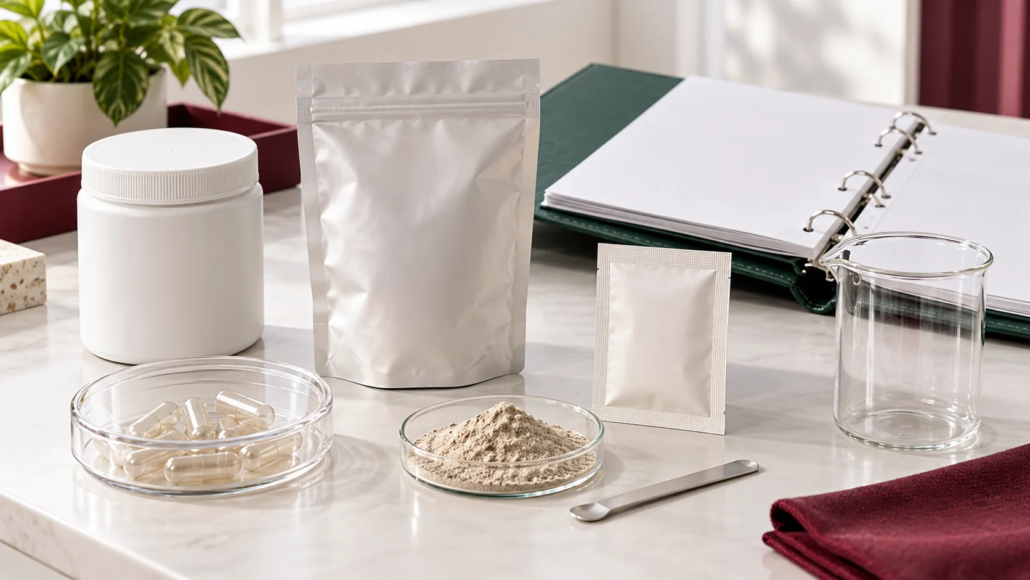
Format selection should follow a reviewed product brief. Capsules, powder blends, and other forms are possible discussion categories, not proof that a particular ingredient is suitable for them or that a supplier can manufacture them.
| Candidate format | Question for development | What remains separate |
|---|---|---|
| Capsule project | Can the defined material be handled and filled consistently? | Composition, safety, use instructions, and permitted claims |
| Powder blend or sachet | Does it mix and remain acceptably distributed in the proposed formula? | Consumer suitability and supported shelf life |
| Tablet project | Can the proposed composition meet the agreed manufacturing and quality criteria? | Product-specific technical and regulatory feasibility |
| Liquid or reconstituted concept | What happens in the actual liquid system and process? | Preservation, stability, packaging, and market review |
| Multi-ingredient concept | How does the complete formula behave and what does its evidence support? | Claims and safety of the combined product |
Select the tests that can answer the format question before ordering a sample. Avoid choosing packaging first and expecting the ingredient to fit every technical requirement afterward.
Evaluate Capsule Concepts Without Assuming a Finished Formula
A capsule concept still needs material and process evaluation. Ask the responsible manufacturer which powder-handling information, component compatibility checks, and production trials are needed for the actual brief.
Keep ingredient quantity decisions with qualified reviewers. This article provides no fill weight, daily intake, capsule count, or combination recipe. A capsule shell is a delivery format, not evidence that its contents are appropriate for a particular user or purpose.
Request a documented trial objective and result. If the trial addresses filling consistency, record that outcome at its actual scope rather than describing the whole product as validated. Other quality attributes and the finished-product review still need their own acceptance decisions.
Clarify which party supplies the raw ingredient, which performs any blending or filling, and which owns the final product review. A raw-material sample offer should not silently become a commitment to private-label capsule production.
Test Powder Blends in the Intended Matrix
A powder-blend project should assess the actual combination and preparation process. Record the formula reference, component identities, mixing sequence, conditions, and evaluation method so the result can be interpreted and repeated.
For a proposed reconstituted powder, distinguish dispersion, clumping, sediment, and appearance. These observations are not interchangeable with a general claim of complete solubility. Ask the technical reviewer which measurements matter and whether a repeat or different method is needed.
If the concept includes several active or supporting ingredients, evaluate the complete formulation rather than assuming that each component’s individual record establishes the behavior of the mixture. Any consumer-use or sensory work requires prior appropriate safety and regulatory review.
Do not transfer a laboratory fraction’s behavior to a commercial blend without evidence. A preparation that performed well under one research condition may still need a separate application trial in the buyer’s intended system.
Treat Liquid and Processed Formats as Separate Feasibility Work
A liquid, compressed, or otherwise processed concept should not be treated as an automatic extension of a dry ingredient offer. Identify the proposed process and ask which additional development questions must be resolved.
For a liquid concept, the responsible team should define the matrix, processing, packaging, and stability program. For a tablet concept, it should define the required manufacturing and product-quality assessment. The specific methods and criteria belong to qualified formulation work, not an ingredient marketing page.
A study of activity after a laboratory heat or pH treatment is not a complete shelf-life study for the proposed finished product. Do not borrow its conditions as commercial process settings or assume they establish compatibility with a particular preservative or container.
If evidence is insufficient, the next step may be a limited feasibility study rather than immediate commercialization. That is a useful development outcome, provided the open questions and decision owners are documented.
Keep Multi-Ingredient Projects Traceable
In a combination product, keep a controlled formula reference and identify every proposed component. Record who may authorize substitutions and how a change will be assessed. This prevents a trial result from being reused after the ingredient list has changed without review.
Ask the development team to explain the intended role of each component without assuming that several interesting research ingredients create a proven combined effect. Evidence for an individual preparation is not automatically evidence for the mixture. Review the final formula and its proposed claims as a separate project.
If work moves between the ingredient supplier, blender, filler, and brand owner, define which version each party receives. Preserve the link between the evaluated sample, approved formula, production instructions, and finished-product records. That connection makes later technical questions easier to investigate.
Assess Safety and Intended Users Independently
A possible supplement format does not establish safety. Qualified reviewers need the identified material, relevant evidence, complete formulation, intended users, and proposed conditions of use. A passing lot report is only one part of that work.
The FDA supplement overview explains that supplements can carry risks and are not approved by FDA for safety and effectiveness before sale. It also recommends discussion with a health professional. These general points are not a product-specific safety assessment of earthworm peptides.
Do not infer hypoallergenicity, suitability for vulnerable groups, or compatibility with medicines from the word peptide or a hydrolysis claim. This guide supplies no individual-use advice or interaction profile. People considering personal use should seek appropriate professional guidance.
Keep analytical samples separate from consumer products. A sample supplied to support laboratory evaluation should not be consumed simply because the eventual project may involve a supplement.
Check Ingredient Status and Claims in the Destination
Commercial eligibility depends on the actual preparation and proposed application in the destination market. Confirm the product category and necessary review route before investing in a launch schedule or public claims.
For the United States, the FDA new dietary ingredient background describes responsibilities concerning ingredient status and supporting safety information. It does not determine whether the particular preparation being considered qualifies or can be marketed.
Ask qualified advisers to review proposed label and website language. A description of laboratory enzyme inhibition or a cell response should not be presented as evidence that a supplement treats disease. A finished format also does not convert a research finding into an authorized claim.
Where the review identifies a gap, state it clearly. The project may need further evidence, a different claim, a narrower scope, or a decision not to proceed. An export document or courier delivery does not replace that assessment.
Plan the Evidence Needed at Each Development Stage
A staged plan makes it easier to distinguish technical progress from product approval. Define the decision and required records at each stage rather than treating every favorable result as permission to launch.
| Stage | Useful evidence | Decision boundary |
|---|---|---|
| Material review | Identity, specification, methods, and relevant composition information | Is the preparation sufficiently understood for further review? |
| Evidence assessment | Relevant studies and a qualified statement of their limits | What does the literature actually support? |
| Format feasibility | Documented trials in the intended formula and process | Which technical questions have been answered? |
| Finished-product assessment | Safety, eligibility, quality, packaging, and stability review | What remains before commercialization? |
| First order | Agreed specification, lot records, scope, and acceptance process | Does the delivered material match the reviewed proposal? |
Assign an owner to each outstanding item. A conditional decision should keep its condition visible so another team does not mistake a preliminary trial for a complete approval.
Prepare a Supplier Inquiry That Can Be Answered
A useful inquiry identifies the intended format, destination, material description, evaluation objective, estimated demand, and document needs. Separate confirmed requirements from questions still being reviewed by the development team.
Ask whether a suitable material and sample are available and which documents can be supplied. Confirm sample quantity, charges, timing, packaging, and quotation scope for the actual request. This guide presumes no fixed allowance, minimum order, or dispatch promise.
For an OEM or private-label discussion, state whether the request concerns only an ingredient or additional work. Formulation, filling, packaging, labeling, and registration responsibilities need separate confirmation. Do not infer those services from a raw-material product page.
Commercial decisions should follow the reviewed material and project scope. An interesting peptide research story can justify asking better questions, but the appropriate outcome remains a supported, limited development decision rather than a promise of benefit.
FAQ
Are earthworm peptides clinically proven for every supplement concept?
No such conclusion is established here. The studies discussed use defined preparations and laboratory models. They do not prove a finished supplement’s human efficacy or safety.
Which format is best?
No universal format recommendation follows from the ingredient name. Select a candidate only after reviewing the preparation, intended use, technical requirements, and destination eligibility.
Does a small molecular-size claim establish absorption?
Do not infer human absorption or benefit from that description alone. Review the analytical method and relevant evidence for the actual material and proposed product.
Can a research stability result set my product’s shelf life?
No. A laboratory treatment and a finished-product stability program answer different questions. The actual formula, packaging, and conditions need an appropriate assessment.
What should I request before a formulation sample?
Request a clear material description, specification, relevant methods, available lot records, and document scope. Explain the intended format and evaluation plan so feasibility gaps can be identified.
Send Your Ingredient Inquiry
Discuss your earthworm peptide supplement-development brief with Venacore Bio. Send the destination, candidate format, intended application, required material description, trial plan, and document checklist. Ask the team to confirm product fit and available support before your qualified reviewers decide the next step.