Enzyme pH Optimum: Separating Lumbrokinase Assay Conditions from Storage Limits
Enzyme pH Optimum: Separating Lumbrokinase Assay Conditions from Storage Limits
pH is one of the most important variables in an enzyme activity test, but an assay pH optimum should not be treated as a storage instruction. The pH that produces a high signal during a short laboratory reaction may be different from the pH that preserves a lumbrokinase powder during months of storage. These are different questions with different time scales, sample states, controls, and acceptance criteria.
For buyers reviewing a lumbrokinase ingredient, the distinction matters because an activity report can be misread as a product stability claim. A supplier may test a reconstituted sample in a defined buffer, while the commercial material is stored as a dry powder in a sealed package. The assay result describes performance under the test conditions. It does not automatically describe the best package condition, the acceptable humidity range, or the behavior of a finished formula.
This guide explains how to separate immediate assay conditions from storage limits, how temperature interacts with pH testing, what to ask a supplier laboratory, and how to build a practical comparison plan without inventing a product-specific pH value. Exact settings should come from the validated method and the material’s current specification.
What Does Enzyme pH Optimum Mean?
In an activity assay, pH optimum usually means the pH at which the measured reaction signal is highest within the tested range under the chosen buffer, substrate, enzyme concentration, temperature, reaction time, and readout. It is a method-dependent observation. Change the buffer system, ionic strength, substrate, temperature, or endpoint and the position or shape of the activity curve may change.
The term does not mean that the enzyme is permanently stable at that pH. A short reaction can show strong activity even when prolonged exposure would cause loss of activity, aggregation, hydrolysis, or another change. Conversely, a storage condition may protect the dry material without being a useful reaction condition. The two experiments should be reported separately so a buyer does not convert a laboratory peak into a warehouse instruction.
A credible report therefore states the pH range tested, buffer identity, temperature, reaction duration, substrate, sample preparation, controls, and calculation basis. If the result is reported as a single optimum, the laboratory should also show enough surrounding points to indicate whether the curve has a clear peak or a broad plateau. A broad plateau may be more useful for routine testing than a narrow mathematical maximum.
Why Assay pH and Storage pH Are Different Questions
During an assay, the sample is usually dispersed or dissolved into a liquid environment and exposed to a defined substrate for a limited period. The purpose is to measure a reaction. During storage, the commercial product may be a dry powder in a sealed container. The relevant variables can include residual moisture, water activity, oxygen exposure, package barrier, temperature cycling, light, and time after opening.
Even when a formulation is liquid, storage pH must be evaluated with the whole formula. Buffer capacity, salts, preservatives, excipients, metals, surfactants, and the concentration of the ingredient can alter the environment. A pH that looks favorable in a simple buffer may not behave the same way in a finished matrix. The supplier’s assay method can support activity testing, but it cannot replace a product-specific stability study.
For a dry lumbrokinase powder, the buyer should not ask only “What is the optimum pH?” A better set of questions is: What pH is used for the activity method? Is the sample reconstituted before testing? What storage conditions were used for the commercial lot? How was activity measured after storage? Which package was used? What result is considered acceptable? Those questions separate test design from shelf-life evidence.
How to Read an Activity Curve
An activity curve is more informative than one reported number. The horizontal axis should show the tested pH values and the vertical axis should show the measured activity or normalized signal. The report should identify replicates and show variation. A curve with a single high point surrounded by sparse data may not justify a precise optimum. A curve with a stable plateau may support a wider operating window, but only within the tested method.
Check whether the laboratory corrected the assay for a blank, substrate background, non-enzymatic reaction, or sample color. If the product is a mixture of proteins or peptides, the signal may represent combined activity under the method rather than one purified enzyme species. The report should use the method’s actual terminology and should not imply a molecular conclusion that was not measured.
Also check the pH at the reaction temperature. Buffers can shift with temperature, and the measured pH at room temperature may not equal the pH during the reaction. If the laboratory adjusts the buffer before warming, records should show how the pH was verified. This is especially important when comparing results from two laboratories that use different temperature controls or adjustment procedures.
| Report item | What it tells the buyer | What it does not prove |
|---|---|---|
| pH range tested | Which reaction environments were examined | That untested pH values behave the same |
| Highest activity point | Where the method recorded the strongest signal | Long-term storage stability at that pH |
| Buffer system | How the reaction environment was controlled | Performance in every finished formula |
| Reaction temperature | The thermal condition during the test | A suitable warehouse or shipping temperature |
| Replicate variation | How repeatable the measurement was | Consistency across every future commercial lot |
Temperature Changes the Meaning of a pH Result
Temperature affects both enzyme reaction rate and the stability of the sample. A higher temperature may increase reaction speed for part of the tested range, then reduce the signal if the enzyme changes during the reaction. If two laboratories use different temperatures, their pH curves are not directly comparable. The buyer should record temperature as part of the assay identity rather than treating it as a minor detail.
Temperature also affects pH measurement. Some buffer systems have a measurable temperature coefficient. A pH meter may compensate for electrode temperature while the chemistry of the buffer still changes. The method should state when the pH was measured and whether the reaction mixture reached the intended temperature before the value was confirmed.
Storage studies need a different temperature design. A real-time condition can show normal behavior over the planned shelf period, while an accelerated condition can reveal sensitivity more quickly. An accelerated result should not be presented as a direct replacement for real-time evidence. Both studies need defined time points, package configuration, sample handling, activity method, and acceptance criteria.
Designing a Useful Assay pH Study
Begin by writing the question in one sentence. If the goal is method development, the question may be which pH range produces a stable and measurable reaction. If the goal is lot release, the question may be whether a routine method can distinguish conforming and nonconforming samples. If the goal is formulation work, the question may be how the ingredient behaves in the target matrix. Each question needs a different design.
Choose a pH range wide enough to see the curve but narrow enough to support practical decisions. Use more than one point around the expected peak rather than testing only widely separated values. Keep substrate, enzyme concentration, reaction time, mixing, temperature, and readout constant while pH is changed. Include blanks and a reference control when the method supports them. Randomize or balance the run order if drift could affect the result.
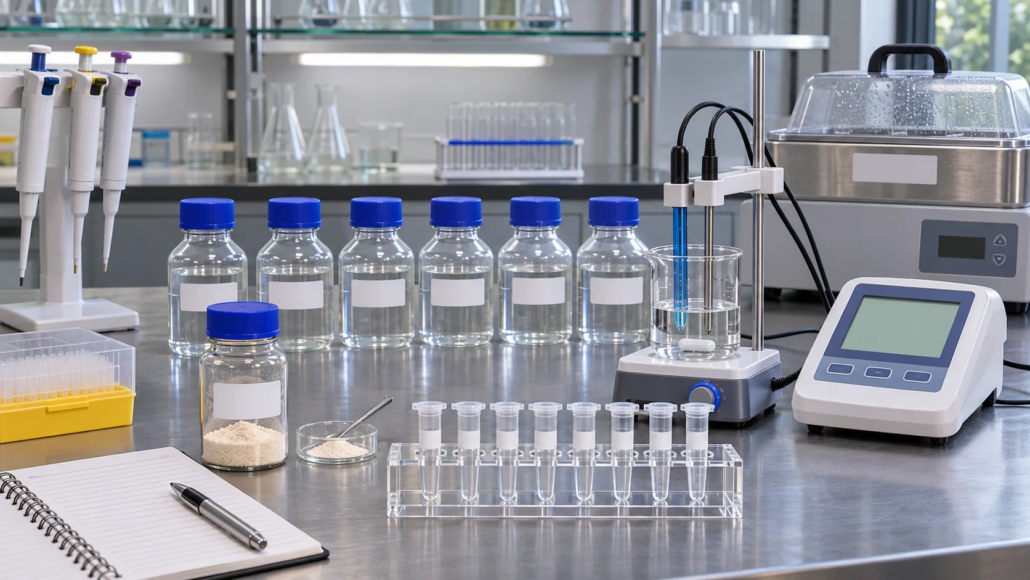
Record the buffer preparation, calibration status, sample mass, reconstitution time, and pH measurement point. If the material settles or remains partly insoluble, describe the mixing and sampling procedure. The buyer should be able to repeat the method or understand why a result cannot be compared with another method. A clear method record is more valuable than a precise number without context.
Designing a Separate Storage Study
A storage study begins with the commercial presentation, not only the assay buffer. Use the package that the buyer will actually receive or a justified representative package. Record the lot, fill quantity, closure, storage temperature, humidity exposure if relevant, and opening history. Keep enough samples at each time point to avoid repeated opening of one container.
Test the attributes that matter to the decision. For a dry enzyme ingredient, this may include appearance, moisture, water activity, dispersibility, microbial scope, and activity after reconstitution. The activity method should remain stable throughout the study. If the method changes, the report should explain how results are bridged. A trend in activity is meaningful only when sample preparation and calculation remain comparable.
Stability limits should be connected to the intended use and the agreed specification. A change that is acceptable for a research sample may not be acceptable for a commercial release. The buyer and supplier should define what happens when a time point falls outside the expected range. Possible actions include investigation, additional testing, package review, retest, or a change to the stated storage instruction. The action should be documented rather than decided informally after the result appears.
| Study type | Primary question | Typical interpretation |
|---|---|---|
| Assay pH screen | Which reaction pH gives a useful measurement? | Method performance under defined short-term conditions |
| Formula compatibility test | How does the ingredient behave in the target matrix? | Application-specific evidence, not a universal storage rule |
| Real-time stability | Does the commercial lot remain within specification over time? | Direct evidence for the planned condition and package |
| Accelerated stability | What sensitivities may appear sooner? | Supporting evidence that needs careful interpretation |
Questions for a Lumbrokinase Supplier
Ask the supplier to distinguish the assay environment from the commercial storage environment. Request the activity method, buffer, tested pH range, temperature, reaction time, substrate, calculation basis, and replicate information. Then request the storage condition, package type, lot information, time points, activity result, moisture or water-activity result where relevant, and the acceptance rule.
Ask whether the reported activity is a routine release test, a development result, or a stability result. Ask whether the laboratory uses an internal reference material and how it is controlled. If different laboratories are involved, ask how method transfer or comparison is managed. These questions do not require the supplier to disclose proprietary production details. They establish whether the data can answer the buyer’s actual question.
The product page can provide a starting point for the commercial category, but the technical decision should use the current specification and lot documents. Buyers can review the lumbrokinase powder product page, then ask the supplier to confirm the exact form, test scope, storage instruction, and documentation available for the quoted lot. A public description is not a substitute for a batch-specific COA or stability record.
Common Interpretation Errors
The first error is treating “optimum” as a permanent property independent of method. Enzyme measurements depend on reaction design, so the report should always be read with its method. The second error is treating activity at a buffer pH as proof of stability in a finished formula. The formula has its own concentration, salts, temperature history, and package.
The third error is comparing two reports without checking units and bases. One laboratory may report relative activity, another may report units per mass, and a third may report a normalized signal. The fourth error is ignoring temperature. A pH curve at one temperature cannot automatically answer a question at another temperature.
The fifth error is moving a storage instruction from one form to another. A dry powder, a reconstituted solution, and a blended finished product should not share a storage conclusion unless the evidence supports it. When documentation is incomplete, the right action is to identify the missing evidence and request confirmation rather than fill the gap with a typical industry value.
FAQ
Is the enzyme pH optimum the best storage pH?
No. The assay pH optimum is the point or range that produced the strongest measured reaction under a defined method. Storage pH or storage condition requires separate evidence over time in the actual product form and package.
Why can two laboratories report different pH optima?
They may use different buffers, substrate concentrations, temperatures, reaction times, sample preparations, controls, or readouts. Compare the full method before deciding that the material itself is inconsistent.
Should a dry lumbrokinase powder be stored at the assay pH?
A dry powder does not have the same liquid pH environment as a reconstituted assay. Follow the supplier’s confirmed storage instruction and review stability evidence for the commercial package. Do not convert the assay buffer into a warehouse rule.
What should a COA say about enzyme activity?
It should identify the activity method or reference, units, sample basis, lot, and acceptance range. The buyer should also ask whether the value is a release result, a typical value, or a stability result, and whether the sample was reconstituted under defined conditions.
Can an assay pH study support formulation work?
It can provide useful method and screening information, but the target formula needs its own compatibility and stability checks. Buffer results should guide questions, not replace testing in the intended matrix.
Send Your Ingredient Inquiry
Send your ingredient inquiry with the intended product form, activity method, pH range of interest, storage condition, package, and documentation requirements. The technical team can help clarify which information is available for the quoted lumbrokinase powder lot and which points need confirmation before sampling.