Earthworm Peptide Packaging Solutions: Material Selection, Validation, and Shipment Acceptance
Earthworm Peptide Packaging Solutions: Material Selection, Validation, and Shipment Acceptance
Earthworm peptide packaging solutions should be selected around the actual powder, handling process, storage period, and shipping route. A shiny pouch or rigid drum does not demonstrate protection by itself. Buyers evaluating earthworm peptide powder need a package specification that connects the contact material, closure, outer protection, labeling, and supporting tests to the intended project.
The right starting point is a packaging brief, not a generic claim that one format is suitable for every shipment. Confirm the current supplier offer separately from the options being considered. The formats discussed below are candidates for evaluation, not a statement that Venacore Bio supplies every format or that any candidate has already been validated for a particular ingredient.
Separate the Contact Package from Shipping Protection
The primary package touches or directly contains the ingredient. An outer carton, drum, or other shipping unit may protect that package during handling. Treat these as related but distinct parts of the system: an intact outer container does not prove an inner seal is sound, and a suitable liner does not establish adequate resistance to handling damage.
Ask for a description of each layer, its purpose, the closure method, and the way the filled unit is arranged inside its outer container. Include any ties, gaskets, adhesives, or inserts relevant to the proposed design. Photographs can clarify assembly, but a photograph without material identification and revision information is not a complete specification.
Start with the buyer’s process. Will a package be emptied at once or opened repeatedly? Will staff tip the contents manually or use a controlled transfer system? Does the receiving site have restrictions on drum dimensions, liners, or disposable accessories? Answers to these questions can eliminate an awkward format before anyone spends time comparing cosmetic details.
Build a Material and Use Profile Before Choosing a Barrier
Packaging needs should follow evidence about the supplied powder and its intended conditions. Do not presume that every earthworm peptide preparation has identical moisture sensitivity, oxidation behavior, flow, odor retention, or storage response. Ask which properties have been measured and which remain to be evaluated for the current material.
For contact suitability, FDA’s food ingredients and packaging overview explains that substances contacting food are evaluated in relation to intended conditions of use. A general description such as food grade is therefore not a substitute for documentation that identifies the proposed material and its relevant use conditions. Confirm the requirements of the destination and application with an appropriately qualified reviewer.
Use the following questions to prepare a trial brief rather than to invent an ingredient specification:
- What are the proposed storage and transport conditions, and what evidence supports them?
- Which product attributes should be followed during a packaging study?
- How long is each filled unit expected to remain unopened?
- What exposure occurs during sampling, weighing, and production use?
- What package dimensions and opening method fit the receiving equipment?
- Which contact-material records and destination checks are still outstanding?
Compare Candidate Formats by Their Trade-Offs
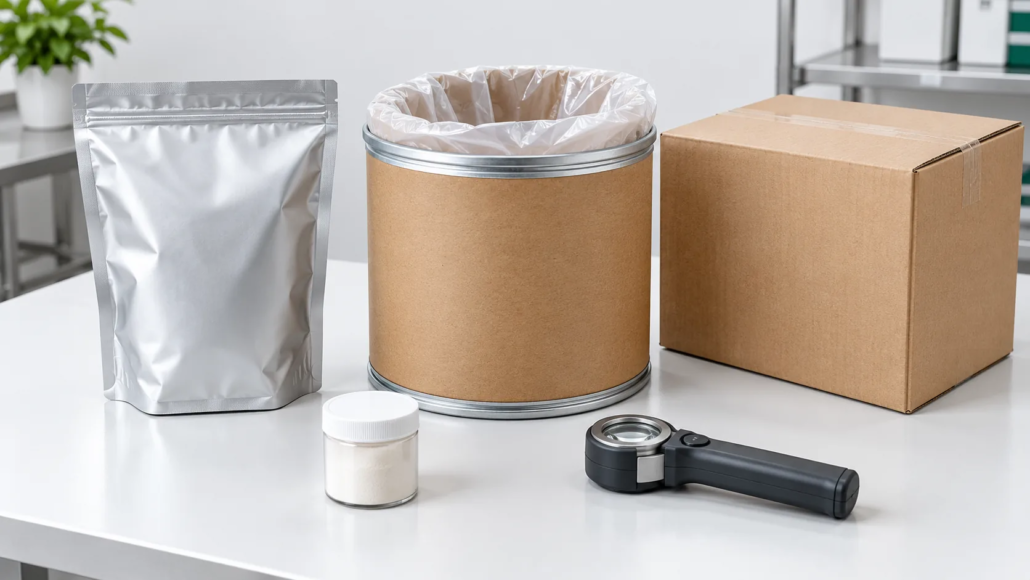
A package format is useful when it solves a stated handling problem and its performance can be checked. Smaller units may allow a production team to open only the quantity needed, while larger units may reduce the number of packages handled. Neither choice is automatically cheaper, more protective, or more sustainable once the whole project is considered.
| Candidate format | Possible project reason to evaluate it | Questions before acceptance |
|---|---|---|
| Sealed flexible pouch | Separate a production quantity into individual units | What is the material structure, seal method, puncture risk, and outer protection? |
| Lined rigid container | Provide a supported outer unit for bulk handling | Which layer contacts the powder, how is the liner closed, and how will it be emptied? |
| Small sample container | Support an agreed laboratory evaluation | Is it suitable for the tests, sample amount, storage period, and delivery route? |
| Multiple sealed inner units in one outer container | Match several separate production sessions | Can each inner unit be identified, counted, inspected, and traced? |
| Finished retail package | Serve a separate finished-product project | Who is responsible for formula, filling, labeling, market review, and package validation? |
A resealable feature can be convenient, but ask whether it is intended only for temporary handling or forms part of the validated storage system. The closure used for original shipment may differ from the closure available after opening. Specify both situations when repeated access is expected.
Ask for Barrier Evidence That Matches the Actual Package
A barrier claim should identify what was tested, how it was tested, and under which conditions. If a supplier provides water-vapor or oxygen transmission data, check the units, test environment, sample construction, and method. Results from an unfilled material sheet do not automatically describe a filled package with seams, folds, and a closure.
Ask the packaging team which exposure routes matter for this powder and whether the proposed test plan covers them. A material may perform well as a flat specimen while the assembled package remains vulnerable at a seal or contact point. Conversely, a more complex material is not justified solely by having additional layers if the project has no demonstrated need for them.
If nitrogen flushing, desiccants, or oxygen absorbers are proposed, treat them as changes requiring evaluation. Request their purpose, suitability, process controls, and handling instructions. Do not add an accessory merely because another ingredient uses it. No such accessory, atmosphere, or protective performance is claimed for the product discussed here.
Validate Filling and Seal Integrity Together
The finished package should be assessed after a representative filling and closing operation, not only as an empty sample. Agree how the package will be filled, how the seal area will be managed, and what inspections will be recorded. The relevant question is whether the proposed operation produces acceptable filled units consistently.
Ask the responsible team to choose tests suited to the package construction and intended hazards. Depending on the project, evaluation might address closure integrity, leakage, puncture, compression, or handling damage. This is a list of potential study areas, not a universal mandatory test set or a claim that a particular result has been achieved.
Keep the test report connected to the material revision, fill quantity, closure settings, and outer arrangement used. Record observations and failures as well as the final decision. If the package passes only after a change, identify that revised configuration explicitly so that purchasing does not later order the earlier version.
Do Not Infer Shelf Life from Appearance or a Short Trial
A clean package and a satisfactory initial analysis do not establish the acceptable storage period. The supporting study needs to address the actual material, container system, conditions, and relevant quality attributes over an appropriate period. Confirm whether a stated date applies to an unopened ingredient package, a repacked unit, or a finished formula.
FDA’s dietary supplement manufacturing compliance guide says that date claims should have supporting data, even though the dietary supplement CGMP rule does not itself require an expiration date. The guide also discusses suitable contact packaging and appropriate holding conditions. Its applicability depends on the operation; a business supplying an ingredient for further processing should not automatically be treated as identical to a finished-supplement packer. These points are a U.S. example, not a global packaging approval.
Request a clear account of the evidence behind the supplier’s proposed date and storage instructions. If the buyer changes the package, introduces repeated opening, or makes a new formula, ask what additional evaluation is needed. Do not copy another ingredient’s shelf life or convert a brief elevated-temperature trial into a long storage claim without a justified assessment.
Plan for Transport and Receiving Conditions
Transport evaluation should reflect the expected route rather than an idealized warehouse. Describe the planned transport mode, handling points, storage stops, stacking arrangement, and likely delays. Where conditions remain uncertain, record that uncertainty and ask the logistics and quality teams how it will be managed.
The outer package, cushioning, pallet arrangement, and loading pattern should be considered together. Ask how movement, sharp contact points, and compression will be addressed for the particular shipment. If monitoring is proposed, agree what will be measured, how records will be reviewed, and who decides whether an excursion affects acceptance. A shipping record is useful only when someone is assigned to interpret it.
At receipt, inspect and document the outer unit before opening, then examine accessible inner units under the receiving procedure. Keep photographs, package counts, lot identification, and any observed damage with the shipment record. Suspect material should be held for the responsible quality decision rather than accepted merely because the courier has delivered it.
Use Labels and Records to Preserve Lot Identity
Packaging should support traceability through receiving, storage, sampling, and production. Agree the identifiers needed on each relevant level of packaging and how they connect to the purchase order and lot documentation. A buyer may need separate inner-unit identification when several units are removed from one outer container.
Review artwork and data fields before the packing run. Distinguish ingredient identification from a finished retail label, and have the intended market and application reviewed separately. Do not place unsupported health claims, certification marks, handling symbols, or expiry statements on packaging as decorative reassurance.
| Acceptance area | Record to request or create | Question for the receiving decision |
|---|---|---|
| Package identity | Approved material description and configuration revision | Does the delivered system match what was agreed? |
| Lot connection | Inner and outer identifiers linked to shipment documents | Can each relevant unit be connected to the correct ingredient lot? |
| Closure condition | Inspection observations and agreed integrity evidence | Are seals and closures acceptable under the receiving procedure? |
| Transport condition | Damage observations and monitoring records if specified | Is a quality review needed before use? |
| Remaining usable period | Applicable date information and supporting scope | Does the evidence cover the buyer’s planned storage and use? |
| Change control | Approved deviations and packaging revision history | Was any material or process change assessed before acceptance? |
Agree Ownership Before Ordering a Custom Package
A custom packaging project needs named responsibilities. Confirm who selects the contact materials, obtains supporting documents, performs filling trials, approves label content, commissions any testing, and signs the final configuration. A supplier may coordinate several tasks without owning every laboratory or packaging operation involved.
Ask for a quotation that separates the ingredient, packaging development, tooling or artwork where relevant, tests, and logistics. Confirm the available order quantities and timing in writing instead of treating a sample arrangement as a commercial commitment. This guide does not promise a custom format, minimum quantity, price, or delivery schedule.
Also agree what happens after a proposed material substitution or an observed failure. Require a clear communication route and a documented decision before the changed system is used for the buyer’s shipment. An approved drawing alone cannot prevent an unreviewed change in liner, closure, filling operation, or outer arrangement.
FAQ
Which package is best for earthworm peptide powder?
There is no universally best format. Compare candidates against the actual ingredient, use pattern, contact suitability, closure performance, route, and storage evidence. A pouch, lined container, or multiple inner units may each be worth evaluating for a different project. Confirm the supplier’s available options separately.
Does a metallic-looking pouch prove high protection?
No. Appearance does not identify the full material structure or demonstrate the performance of the filled package. Ask for the relevant material description, barrier data where needed, closure details, and package-level evaluation. Inspect the exact configuration rather than relying on a visually similar example.
Can an unopened shelf life be applied after repeated opening?
Not automatically. Opening changes the handling situation, and the closure available afterward may differ from the original sealed system. Ask for instructions and evidence covering the intended use pattern. Smaller individually closed units may be a trial option, but their suitability still needs evaluation.
Are nitrogen flushing and desiccants always necessary?
No universal need is established here. Their use should follow a material-specific assessment and a suitable packaging process. Confirm their purpose, contact considerations, handling, and supporting results before inclusion. An added component is not proof of a longer usable period or improved ingredient quality.
What should I send with a packaging inquiry?
Share the target market, intended application, proposed quantity per unit, receiving equipment, opening pattern, storage plan, and shipping route. Include required documentation and any known constraints. Ask which configurations are available now and which would need development, testing, and a separate written quotation.
Send Your Ingredient Inquiry
Use the form below to discuss earthworm peptide sourcing and your packaging requirements with Venacore Bio. Describe the destination, intended use, quantity, package preference, and documents your team needs. Confirm the current offered configuration, sample arrangement, storage evidence, and any custom work in writing. The Venacore Bio home page provides an overview of the ingredient range.