
Earthworm Peptide Export Standards: What Ingredient Buyers Should Check
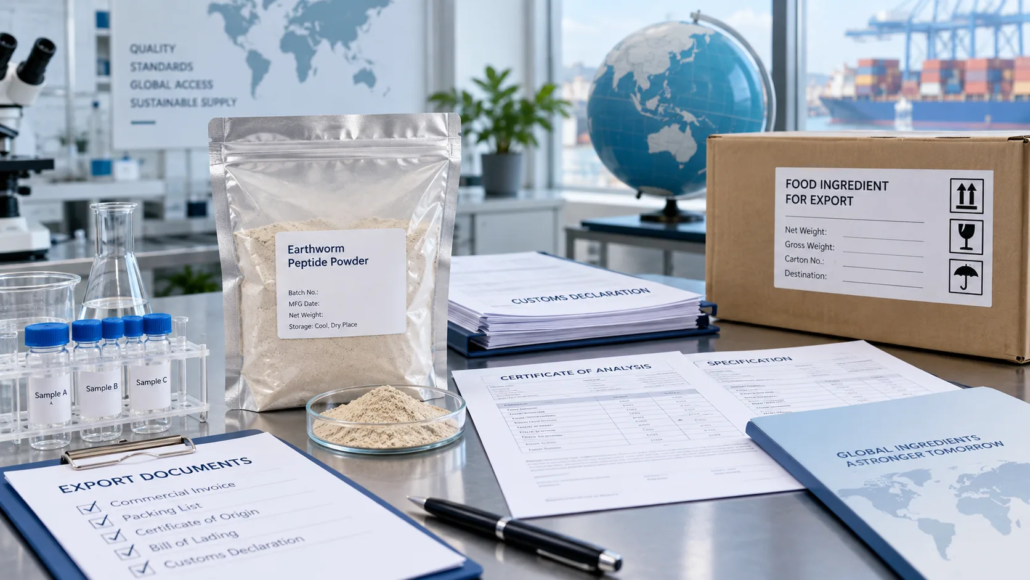
Earthworm Peptide Export Standards: What Ingredient Buyers Should Check
Earthworm peptide export standards are not a single universal checklist. For B2B buyers, the practical standard is whether the supplier can provide a consistent product identity, export-ready documents, batch traceability, suitable packing, destination-aware communication, and compliant wording for the intended market. Buyers sourcing earthworm peptide powder should review the shipment file before treating a quote as ready for purchase.
Export preparation matters because a peptide ingredient can move through several review points before it becomes usable: supplier QA, buyer procurement, customs documentation, logistics, warehouse receiving, contract manufacturing, and local compliance review. If the product name, COA, packing label, invoice, and application language do not match, the order can stall even when the powder itself is acceptable.
This guide explains export standards in buyer language. It does not claim that one document set fits every country or product category. Instead, it shows how importers, supplement brands, functional food developers, and ingredient distributors can ask for a clear file and avoid unsupported expectations.
What do export standards mean for earthworm peptide powder?
For earthworm peptide powder, export standards mean the combination of product specification, batch COA, packing label, shipment documents, storage guidance, and destination-specific statements needed to move the ingredient from supplier to buyer without quality or compliance confusion. The exact requirements depend on the buyer’s country, application, and internal QA policy.
A supplier may use the phrase “export standard” to mean normal export packing. A buyer may use it to mean customs paperwork. A QA manager may use it to mean microbiology and heavy metal limits. A regulatory reviewer may use it to mean whether the ingredient and claim language fit the local product category. These meanings overlap, but they are not identical.
That is why the first step is to define the project. Is the buyer evaluating a sample, placing a trial order, stocking for distribution, or supporting a finished supplement launch? Is the product going into capsules, tablets, sachets, beverages, or another format? Which documents are mandatory before payment? Which can follow before shipment? Clear answers help the supplier prepare the right file.
Buyers should avoid treating any supplier’s standard export package as an automatic fit for every market. A serious supplier can support the process, but the buyer remains responsible for confirming destination requirements with local professionals and customers.
Which core documents should buyers request before shipment?
Buyers should request a product specification, batch or representative COA, MSDS or safety document where available, packing information, storage statement, commercial invoice, packing list, and any certificate or declaration required by the destination and product category. The document request should be specific, not a vague request for “all certificates.”
The specification defines what the supplier is offering. It should use a consistent product name, describe appearance and routine test items, and show the limits that will guide release. The COA should report actual or representative batch results. Buyers should check whether the COA belongs to the sample, current stock batch, or a previous batch used only for reference.
Export documents should align with quality documents. If the invoice says earthworm peptide powder, the packing list should not use an unrelated description. If the sample label includes a batch number, the COA should not point to a different lot without explanation. These details may seem small, but they are common causes of internal delay.
Some buyers need additional statements, such as country-of-origin information, ingredient source declarations, non-GMO statements, allergen statements, or customer-specific forms. These should be requested early and reviewed case by case. A supplier should not invent documents or claim certifications it does not hold.
| Document | What it should clarify | Buyer review point |
|---|---|---|
| Specification | Product identity, appearance, routine limits, storage | Does it match the quoted product and application? |
| COA | Batch test results and release items | Does it match the sample or shipment lot? |
| MSDS or safety file | Handling, storage, and transport information | Is the product name and version current? |
| Commercial invoice | Seller, buyer, product description, quantity, value | Does the description align with import review? |
| Packing list | Carton count, net weight, gross weight, packing format | Will warehouse receiving match the physical goods? |
How should buyers review the COA for export orders?
Buyers should review the COA by checking product name, batch number, issue date, test items, limits, actual results, testing basis, and whether the document connects to the sample or shipment batch. A COA is useful only when it can be traced to the material being evaluated.
For earthworm peptide powder, common review areas may include appearance, odor, moisture, ash, protein or peptide-related indexes where available, microbiology, heavy metals, and other specification items defined by the supplier and buyer. Exact values should come from the supplier’s current documents, not from broad category expectations.
Buyers should also check whether the COA supports the intended order stage. A representative COA may be acceptable for first screening. A shipment batch COA is stronger for purchase approval. If the supplier sends an old COA, ask whether it is only a reference and when the current batch COA can be provided.
When destination rules require specific limits or methods, send the checklist before confirming the order. Do not wait until goods are packed to ask whether a missing test can be added. Some tests may need extra time, third-party labs, or a different production batch.
What packing details affect export readiness?
Packing details affect export readiness because the physical shipment must protect the powder, match the documents, and be easy for customs, logistics, and warehouse teams to identify. Buyers should review inner packing, outer cartons, net weight, gross weight, labels, storage instructions, and carton markings.
Export packing is not only about avoiding damage. It also supports traceability. The product label should connect to the COA and packing list. A receiving team should be able to identify product name, batch number, quantity, and storage condition without guessing. If the buyer needs neutral labels, private labels, distributor labels, or customer-specific carton marks, that should be discussed before production or packing.
Moisture protection deserves particular attention for powders. Ask how the inner bag is sealed, whether desiccant is used when appropriate, and what storage condition appears on the label. The buyer’s warehouse and contract manufacturer should receive the same storage guidance shown in the supplier documents.
Photos before shipment can prevent mistakes. A supplier can send images of the sealed inner bag, carton label, carton count, and final pallet or courier package. These photos should not replace formal documents, but they help buyers catch simple errors before goods leave the facility.
How should product names stay consistent across export files?
Product names should stay consistent across quotation, specification, COA, invoice, packing list, labels, and sample communication. Minor translation differences may happen, but uncontrolled naming creates avoidable QA and import review risk.
Earthworm peptide powder may appear under related wording such as earthworm peptide, earthworm protein peptide, or peptide powder in supplier communication. Buyers should decide the approved product name early and ask the supplier to use it consistently. If a different customs description is needed, it should be explained and documented.
Name consistency matters for internal teams. Procurement may approve a quote under one name, QA may test a sample under another, and logistics may receive cartons under a third. When these files reach a customer or regulator, the mismatch can look like poor control even if the material is the same.
A clean file uses one main product name, one batch number format, one sample reference, and matching packing descriptions. This makes later repeat orders easier because the buyer can compare new documents against a known baseline.
Which export questions should be answered before quotation?
Before quotation, buyers should answer the destination country, intended application, quantity, sample needs, document checklist, packing preference, shipping route, and timeline. These details affect whether the supplier can quote a realistic and usable export plan.
A vague inquiry such as “send earthworm peptide price” often creates a vague response. A stronger inquiry says: “We are evaluating earthworm peptide powder for a supplement or functional ingredient project. Please quote available grade, MOQ, sample option, COA/specification/MSDS availability, packing, lead time, and shipping options to our country.” This gives the supplier enough context to respond with relevant information.
If the buyer has a strict document checklist, attach it at the beginning. If the buyer needs a specific courier, import code review, label wording, or certificate format, say so before payment. Some requests may be easy; others may require time or may not be available. Early clarification is better than late disappointment.
Buyers should also define who will import the product. DDP, courier shipment, freight forwarder pickup, and buyer-arranged import all create different document and responsibility patterns. The chosen route should match the buyer’s internal policy and destination requirements.
| Question | Why it matters | When to confirm |
|---|---|---|
| Destination country | Document and import expectations vary | Before quotation |
| Application | Supplement, food, research, or distributor use may need different review | Before sample request |
| Document checklist | Missing files can delay approval | Before payment |
| Packing preference | Labels and carton details affect receiving | Before packing |
| Shipping route | Courier, air, or forwarder route changes responsibility | Before shipment |
How do buyers avoid compliance mistakes in export communication?
Buyers avoid compliance mistakes by separating raw material facts from finished-product claims, confirming local requirements, and keeping supplier documents tied to verifiable specifications rather than broad health promises. Earthworm peptide export communication should remain factual and document-based.
Health-related language can create risk when it moves from online marketing into customs, labels, or customer documents. A raw ingredient supplier can discuss product identity, process, specification, COA, storage, packing, and sample support. It should not be expected to guarantee finished-product effects or provide disease claim language for the buyer’s market.
Destination compliance should be reviewed by the buyer’s own team or local adviser. The supplier can help provide documents and answer factual questions, but product classification, label claims, permitted use, and finished-product marketing rules depend on the destination and sales channel.
A good communication habit is to write claims in layers. The supplier document layer states what the material is and how it is tested. The formulation layer records how the buyer intends to use it. The market layer reviews what can be said to customers. Mixing these layers can create problems.
What role do samples play in export qualification?
Samples help buyers evaluate appearance, odor, handling, formulation behavior, document match, and internal testing before approving a larger export order. A sample should be treated as a traceable material, not a loose promotional item.
The sample label should show product name, batch or sample code, net weight, and storage condition where appropriate. The supplier should state whether the sample comes from current stock, a pilot batch, or a representative batch. If the future bulk order may come from another batch, ask how the supplier controls consistency.
Buyers should test samples under realistic project conditions. For capsules, review flow and fill behavior. For powder blends, review odor, color, mixing, and stability under planned storage. For distributor qualification, review document completeness and customer questions. Keep retained samples if your QA policy requires them.
Do not let a good-looking sample override weak documents. If the sample performs well but the supplier cannot provide a matching COA, clear packing plan, or reliable export paperwork, the buyer may still face approval issues later.
How should buyers compare suppliers on export support?
Buyers should compare suppliers on export support by reviewing document accuracy, response speed, naming consistency, packing clarity, shipment experience, sample traceability, and willingness to answer compliance-boundary questions. Price alone does not show whether an export order will proceed smoothly.
A supplier with strong export support will ask about destination country, application, document checklist, packing needs, and timeline. It will not simply push the buyer to pay quickly. It will clarify what documents are available, what requires extra time, and what cannot be promised.
Response quality is a useful signal. If the supplier answers technical and document questions clearly, internal review becomes easier. If it responds with only broad claims, buyers may need more verification before approving the supplier. For repeat orders, communication discipline often matters as much as the first sample.
Buyers can create a simple comparison sheet for each supplier: product name consistency, COA availability, specification clarity, packing details, export document scope, sample match, lead time, shipping route, and claim discipline. This turns supplier choice into a documented decision instead of a price reaction.
What should be checked before final shipment approval?
Before final shipment approval, buyers should check the final invoice, packing list, batch COA, product labels, carton marks, quantity, shipping route, storage instruction, and document naming. Shipment should not be released if essential files are missing or inconsistent.
The final check should be done against the purchase order or proforma invoice. Product name, grade, quantity, unit price, destination, consignee information, and shipment terms should match the agreement. If the supplier uses a different product description for logistics reasons, the buyer should review it before shipment.
Batch COA timing is important. If goods are from a current batch, ask for the current batch COA before release. If testing is still pending, clarify whether shipment will wait. For sensitive projects, the buyer may require approval of the COA before final balance payment or pickup.
Photos of packed goods can support the final review. They can show carton count, labels, sealing, and packing condition. Again, photos are not a substitute for documents, but they are a practical safeguard in export operations.
Buyer checklist for earthworm peptide export readiness
Use this checklist before approving an earthworm peptide export order:
- Confirm the exact product name and approved description.
- Review specification and COA for matching product identity.
- Check batch number, sample code, or shipment lot traceability.
- Confirm required documents before payment or shipment.
- Review packing format, labels, carton marks, and storage wording.
- Confirm destination country, importer role, and shipping route.
- Keep raw material facts separate from finished-product claims.
- Ask early about extra statements, third-party tests, or customer forms.
- Compare suppliers by document accuracy and export support, not price alone.
- Save final invoice, packing list, COA, and shipment records in one file.
This checklist helps buyers reduce avoidable delays. It also gives the supplier a clear target, which usually improves response quality and shortens the path from sample review to commercial order.
FAQ
Is there one global export standard for earthworm peptide powder?
No. Export requirements vary by country, product category, buyer policy, and application. Buyers should define the destination and document checklist before treating any supplier’s standard file as enough.
Which document is most important for first screening?
The specification and representative COA are usually the first screening documents. They help buyers understand product identity, routine test items, and whether the material deserves sample review.
Should the COA match the exact shipment batch?
For purchase approval, a shipment batch COA is stronger than a generic reference COA. If only a representative COA is available during early screening, ask when the current batch COA can be provided.
Can a supplier provide destination compliance approval?
A supplier can provide factual product documents and answer ingredient questions, but destination compliance approval should be handled by the buyer’s local team, importer, consultant, or customer review process.
What causes the most export delays for peptide powder orders?
Common delays include inconsistent product names, missing COAs, unclear packing labels, late document requests, mismatched invoice descriptions, and unresolved destination requirements.
Send your ingredient inquiry with destination country, intended application, document checklist, quantity, and packing needs when requesting earthworm peptide supply. Venacorebio can help review whether the current earthworm peptide powder option fits your export and B2B sourcing workflow.